The cloud has a surprisingly earthly problem: somebody can cut the cable. In greater Jakarta, where data centers sit amid a busy construction economy, Indonet has built a network around that possibility. A supplier case study describes a three-node ring with four routes from each site, protecting connections both directly and indirectly. The point is wonderfully unglamorous. Keep the traffic moving when the city gets in the way.
That is a useful introduction to a company whose name belongs to Indonesia’s early internet history, but whose business increasingly concerns what happens between other people’s machines. Indonet sells internet access, links between data centers, private connections to cloud platforms, managed networks and places to house equipment. Its customers buy the ability to operate across those pieces without treating every connection as a separate engineering expedition.
The stakes are practical. A payment request has to reach its destination. A retailer’s application has to talk to its database. A factory needs access to operational systems beyond its gates. Faster servers do little good if the route to them becomes the bottleneck. Indonet’s proposition begins with that often overlooked journey.
Before the cloud, there were expensive books
Indonet began in 1994 as Indonesia’s first commercial internet service provider. Among its cofounders were Otto Toto Sugiri and Marina Budiman, both later associated with data center operator DCI Indonesia. The original impulse, Sugiri told Forbes, included helping students obtain learning material more quickly and cheaply. “Books were expensive at the time and took time to get to Indonesia,” he recalled.
There is something pleasing about that origin. Today’s digital infrastructure vocabulary can make a cable sound like a philosophical breakthrough. The early problem was easier to picture: somebody wanted to read something, and getting it was slow. Connecting people to information was useful before anyone had to call it transformation.
The company’s own chronology shows a gradual accumulation of capabilities. It entered the data center business in 2002, added satellite services in 2005 and developed another data center in South Tangerang in 2011. An Alibaba Cloud collaboration followed in 2017. By 2020, Indonet was developing Cloud Exchange and building the EDGE data center business. Each step extended the places its network could take a customer.
Read that sequence as an expansion of the original service: first access, then somewhere to keep the machines, then connections to computing rented from somebody else. The internet provider acquired more of the jobs surrounding the internet connection.
A connection is not a cloud
Cloud Exchange is the clearest expression of the current business. Indonet lists connections to AWS Direct Connect, Google Cloud Interconnect, Alibaba Cloud Express Connect, Huawei Cloud Direct Connect and BytePlus Direct Connect. Customers can connect enterprise infrastructure to cloud services or link environments across providers. The company advertises port options up to 100 Gb and service increments as small as 50 Mbps.
Those are connectivity products. Buying a private route does not itself buy the applications, computing capacity or storage at the other end. That distinction matters when an IT team budgets a project: the journey and the destination are separate pieces of the bill, even when a supplier helps arrange both.
Cross Link handles another journey, connecting data centers and strategic locations within a metropolitan area. Its published design includes automatic switching to a predetermined alternate path. EPIX, the Edge Peering Internet Exchange, lets participating networks exchange traffic. Peering can shorten a route between networks; it does not magically make every destination nearby.
The wider catalog includes dedicated internet, IP transit, dark fiber, optical transport and network management. A company leasing dark fiber takes more responsibility for the equipment that lights it. A company buying managed connectivity hands more of that work to the provider. These choices put Indonet in the enterprise infrastructure market, with services for network operators as well as businesses that would prefer not to become one.
Four ways out of a broken connection
The most revealing detail in Indonet’s engineering story is its response to fiber availability. In the Smartoptics case study, operations executive Rahman Isnaini explains the need to protect individual fiber segments and provide four routes from each site. His team used a triangular network with protection for both direct and indirect paths. This is local operating knowledge translated into network design.
01 / Anatomy of an alternate route
The optical equipment also addresses a less visible constraint: getting more useful capacity from available fiber. Smartoptics describes hardware that combines four 100G connections and an optical system prepared for 800G. Its March 2025 announcement separated the installed, 800G-ready platform from a subsequent plan to deploy 800G optics. Readiness is a capability, not evidence that every customer already receives that speed.
Indonet’s infrastructure upgrade page also describes underground cable routes and a 576-core dark fiber build. That investment sits underneath the polished language of cloud services. Connectivity depends on where a cable runs, how it is protected and whether the alternate route can survive the same incident.
“In Indonesia, fiber availability is a challenge”
Rahman Isnaini / Indonet / Smartoptics case study
The transferable lesson is to start with the physical failure domain. Two connections deserve closer inspection if they share a vulnerable path. For a buyer, the useful conversation concerns route diversity and recovery behavior, followed by speed. A large number printed beside “bandwidth” cannot answer those questions.
Selling to the people behind the checkout
Indonet’s website displays customers including Dewaweb, Indodax, Adira Finance, Kredivo and Mitra Adiperkasa. The mix spans hosting, digital assets, finance and retail. The logos establish commercial breadth; they do not establish that each organization buys the same service or has achieved the same result. The common thread is a dependence on connected systems.
Its business model combines paid network services, colocation and cloud offerings. For the customer, the economic choice is how much infrastructure to own and how much to contract out. Leasing a connection avoids building that route yourself. Colocation puts equipment in a specialist facility. Managed services add people and operational responsibility to the purchase.
Indonet also straddles cooperation and competition. Its Cloud Exchange page lists connections to facilities associated with NTT, DCI Indonesia, BDx, Princeton Digital Group and Biznet, among others. Those names belong in a buyer’s wider infrastructure comparison, while some of their facilities are destinations Indonet helps customers reach. The market is a web of interdependent providers.
That gives Indonet a specific position: a local network operator with cloud relationships and ties to a regional data center owner. Its appeal is strongest when a customer needs those pieces to work together. A small operation running a simple workload in one cloud may have less reason to buy a complicated interconnection arrangement. Architecture should earn its keep.
The $165 million change of scale
Digital Edge’s 2021 investment put a price on its entry into Indonet: $165 million for a controlling interest. That was an ownership transaction, not a published construction budget or a price list for customers. Digital Edge cited Indonet’s telecom licenses, self-built fiber and interconnected services as reasons for the deal.
An acquisition figure, not a construction bill.
In December 2023, Digital Edge bought the remaining stakes held by the original founders, deepening its control. “Remaining” referred to the founders’ holdings; the company’s later public-shareholder tender process makes it important not to confuse that transaction with the disappearance of every minority shareholder.
Then came more physical capacity. EDGE2 opened in February 2024 with a 23 MW IT load and more than 3,400 racks, less than three kilometers from EDGE1. Operated by Indonet subsidiary PT Ekagrata Data Gemilang, it connects the ownership story to something concrete: equipment space, electricity, cooling and nearby networks.
The facility’s announced design PUE of 1.24 is another number worth reading carefully. PUE compares total facility energy with the energy used by IT equipment; lower overhead is preferable. A design figure describes intended performance under specified assumptions. It should not be mistaken for a continuously measured result at every occupancy level.
The AI pitch arrives at the ballroom
Indonet became a BytePlus strategic partner in April 2025, joining its existing Alibaba Cloud relationship. At the ForceX launch in Jakarta, the stage and chandeliers supplied the spectacle. Indonet’s role was the connection between that promise and an enterprise deployment: cloud access, network design and the infrastructure needed to keep applications responsive.
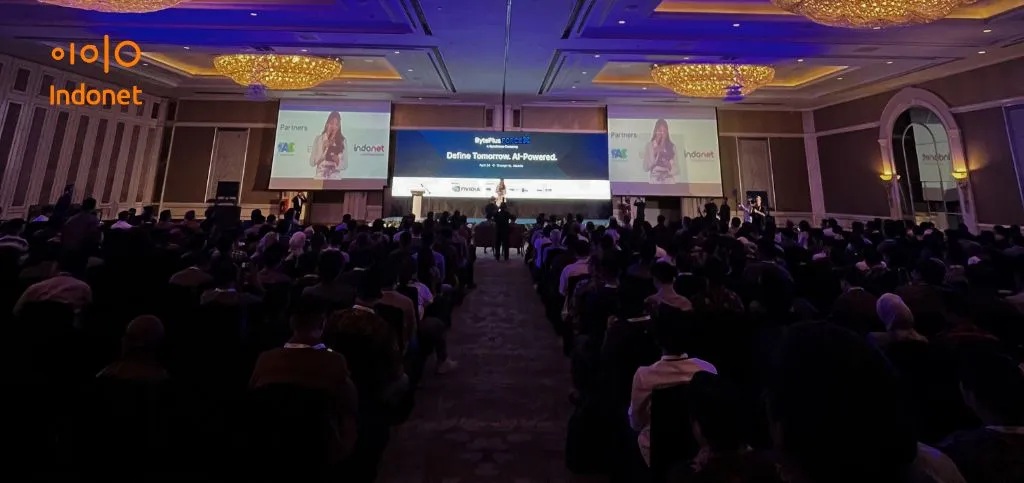
Its public events offer a glimpse of how it teaches and sells. At a July 2025 session in Semarang with Alibaba Cloud and community partners, Indonet advised putting critical payments and APIs on private cloud connections, using peering for other traffic and testing automatic failover quarterly. That is a more useful starting point than moving everything simply because a private connection is available.
A later workshop with BytePlus and the University of Indonesia’s economics and business faculty introduced practical AI tools to lecturers. Sessions covered tasks such as creating teaching materials and analyzing data. These events demonstrate outreach and technical education; their value to an individual institution depends on whether the tools improve the work at hand.
The same restraint appeared in Indonet’s account of ScaleCon 2025: choose the model for the use case and measure the relevant outcomes. That is a sensible rule for infrastructure purchasing too. Begin with an application, identify its constraints, then buy the capacity that changes the result.
A bigger map, with work still to do
In its April 2026 update, Indonet reported IDR 842.1 billion in 2025 net revenue. Network business grew 22 percent and the data center segment grew 48 percent. EDGE1 was fully contracted, while EDGE2 reached approximately 70 percent contracted capacity at year-end. Contracted space indicates commitments; it is different from saying every contracted rack is already consuming power.
02 / Two businesses, two growth rates
The next map reaches beyond downtown Jakarta. Indonet described underground connections toward Bekasi, Cibitung and Karawang, alongside a planned GIIC data center campus through Digital Edge Indonesia: 500 MW, scalable to 1 GW. Those are development ambitions, distinct from the capacity already in service.
It also announced a voluntary delisting plan, arguing that closer integration with Digital Edge would simplify decisions and long-term investment. Donauly Situmorang became chief executive, with Andrew Rigoli moving to the board of commissioners. The company’s direction now joins network expansion to a larger group’s capital plans.

For customers, the useful test remains smaller than that map. Can the supplier connect the required sites, demonstrate a workable alternate route and explain the complete cost of the arrangement? Indonet’s history offers a durable observation: as computing moves, the work of connecting it moves too. Even the newest AI application eventually has to send its data somewhere.