Eugene Chan’s former colleague remembers a salesperson who kept beating his targets. He also remembers that winning could make things difficult inside the company. The compliment arrives with a little grit left in it. A sale has a finish line. Managing the people who help deliver it is a considerably longer event.
Mike Bezer, who worked with Chan at Carlson Wagonlit Travel, describes a colleague who learned to acknowledge his weaknesses and become a better team leader. The competitive instinct stayed. The way he worked with other people developed. That account offers a useful starting point for understanding the executive who now leads Plover, the Singapore travel and technology company.
Plover’s brief reaches from business trips to expense claims and workspace administration. It is a collection of subjects that sounds rather less exciting than a departure board. Yet those ordinary chores make a revealing setting for Chan’s next chapter. His working world includes the person buying the ticket, the person approving it and the person who must eventually explain the bill.
A salesman learns the other half of the job
Bezer’s account is affectionate without making Chan sound frictionless. He recalls almost six years together at CWT and a shared effort to build an Asia Pacific sales team. Chan’s determination could complicate internal relationships. Bezer also describes him as someone who argued for the client and the company, and who worked on the skills needed to manage people.
Yvonne Ng, a former colleague at BCD Travel, adds a complementary observation. She describes Chan as focused and demanding, while also attentive to recognition and rewards. Together, the two recollections suggest a leader whose expectations were felt by the people around him. They are colleagues’ assessments, with all the particularity that implies, rather than a personality test dressed up as a résumé.
The distinction between making a sale and leading a team is easy to underestimate. A target can tell a salesperson whether he has won. A team needs something more sustained: clear priorities, help with the work, and reasons to trust the person setting the pace. Bezer’s recollection places Chan’s development in that quieter territory. The achievement is the willingness to keep learning after the numbers already look good.
“a strong personality and tenacious desire to win”
Mike Bezer, former CWT colleague
The machinery behind the ticket
By 2016, Chan’s career had taken him through senior leadership positions at BCD Travel and Carlson Wagonlit Travel. He had been managing director of BCD Travel in Singapore before moving to Amadeus. The new appointment put him in charge of the commercial side of travel-agency distribution across Asia Pacific, based at the company’s Singapore regional hub.
At Amadeus, he reported to Asia Pacific president Albert Pozo. His responsibilities included commercial growth across the region and leadership of the distribution teams. Trade publications reported the appointment that July and August. It was a job inside the infrastructure of travel: the commercial relationships that help agencies connect travelers with what suppliers sell.
That career sequence matters because a business trip is several businesses passing work between one another. The traveler experiences an itinerary. The agency must arrange it. The company paying for it has its own rules. Distribution sits among those relationships. Chan’s move from travel management to distribution put different parts of the same transaction inside his professional brief.
The sequence also makes Plover’s combination of service and software easier to understand. It sells tools to corporate customers and other travel agencies. The latter are professionals with their own customers to serve. For a company in that position, a useful screen has to do more than look welcoming. It has to fit the work of someone who already knows how complicated an apparently simple journey can become.
A wider brief for Plover
Plover Trip was founded in 2017. By February 2022, Chan was describing a business that needed more than bookings. “With travel out of the picture, we needed to diversify our revenue streams,” he said. His explanation was practical: fewer trips required another source of work, alongside preparation for continuing technological change.
The response brought travel, expense and workspace tools together. The shape of that decision is visible in an employee’s account. Roger Ong, who joined Plover at the end of 2017, describes a period when travel enquiries fell away, costs had to come down and people took on unfamiliar responsibilities. He was asked to manage the company’s social media accounts.
Ong took a four-month digital marketing course funded by Workforce Singapore. He describes encouragement from his colleagues and company, learning to judge which content reached the intended audience, and adding several hundred unique followers to Plover’s LinkedIn page. His experience puts a human scale on the product expansion. Someone still had to learn a new job and do it.
A chief executive can describe a wider business in a sentence. Employees encounter it as a changed list of tasks. Ong’s account is useful because it shows that change from a different desk. Software development, marketing and customer service had to continue while the company reconsidered what it could sell. The work was collective, even when the explanation carried one executive’s name.
Receipts and rooms enter the itinerary
Under Chan’s leadership, Plover’s product range now places three familiar administrative problems alongside one another. Travel concerns the booking. Expenses concern what gets claimed and approved. Workspace management concerns desks, rooms, schedules and office services. Their common subject is the movement of people and information through an organization.
The expense app uses receipt recognition to capture information, with the employee checking the result. It also offers checks for duplicate claims and expenses outside company policy. Approval progress can be followed online. There is a modest pleasure in the proposition: a receipt may finally have somewhere to live other than the bottom of a bag.
The workspace product extends the brief to office administration. Employees can book desks and meeting rooms; managers can coordinate multiple locations and keep records of maintenance services. Plover describes travelers reserving internal rooms in overseas offices before departure. A trip and a workspace meet in one ordinary question: where will the meeting happen when you arrive?
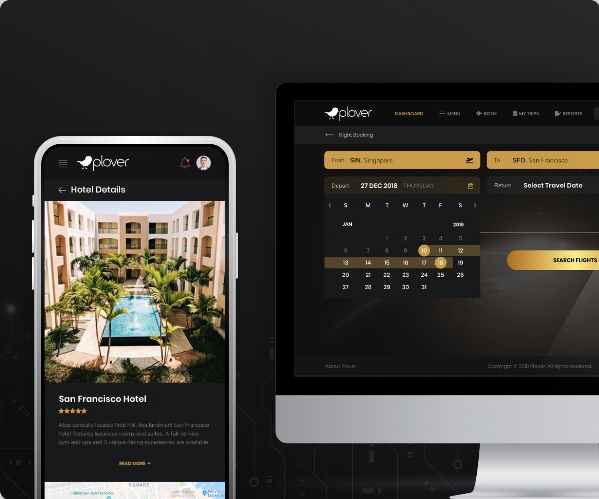
The underlying platform also includes tools for travel consultants handling complex itineraries, with checks in the middle of the booking process. This keeps the professional doing the work in the picture. An employee may want to arrange a straightforward trip independently. A consultant still needs room to deal with the journey that refuses to remain straightforward.
What the numbers are for
A Singapore IMDA case study describes Plover Trip building around a central cloud database from its inception. The aim was to bring together information that otherwise required manual collection from separate places. Reports and interactive dashboards could then help clients examine past transactions and plan travel budgets. The same records could inform decisions inside Plover.
Garry Chee, then assistant vice president for product development, described using booking patterns and historical sales information to identify suitable travel and hospitality partners. The case study also reported a 98% customer retention rate. That figure belongs to the documented case, rather than a promise about every subsequent year. Its useful context is the connection between organized information and the service clients receive.
Customer retention reported in IMDA’s Plover Trip case study.
A historical company measure, not a current personal scorecard.
For Chan’s story, this adds another dimension to the commercial career. Winning a booking creates a record. A company can leave that record behind or make it useful to the next decision. The reporting tools Plover describes are concerned with that second task: understanding spending and booking patterns, then giving customers and staff information they can work with.
The company around the chief executive
Chan’s public comments about BIF Partners acknowledge help with business strategy and direction, alongside continued investment commitment during difficult trading conditions. Plover also lists Jebsen & Jessen’s JPJ Invest and C. Melchers among its investors. Capital appears in this story as a relationship involving advice and patience, as well as money.
There are less formal relationships too. In 2023, Chan shared Plover’s thanks to Singapore Airlines after an appreciation dinner. The photographs show a room full of industry people and a table gathered for the evening. It is an agreeable reminder that the travel business still has a social life, however much of its daily work moves through software.

The picture suits the career. Chan’s responsibilities have moved across sales, management, distribution and company leadership, but the work keeps returning to relationships between people who need something from one another. The software can carry a booking, expose an expense or reserve a room. Colleagues still have to learn, customers still have to trust, and somebody still has to help when the itinerary changes.