A flight can cross a continent in a few hours. An expense report can remain on your to-do list with the quiet confidence of a permanent employee. Prashant Kirtane had encountered the mismatch from inside the business. He had worked in technology, helped build a travel marketplace and held a regional executive role. The tools around work travel still left him doing repetitive administrative jobs. Eventually, that irritation became part of the reason to start another company.
He remembers that “expense management was mostly a manual process”. It is a modest beginning for an entrepreneurial story. There is a journey to arrange, an approval to obtain and a bill to reconcile. The opportunity lies in noticing how much effort survives after the apparent task is finished.
Today, Kirtane is the co-founder and CEO of WegoPro, the business travel and expense platform previously called Travelstop. His professional base is Singapore. The route to that role runs through electrical engineering in Mumbai, consumer internet products at Yahoo and accommodation across Asia. It also runs through colleagues with whom he had already worked. The company names provide the milestones; the everyday tasks explain why he kept moving.
Before the boarding pass
Kirtane studied electrical engineering at the Veermata Jijabai Technological Institute, affiliated with Mumbai University. He began his career at Tata Infotech in India. His next long chapter was Yahoo, where he spent 12 years and worked on mobile media and video. By the time he left, his responsibilities included leading global video engineering and a team of more than 40 engineers.
That background matters to the story because travel software is experienced through small decisions. A person searches, compares, clicks, changes their mind and tries again. The interface must make sense while a substantial system works underneath it. Kirtane’s earlier jobs involved building consumer products at that junction between the visible experience and the machinery required to deliver it.
People who worked with him describe a practical colleague. Neville Taraporewalla, a former Yahoo India colleague, credits his work on a mobile platform that extended into Southeast Asian markets and recalls his humility and energy. Aditya Kuber remembers him as someone colleagues could turn to for technical guidance. These are descriptions from particular working relationships, and their scale is appealing: someone had a question, and Kirtane helped them find an answer.
Villas, boats and a regional education
In 2012, he co-founded Travelmob with Turochas Fuad, formerly managing director of Skype Asia Pacific. Fuad was CEO; Kirtane was CTO. The marketplace connected travellers with accommodation beyond conventional hotels. By the following year, its listings included villas, city apartments, houseboats and even a private island. A holiday search could therefore produce rather different interpretations of a room with a view.
The business was regional from the start. At the time of HomeAway’s 2013 acquisition announcement, Travelmob had a 16-person team, supported 13 currencies and operated in eight languages. Those numbers describe a specific moment in an earlier company. They also show the amount of local variation that sat behind the uncomplicated idea of booking somewhere to stay.
Travelmob at the 2013 acquisition announcement
HomeAway first bought a majority stake in 2013. It acquired the remaining stake in October 2015, when Travelmob became HomeAway and the team launched 14 localised sites across Asia. Kirtane became vice president for Asia. His job had expanded from building the product to regional leadership, with the continuing demands of developing and operating the business.
The transition offers a useful way to read his career. A founder’s sale can look like the final page when it appears in a short biography. Here it led into another operating role. The questions of language, market coverage and regional execution remained. The scale and company name changed, while the work still required an understanding of how people in different places actually booked travel.
Another company, familiar colleagues
Travelstop followed in 2017, co-founded with Vijay Aggarwal and Altaf Dhamani. Their working histories overlapped at Yahoo and in the Travelmob and HomeAway businesses. Aggarwal took the chief technology officer role; Dhamani was chief product officer. Kirtane became CEO. This was a new venture assembled by people with experience of working together.
The product launched in 2018. A US$1.2 million seed round led by SeedPlus supported its early development. In July 2019, an additional US$3 million round led by Accel brought in Strive and existing investor SeedPlus. A Traveloka partnership announced alongside that financing would provide flight and hotel booking tools. The funding and partnership addressed different needs: resources to build, and travel options to put in front of customers.
Kirtane’s complaint about traditional travel management concerned complexity, disconnected processes, cost and restricted options. Each points to a separate irritation. A complicated tool consumes attention. Disconnected tools require information to be carried between them. Expense affects a company’s budget. Limited choice affects the person who must take the journey.
“They’re complicated, disjointed, expensive and they don’t offer choice”.
Prashant Kirtane on traditional travel management, 2019
Travelstop brought booking, approvals and expense management together. Its 2019 conference profile described a subscription model with a fee per active user. The proposed relationship with the customer extended beyond one ticket purchase. It included the recurring business processes surrounding the trip, and the ability to see spending across them. That gives the paperwork a place in the product, rather than leaving it as an afterthought.
A policy people can actually use
Kirtane also put his thinking in writing. In a May 2019 article about AI and small-business travel, he discussed personalised recommendations, automated workflows and the usefulness of spending insights. His examples were ordinary tasks: narrowing travel choices, capturing receipts and moving information into accounting systems. The technology had a job to do before it needed an impressive name.
There is a sensible distinction inside that argument. A recommendation can help someone choose. An approval workflow helps the employer authorise the choice. An expense tool helps explain what was spent. The same journey creates different requirements for each participant. A useful platform has to accommodate those requirements without making the traveller administer every connection by hand.
- 01ChooseFlights and hotels
- 02ApproveBudget and policy
- 03ReconcileExpenses and insights
An editorial diagram of the tasks Kirtane’s platform connects
His travel-policy advice, published in late 2019, adds a less technological ingredient: clarity. Employees need to understand the rules and the reimbursement process. Policies should account for travellers’ preferences and be reviewed as circumstances change. A convenient hotel location and a sensible flight time deserve consideration. The person attending the meeting will have to live with the itinerary long after someone has approved its price.
His connections also extend outside the companies in his biography. Entrepreneur Priya Wagh, his sister and a MavenChic co-founder, has described receiving his guidance as she built her business. Her account places him in the role of a mentor to another founder. Alongside the larger transactions, it offers a smaller picture of experience being passed between people.
The handshake and the next itinerary
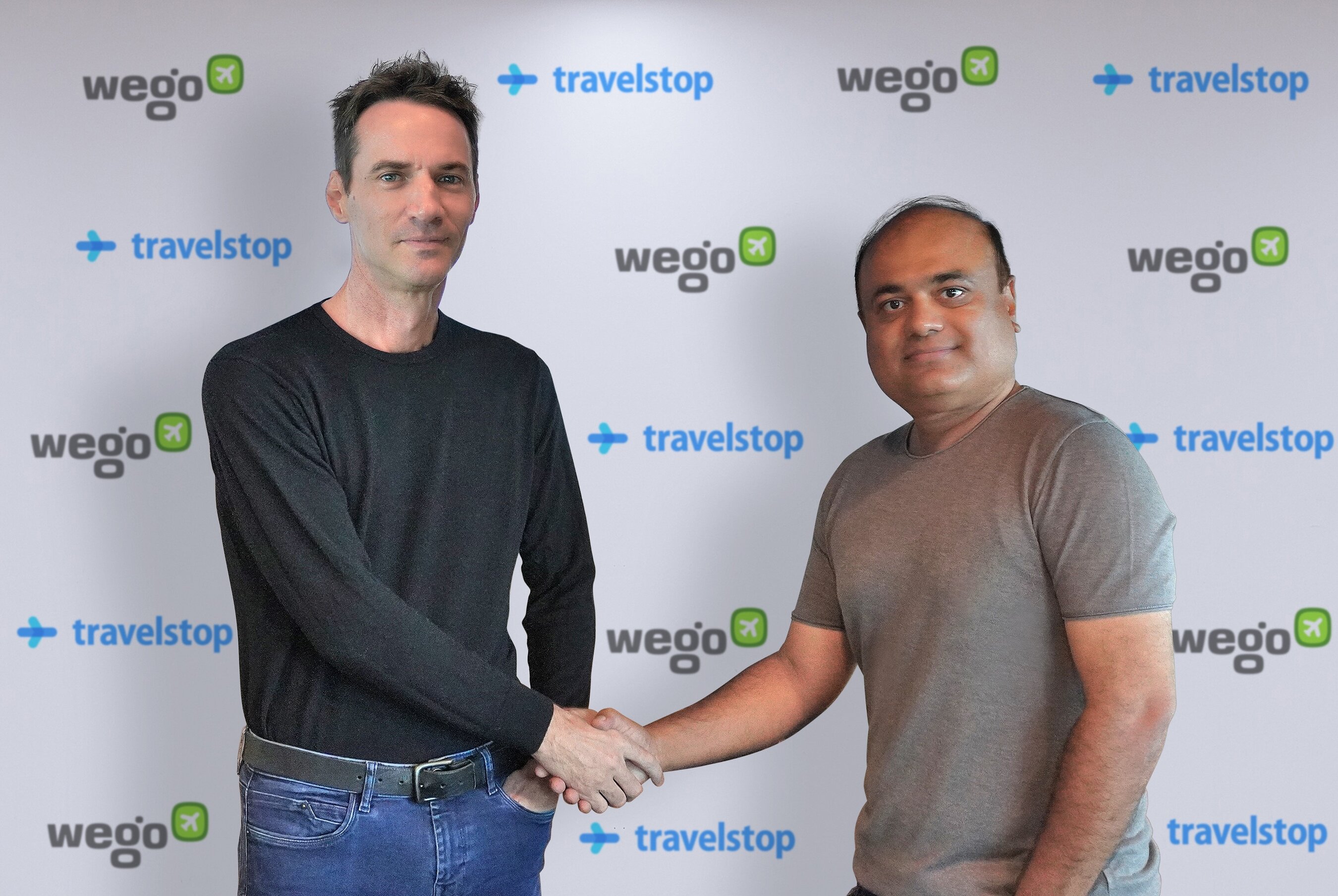
In September 2023, Wego acquired Travelstop. The acquisition brought Kirtane’s business into a travel company with an established network in the Middle East and North Africa. The accompanying photograph shows Wego co-founder and CEO Ross Veitch on the left and Kirtane on the right, shaking hands in front of the two company names. It is the familiar public pose for a deal, with a practical next chapter waiting behind it.
The WegoPro launch came in January 2024. It introduced the renamed platform in Saudi Arabia, the UAE, Qatar, Bahrain, Oman, Kuwait and Egypt. Kirtane described a combination of Wego’s travel supply, technology, accessible design and human support. The announcement also set out localised services, multiple approval levels and configurable policies. The expansion carried his earlier work into another collection of regional requirements.
By November 2024, his public discussion of the business included tools for travel agents. He described a central booking management system for tracking and changing reservations, alongside supplier integrations and local pricing. The emphasis is revealing in its practicality. A booking does not remain a neat, fixed object simply because it has been made. Customers need changes, and the agent needs a usable way to handle them.
At a Dubai event announced in July 2025, Kirtane returned to the connected process from approvals to expense management and the need to accommodate local workflows. Wego’s April 2026 update confirmed a dedicated WegoPro office in Mumbai. The geography has broadened since the venture’s early Singapore chapter, while the operational vocabulary remains recognisable.
The useful part of an ordinary ambition
Read across those chapters and a recurring question appears: what is still difficult after the customer has done the obvious thing? Finding accommodation leaves regional details to manage. Booking a work trip leaves approvals and expenses. Completing a reservation leaves possible changes. Kirtane’s public work gives these follow-on tasks sustained attention. The names on his business card have changed several times; the need to make the next task easier has kept giving the work its shape.
The ambition he describes is easy to understand without an airport lounge or a product demonstration. Employees need flexibility; companies need visibility; people on both sides need to finish the process. His career has carried that problem through engineering, marketplaces and executive responsibility. The traveller eventually gets home. The useful test of the software is whether the administration gets there too.