A cash register has a modest public life. It adds up a bill, takes payment and produces a receipt. Adi Wahyu Rahadi has spent years looking at the much larger business crowded behind it: the stock, the staff, the books, the customer who might come back. His company, majoo Indonesia, connects those jobs in software. His route to that counter took 22 years through telecommunications, a spell in mobile money and a computer-hardware shop of his own.
There is something pleasingly practical about this sequence. The founder’s education in small business included selling equipment to people who actually ran one. A machine could help them complete a transaction. Their working day contained rather more than transactions. When Adi turned that observation into a company, he chose a problem with little ceremony and plenty of repetition. Every day, someone opens a shop. Every evening, someone needs to understand what happened inside it.
Twenty-two years, then a smaller counter
Adi joined Telkomsel in January 1997. His public career record runs through June 2019, ending with the title of general manager. Telecommunications gave him a long apprenticeship in the movement of information, the organization of a national business and the commercial work required to keep people using a service. By the time he left, software and strategy were familiar territory. Building a young company would give those skills a different audience.
He also worked on T-Cash, the mobile-money business that became part of LinkAja. For the first six months of 2019, he was LinkAja’s Head of Commercial. The role covered developing uses for payments across merchants, transportation, financial services and other parts of everyday life. A payment product must fit into an existing routine. A commuter has a train to catch. A merchant has a customer waiting. Neither has much interest in an elegant system that makes the routine harder.
His education joined engineering to business. He studied Electrical, Electronics and Communications Engineering at Institut Teknologi Sepuluh Nopember and took an MBA in finance at Universitas Prasetiya Mulya. The combination suits the work he would choose: understanding how a system operates and why a business might pay for it. A functioning application answers one question. A subscription that someone renews answers another.
The customer on the other side of the hardware
Alongside his professional career, Adi opened an online computer shop. He sold and distributed hardware, including point-of-sale equipment. That business brought him into contact with small-business owners and the complications of managing their operations. The experience helped prompt the majoo project. Selling the device had exposed the work around the device.
The interest in retail software went back further. In the late 1990s, he made a point-of-sale application for a friend’s retail business using Microsoft DOS and DBase. These are wonderfully unromantic names for a founder’s origin story. They belong to an era when an application’s usefulness had to survive without a glossy app-store listing. The underlying job was already recognizable: record a sale and help a business keep track.
At Prasetiya Mulya, Adi met Audia Rizal Harahap, who would become majoo’s co-founder and chief operating officer. Their relationship began well before the company’s commercial launch. As students, they worked on a business plan that entered the Global Social Venture Competition. Adi has described competing alongside teams from Harvard, Stanford and MIT Sloan, and learning to think about social impact alongside profitability. The lesson gave their commercial ambition a wider purpose.
They initially worked on majoo at weekends, funding the project themselves. More than 100 beta customers paid to use it. A weekend project can accumulate encouraging comments indefinitely; paying customers introduce a more exacting form of encouragement. The project began in 2018. In mid-2019, Adi left Telkomsel and LinkAja. Commercial service began that July. Audia brought operating experience; Bayu Indriarko helped lead engineering. The venture needed the work of several people to make its promise usable.
A receipt with a second life
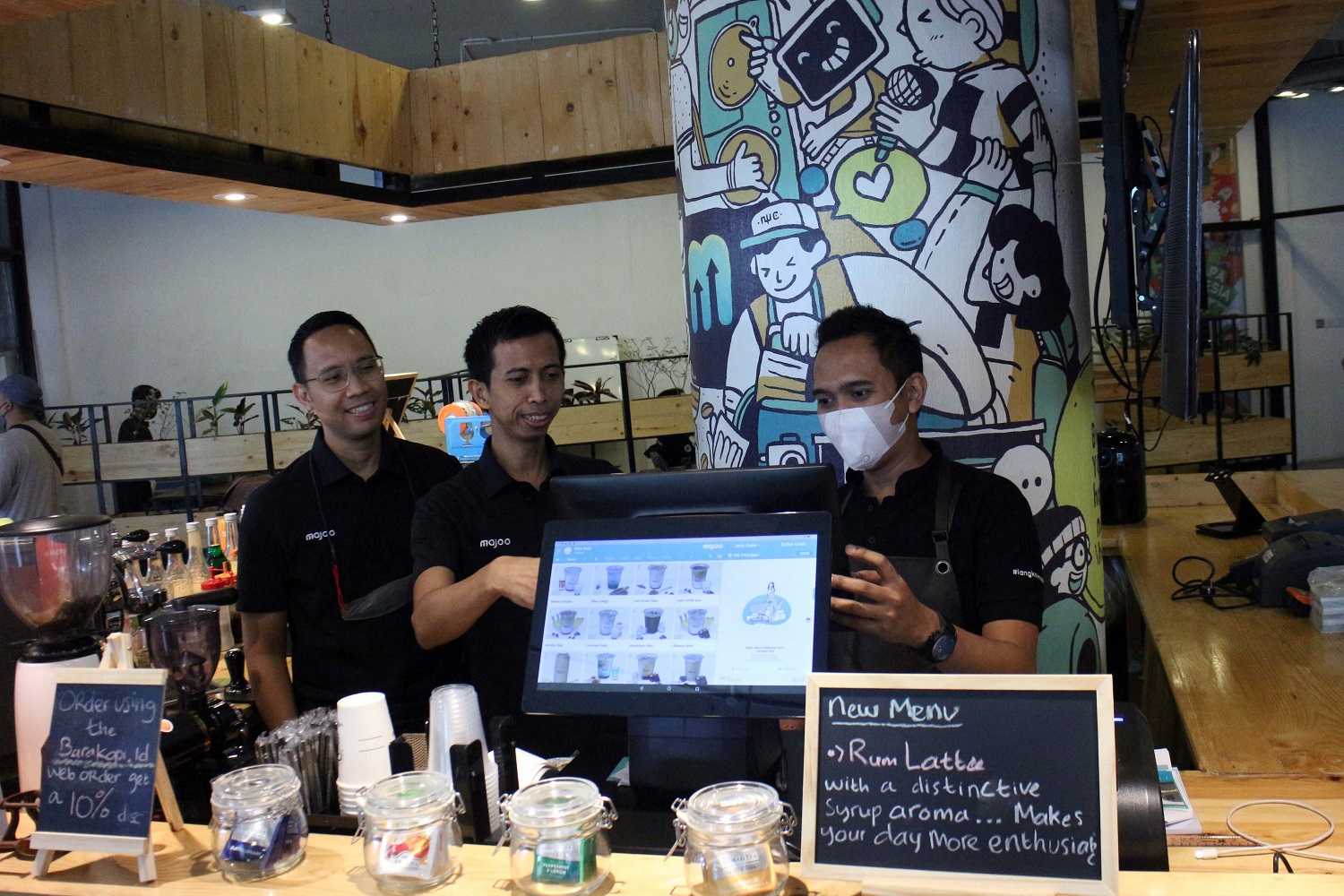
Majoo grew from point of sale into a connected set of tools for running a business. Cashier functions sit alongside inventory, accounting, employee management, customer relationships, business analysis and online ordering. Adi describes the original ambition as a miniature enterprise resource planning system for small businesses. The term is lengthy. The practical desire is easy to understand: let the different parts of a business share the same information.
Think of the ordinary consequences of selling an item. The stock changes. The accounts change. A record of customer demand appears. Connected software can carry that information between functions. The appeal lies in what an owner can learn from the sale after the receipt has been handed over. A checkout screen may be the most visible part of the product, but it introduces the information needed elsewhere.
A connected view for the business owner
Online selling added another set of connections. In March 2022, majoo presented an omnichannel offering that linked small-business online sales with marketplaces. The owner could operate across channels rather than manage each as a separate island. Adi discussed this work with investor Adrian Li on the Indonesia Digital Deconstructed podcast. Their conversation explored feature priorities, affordability and the difficulty of building a scalable business for merchants whose budgets are limited.
Distribution required attention of its own. Adi described a partner model with compensation tied to performance and internal customer-management tools that helped the sales team work with leads. Customer acquisition costs mattered. So did presenting a broad set of features at a single price. For a founder coming from a national telecom business, reaching users was familiar work; earning their continued subscription remained a daily obligation.
By August 2022, majoo announced a $10 million Series A. Existing investors participating included AC Ventures, Quona Capital, BRI Ventures and Xendit. The money was intended for wider customer reach, partnerships and development. These relationships placed a small-business software company within a network of investors and financial-service organizations. Adi’s ambition needed product work, commercial work and partners capable of extending what merchants could do.
August 2022
August 2022
Company report, January 2025
The figures mark successive moments. In 2022, the company reported more than 35,000 Indonesian MSMEs using its services. Early in 2023, Adi described more than 40,000 businesses across over 600 cities during the previous year. A January 2025 company update put the number supported during 2024 above 45,000. These are dated accounts of adoption. The actual test occurs at the level of one enterprise: whether the software remains useful when the next working day begins.
Malang, with room for conversation
Majoo’s business has roots in Jakarta and Malang. Its engineering operation grew from a small group of developers in Malang. By February 2022, the company described support teams in 60 cities and sales representatives in more than 100. Software could travel over a network; introducing it to business owners involved people on the ground. The geography of adoption carried its own workload.
Adi’s public posts offer a glimpse of how he talks about this work. A visit to Malang included office renovation, engineering discussions, a gathering with colleagues and plans for communal space where startups and small businesses could meet. He described preserving the building’s Malang character while making the interior informal and communal. An office, in this account, had room for conversations beyond its own payroll.
The same update found space for breakfast pecel, lunch rawon and an evening outing with colleagues. The food appears beside organizational improvement with no apparent competition for attention. It is a useful detail in a career often described through executive titles. Small businesses make up the places where a work trip becomes enjoyable, too. The economy Adi talks about supporting also supplies lunch.
“Although we are a software or technology company, what we offer is fundamentally a service.”
Adi Wahyu Rahadi · translated from Indonesian
The next question is service
That view of service has consequences. In a Telkomsel and Tech in Asia white paper, Adi explained that owners stop buying digital solutions when features or service fail to fit. Majoo had invested in customer-support teams across 80 cities. A useful tool still requires help when someone encounters a problem. For a business owner, the need for an answer rarely arrives at a conveniently scheduled product demonstration.
At majoo’s sixth anniversary in September 2025, Adi emphasized customer experience, connecting it to collaboration inside the organization. The company described AI-enabled live chat intended to give users answers more quickly. It also highlighted majoo Prime for more demanding businesses and Accounting Services for bookkeeping and tax administration. The agenda continued to expand around the everyday work of the enterprise.
His public messages in 2025 stayed close to those practical concerns. In August, he framed business freedom as relief from manual processes and the ability to monitor operations across time and distance. In December, he emphasized orderly bookkeeping as a way to understand the business and prepare for its obligations. In a separate discussion of customer loyalty, he urged attention to existing customers as well as new ones. The themes return to records, relationships and repeated use.
In 2026, Adi appeared at the Bravo 500 Summit discussing data, AI and anticipating customer needs. The vocabulary had moved a long way from DOS and DBase. The question beneath it remained recognizably his: what can a business learn from the information it already creates? His next chapter depends on making that answer practical enough for an owner to use between customers.
A register finishes its task when the payment is complete. Adi has built his second career around everything that follows. There is stock to replenish, a customer to remember and tomorrow to plan. The receipt is small. The work it sets in motion fills the day.