The shuttle was yellow, covered in black spots, and quite prepared to look ridiculous. The Parking Spot understood something about airport travel: a person trying to catch a plane has limited patience for tasteful invisibility. A recognizable bus is useful. A bus that arrives when it should is more useful still. Marty Nesbitt built a business in the space between those two observations.
Long before investment committees and foundation meetings filled his biography, Nesbitt was thinking about the place where travelers leave their cars. The service could be forgettable, the operators scattered, the customer experience uneven. That combination gave him something to work on. His company brought a recognizable identity and a hospitality sensibility to a transaction people generally hoped to finish as quickly as possible.
Today he is a co-founder, co-chairman and co-CEO of The Vistria Group, and chair of the Obama Foundation board. The parking business still supplies a useful way into his story. It puts the customer, the employee and the small operational decision in the foreground. It also gives a career associated with a former president a beginning of its own.
A business hiding beside the runway
In 2007, The Parking Spot offered travelers newspapers, bottled water and chocolate chip cookies. Its yellow-and-black identity extended to employee uniforms. Behind the cheerful appearance was a less photogenic concern with how things worked: cameras monitored service, equipment tracked abrupt driving, and software helped distribute cars efficiently through the lots.
There is comedy in applying such attention to a garage, but there is also a customer waiting with a suitcase. Every minute spent looking for a space or wondering about the shuttle is a minute the traveler would rather have back. Parking was an opportunity to improve an ordinary experience by taking its inconveniences seriously.
At the Phoenix facility’s opening that year, Nesbitt described the company as belonging to the hospitality industry. Covered spaces, luggage help and frequent shuttles gave that description substance. The journey began before the terminal doors. Someone had to be responsible for that part too.
“We consider ourselves part of the hospitality industry.”
Marty Nesbitt, 2007
The distinction matters when considering his later move into investing. A company contains more than the property it occupies. It contains habits, expectations and hundreds of decisions that customers encounter without ever seeing an organizational chart. An airport parking operator has to turn all of that into a service people can rely on. It is an education with very little room for theoretical punctuality.
The road out of Columbus
Nesbitt was born in Columbus, Ohio, in 1962. He graduated from Albion College in 1985 and earned his MBA at the University of Chicago in 1989. The sequence sounds tidy when printed on a biography. Moving through it required decisions about opportunity, security and what kind of working life he wanted.
He was the first in his family to attend college. After graduation, he worked at General Motors in Detroit. Returning to school meant leaving a job that his family regarded as a considerable achievement. He later described his progress as a series of increasingly bold steps. Each move made the next one imaginable, even when it remained uncomfortable.
Albion remembers a student whose life extended beyond the classroom: he co-captained the basketball team and took part in campus organizations. The college awarded him an honorary doctorate in 2009. Chicago became the place where his professional life developed, where he met his wife, Anita Blanchard, and where many of his enduring relationships took shape.
After his MBA, Nesbitt joined LaSalle Partners. He became a vice president in 1991. Work in real estate gave him the chance to examine parking as an asset class, and eventually to turn that interest into a plan for an operating company. The path to entrepreneurship began inside an existing firm, with something worth investigating.
In 1996, while seeking backing for the parking idea, he became acquainted with Penny Pritzker. He joined her real estate organization, and in 1998 received the funding to establish The Parking Spot. A proposal had become a business with customers to serve and employees to lead. The interesting question now had a payroll.
The Parking Spot was sold to Green Courte Partners in 2011 for a reported $360 million. That transaction helped spark Nesbitt’s interest in private equity. Having spent years on the operating side of a company, he could now consider a different position: choosing businesses to back and helping them develop. The sale marked a change in vantage point, with the experience of running things still available to him.
Friends before the firm
Basketball has a recurring place in Nesbitt’s biography. He and Kip Kirkpatrick became friends through recreational games before co-founding Vistria in 2013. Barack Obama was part of their basketball circle too. The setting is a useful reminder that consequential relationships can begin somewhere less ceremonial than a conference room.
A pickup game lets people observe one another while they are occupied with something else. They have to cooperate, compete, recover and return. It would be too neat to claim that a good teammate necessarily becomes a good business partner. Still, the court supplied these men with time together before the partnership acquired an office and investors.
Nesbitt’s friendship with Obama became part of his public identity. He served as national treasurer of the 2008 and 2012 presidential campaigns. He now chairs the Obama Foundation board. Friendship had brought him into public responsibilities that continued beyond an election night and beyond a presidency.
The connection also invites an easy shorthand for his business career. A famous friend is an efficient biographical label; it can consume the paragraph. Yet Nesbitt’s experience in real estate and airport parking preceded Vistria, and Kirkpatrick brought his own investing experience to their partnership. Both men had work behind them when they started the firm.
Vistria’s premise gives them a continuing question to answer: can a business create financial value while serving wider public interests? Education, financial services and housing make that question concrete. A student wants useful learning. An employer needs capable people. A resident needs a place to live. Investors expect the company serving those needs to hold up as a business.
The firm announced $3 billion in commitments for its fifth flagship fund in January 2025. That figure measures capital entrusted to a fund, with expectations attached. Raising money is one chapter. Making decisions about it occupies the chapters that follow.
Capital commitments to Vistria Fund V, announced January 2025.
Fund capital - distinct from personal wealth.What a board owes the people doing the work
Nesbitt joined the Chicago Housing Authority board in 2003 and became its chairman in 2006. The role brought him into the institution’s effort to reshape public housing. His career had acquired another arena where plans mattered because people would have to live with the results.
Corporate governance has also remained part of his working life. He joined the American Airlines Group board in 2015 and Chewy’s in 2020. Their businesses differ substantially, but both appointments draw on a career involving executive leadership, operations and investment. A director arrives with experience; the organization still has its own people and its own problems to understand.
In college, Nesbitt and his roommates became informal mentors to a neighborhood boy who visited their house and did homework. He later connected that experience to his interest in civic service. The anecdote has an appealingly ordinary scale: a child, some schoolwork and adults willing to make room.
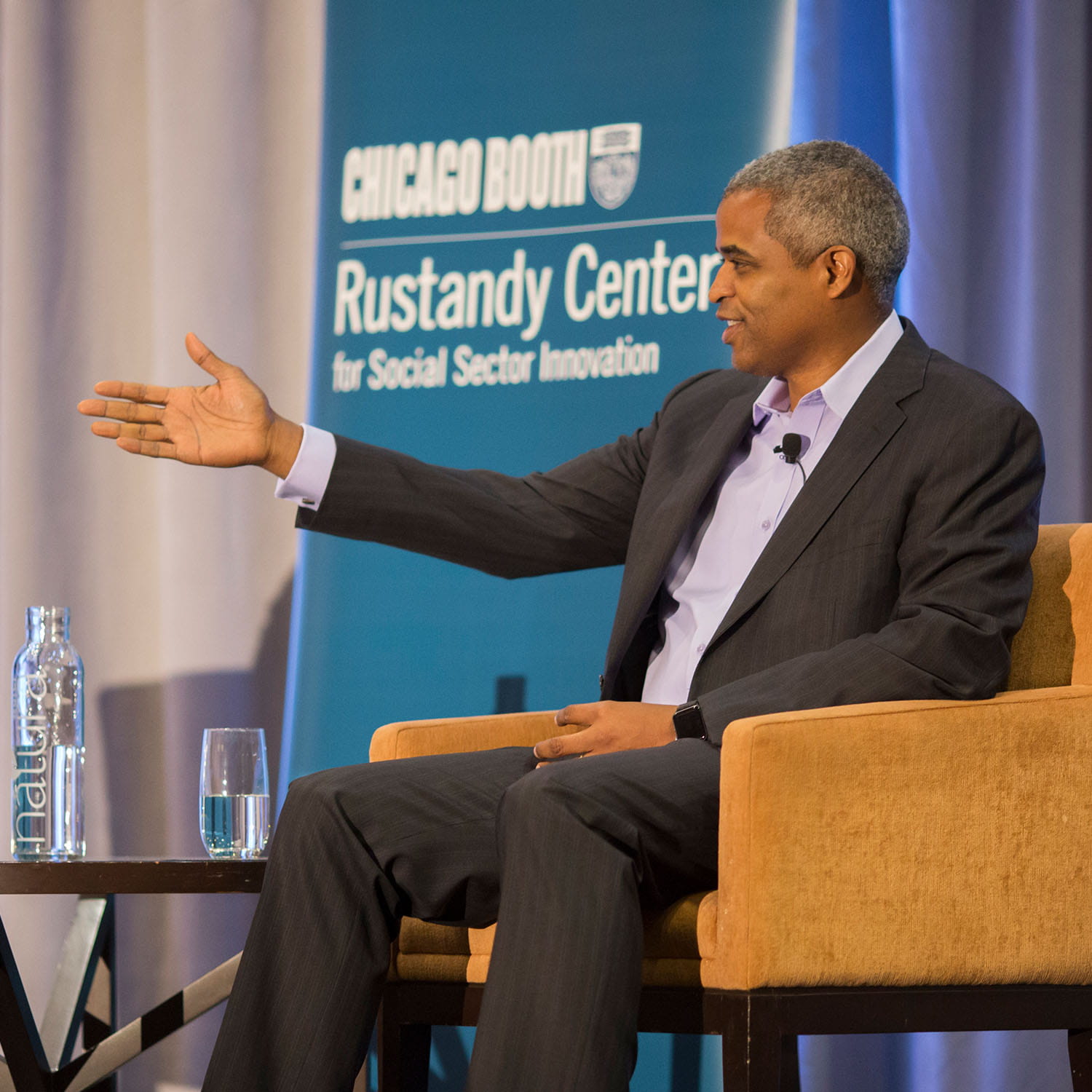
At a 2018 discussion about nonprofit boards, he emphasized a partnership between directors and staff, clear goals and permission to experiment. Caring about an institution is a beginning. The people charged with its daily work need a setting in which they can act, propose ideas and learn when something fails.
That is demanding advice precisely because it sounds so reasonable. A board member can have a strong opinion without having to implement it the following morning. Shared responsibility requires attention to that difference. The institution needs the board’s judgment and the staff’s ability to execute; either can become less useful when it crowds out the other.
Room for a record player
Nesbitt’s interests also reach into the arts. He is a trustee of Chicago’s Museum of Contemporary Art, and he and Blanchard collect art together. In April 2026, MoMA’s Black Arts Council honored the couple alongside artist Mark Bradford. The event supported the council’s acquisitions, programming and exhibitions.
There is room for music in the working day as well. In 2019, Nesbitt described putting on Stevie Wonder or Marvin Gaye while he packed up his office. A record playing at closing time offers a welcome change of scale after the funds, board appointments and campaign responsibilities. Someone still has to finish up and go home.
The yellow shuttle belongs in the same portrait. It recalls a business built around an everyday need, with enough personality to make a parking lot memorable. Across the larger institutions that followed, the practical questions persist: who is being served, who is doing the work, and what would make the experience better? Nesbitt’s career began by giving those questions a place to park.