Lou Rassey did his homework at a drafting table in his father’s office. Outside the arithmetic and school assignments was another kind of education: a family machine shop in Detroit, making precision parts for the auto industry. His grandfather had started the business. His father carried it on. A drawing could become something solid here, and something solid could help a much larger machine work.
Years later, Rassey remembered his father holding up a part and asking, “Lou, what is this? What does it do?” It is an unusually good question to bring into a career. A part has a shape, a material and a price. It also has a job. That last detail can disappear surprisingly quickly once a business starts talking about technology.
Rassey eventually became an engineer, a consultant, a manufacturing founder and a private equity executive. Today he is co-CEO and managing partner of McNally Capital in Chicago. The route connects the physical demands of making things with the financial demands of keeping a company going. Along the way came an ambitious proposal: let a part travel as information, then make it close to the person who needs it.
Homework beside the machines
Rassey calls himself a third-generation manufacturer. His early professional work remained close to the family trade, though at a different scale. At Chrysler he worked on powertrains and body systems. He then helped design and launch a factory in Brazil for a Chrysler-BMW joint venture. A factory launch gives the word implementation a reassuringly concrete meaning. Eventually the equipment must run.
His education crossed the boundary between engineering and management. At MIT, he studied both through the Leaders for Manufacturing fellowship. That combination is useful context for his subsequent career: the technical question and the business question were already sharing a desk.
Between 2003 and 2015, he worked at McKinsey, becoming a partner. Consulting widened the frame from individual systems to companies and industrial competitiveness. The engineer who had helped bring a factory into operation was now considering where factories should be, what capabilities they needed and how leaders should respond to changing technology.
In 2014, with Katy George and Sree Ramaswamy, he co-authored an argument for “next-shoring.” Manufacturing decisions, they argued, would increasingly depend on closeness to demand and to innovation. A low wage could be attractive. So could a nearby customer, a capable supplier or the right technical workforce. The arithmetic had more columns than the wage bill.
The distance between a drawing and a part
By 2015, Rassey was discussing digital manufacturing alongside Bill King and GE’s Joe Salvo. His contribution emphasized the value of data and the need for companies to begin experimenting while thinking seriously about their longer-term strategy. Technology was becoming a question about the shape of a business, as well as the machinery inside it.
“Data is a powerful asset,” he said. For someone whose early working world had contained factory equipment and automotive systems, that idea carried a particular weight. Information about what a customer needs, and about how a product can be made, could have value alongside the equipment that makes it.
The connections were also personal. Rassey and several future Fast Radius colleagues had collaborated around Chicago’s Digital Manufacturing and Design Innovation Institute. Those colleagues included Bill King and John Nanry. Chicago offered a meeting place for manufacturing knowledge and technology work. It also became the setting for the business they would build.
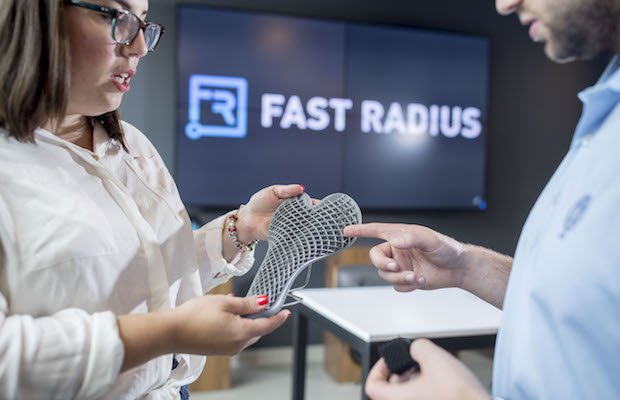
Fast Radius brought software together with production capabilities and logistics. Under Rassey’s leadership, the ambition was to give customers a route from an application to a manufactured part, supported by the information needed to repeat the process. The attractive idea was access: an organization could use advanced production capability without having to build every piece of it itself.
A file takes the shorter route
In 2019, Rassey described an aerospace customer that needed a tool for an urgent repair. The conventional production and delivery route would have taken about 45 days. Fast Radius retrieved a digital file, printed the tool and delivered it through its UPS partnership in 45 hours. The comparison came from Rassey’s account of that particular job. It was a practical illustration of what the model could do.
He used the phrase “fourth modality” of logistics for the larger idea. Goods traditionally traveled by land, sea or air. Digital manufacturing added a route for the instructions. A customer’s inventory could include files ready to become physical parts, with production happening closer to use. The destination still required machines, materials and qualified processes. A file, however obliging, cannot tighten a bolt.
One customer example described by Rassey. Bars show elapsed time on the same scale, not a general performance guarantee.
Another application was less dramatic and more familiar: the arm cap of a Steelcase SILQ office chair. Fast Radius and Carbon consolidated three parts into one printed part and reduced material use by about 70 percent. A person sitting at a desk might never give the armrest a second thought. The engineers making it had reason to.
The importance of these examples is their specificity. A repair tool has a deadline. A chair component has a design and material requirement. The business case begins there, with the use of the object, rather than with enthusiasm for the machine producing it.
Rassey’s 2022 advice to manufacturers followed that order: identify an application where additive manufacturing creates business value, then work out how to access the capability. He also stressed process validation and the economics of materials and equipment. Those concerns temper the more glamorous picture of a factory summoned through a browser. Production must be reliable enough for the customer’s actual needs.
Recognition meets the balance sheet
In September 2018, the World Economic Forum selected Fast Radius with UPS in Chicago for its initial group of nine manufacturing Lighthouses. It was the only United States site in that cohort. The recognition singled out distributed industrial-grade 3D printing and an operating system connecting design, production, analytics and fulfillment.
The distinction concerned a system. Advanced machines mattered, but so did the way work moved between them and the customer. Rassey’s industrial project was already broader than the printer itself. In July 2019 he was named to Crain’s Chicago Tech 50, another marker of the company’s place in Chicago’s technology community.
Then came a sharply different sequence. Fast Radius went public through a SPAC transaction in February 2022. That November it filed for Chapter 11. The public listing and the bankruptcy occurred within the same year. A company recognized for its manufacturing approach had encountered a financial outcome that recognition could not prevent.
In December, a SyBridge affiliate acquired operating assets. The acquisition announcement described plans to continue the digital manufacturing and software business and to offer employment to most employees. The work had value to another owner even as the original corporate structure went through bankruptcy.
These events belong together in Rassey’s career. The Lighthouse designation describes a technical and operational achievement. The bankruptcy describes a business outcome. An account that keeps both in view is more useful than a collection of prizes. Industrial innovation needs a working process, customers who want it and an organization that can continue delivering it. Each has its own test.
“Data is a powerful asset.”LOU RASSEY / 2015
Eight years before the new title
Rassey’s relationship with McNally Capital preceded his appointment to its leadership. He began serving as an industry partner in 2016. In February 2024, the firm named him co-CEO and managing partner alongside founder Ward McNally. An eight-year relationship stood behind the announcement.
Ward’s family background gave the partnership another industrial connection. He is a sixth-generation member of the family that owned and operated Rand McNally. Rassey came from a family machine shop. The businesses were different, but both careers had a connection to companies that were built and operated across generations.
The appointment gave Rassey a mandate to bring operational and technological innovation into McNally’s portfolio companies. That fits the breadth of his earlier work: understanding a production problem, considering a company’s competitive position and trying to turn a strategy into operating capability.
His current board roles place him close to that work. They include Dedicated Computing, Foundral, Airforce Turbine Service and Thryve Automation. This is a different setting from building one manufacturing platform. The focus extends across businesses with their own management teams, customers and operational requirements.
The work after the deal
McNally calls its value creation approach Atlas. Its portfolio operations team supports management in putting that approach to work. In March 2025, the firm announced five hires across portfolio operations and the deal team, with Rassey connecting the expansion to operational and technology expertise.
In March 2026, he joined the announcement of four promotions, emphasizing the team’s contributions to relationships with founders, management and investors. The subject was people and the work they do together. A strategy requires a team capable of carrying it out, however elegantly it has been drawn.
That is where this career becomes especially interesting. Rassey has worked on the part, the factory, the corporate strategy and the platform through which other people could access production. Now he works with capital and company leadership. The changes in scale are considerable; the problem of making an idea function survives them.
Return to the drafting table in Detroit. A child doing homework could see a drawing and a finished component in the same working world. Rassey’s later ambition stretched the distance between those two things across digital networks. His present role adds another set of decisions about resources, management and growth. Through it all, his father’s question remains a useful place to begin: what does it do?