A company can have clever engineers, useful software and a government customer, and still face a surprisingly awkward question: how does it become a larger business? Matt Norton has spent much of his career working in that gap. His investments at Madison Dearborn Partners connected the language of private equity with the practical demands of government technology. Now, after more than two decades at the Chicago firm, he has become a founder himself.
Norton is CEO of Watch Point Capital, a private equity firm focused on the lower middle market in national security, government technology and adjacent public sector markets. His former colleague David Pequet is joining him as co-founder and chief operating officer. The new venture gives a fresh setting to a familiar subject: companies whose technical work has to survive the journey from a promising idea to something a customer can actually use.
There is a pleasing reversal here. The investor who spent years partnering with founders now has the responsibilities of building a firm of his own. His earlier career supplies the context for that move. Procurement software, airborne intelligence, cybersecurity in orbit and artificial intelligence all appear along the way. A business card has considerably less room than his board history.
Twenty years before the new letterhead
Norton’s financial education began at the Wharton School of the University of Pennsylvania, where he earned a bachelor of science degree and an MBA. Before his MDP career, he worked as an investment banking analyst at Merrill Lynch. He joined the MDP team in 2004. Over the following two decades, he moved into leadership of its technology and government investing practice.
The breadth of his board experience is striking for its variety. His career includes service at software companies such as Aderant and Fieldglass, network technology business BlueCat, and building materials company Boise Cascade. Later appointments brought him into companies working on defense, space and government systems. The connecting thread is ownership and governance: spending time with the people responsible for turning a company’s capabilities into a functioning business.
A director’s role is also a useful vantage point from which to understand Norton. An acquisition announcement records one day. Board service extends beyond it, into decisions about leadership, investment and growth. His professional record runs through companies with very different products and customers, suggesting how much of his work takes place after the transaction has been agreed. The signed paperwork is an opening scene.
In September 2024, MDP named Norton one of eight partners supporting Vahe Dombalagian, the firm’s newly appointed managing partner. Norton continued to lead Technology & Government. The promotion placed him within the group charged with helping manage the wider firm, alongside leaders in investing, capital markets, business development and legal and compliance. His sector responsibilities were becoming part of a broader institutional role.
The business of buying things
Consider Unison, a company whose work begins where the glamour of technology announcements usually ends. It provides procurement, supply chain and contract management software for government agencies and contractors. Those are the systems that help organizations transact, manage agreements and comply with federal requirements. They are infrastructure for the business of government, with all the procedural detail that phrase implies.
In July 2022, Unison announced a strategic majority investment from MDP-affiliated funds. Carlyle would remain a minority investor, and the management team would continue in its roles while retaining a significant investment. At the time, Unison served all 15 US cabinet-level agencies and had more than 200,000 product users. These were established working relationships, rather than an audience waiting for a product launch.
Norton described Unison as sitting at the intersection of his team’s core interests. The transaction paired government expertise with enterprise software experience. It also preserved connections with existing owners and management. That structure matters in a career built around partnerships: a new investor can bring resources while the people who know the customers continue to lead the company.
For a reader accustomed to consumer technology, this is an instructive change of scenery. There is no need for everyone to recognize a product for it to have a substantial customer base. Government software can be embedded in work that is essential, recurring and unusually particular. Norton’s sector focus puts that specificity at the center of the investment conversation.
A portfolio acquires an altitude
Other parts of Norton’s career took the same conversation into the air. In 2020, MDP and CoVant announced an agreement to acquire AEVEX Aerospace, a provider of airborne intelligence, surveillance and reconnaissance solutions. Its work included engineering, mission operations and intelligence data processing. Norton spoke about supporting investment in business development, technology research and development, and the company’s pipeline.
That combination of technical capability and business investment helps explain the portfolio’s shape. AEVEX’s work was different from Unison’s procurement software, but each required an understanding of government customers. Buying a company in this field involves more than deciding whether its technology is interesting. The customer’s mission, the company’s people and its ability to deliver all belong in the same assessment.
Space cybersecurity added another dimension in January 2023. SpiderOak announced a $16.4 million Series C round led by Empyrean Technology Solutions, a space technology platform backed by MDP-affiliated funds. The planned uses included on-orbit testing of OrbitSecure 2.0, engineering capacity and a laboratory for qualifying cybersecurity technology with hardware in the loop.
The details are useful because they describe what capital was supposed to make possible. Testing in orbit is a different proposition from a software demonstration on a laptop. A laboratory and an engineering team give a financing announcement a physical consequence. Norton’s comments connected SpiderOak’s commercial cybersecurity background with national security, a field in which MDP already had investments.
The founders stay in the room
In November 2023, MDP-affiliated funds acquired T2S Solutions, a founder-owned company in Belcamp, Maryland. T2S worked in research and development, prototyping, engineering, integration and technology products for US defense and intelligence programs. Its founders retained a significant minority ownership position and continued to lead the business. The arrangement kept the people who had built it involved in its next stage.
Norton’s remarks emphasized relationships with military program leaders, technical capabilities and execution. He also discussed maintaining the company’s core approach while extending what it could offer customers. That is a more specific proposition than simply making a company bigger. It raises the question of what needs to be preserved as new resources arrive.
T2S’s fields included space, navigation and timing, artificial intelligence, cybersecurity and electronic warfare. Those capabilities placed it among other MDP government technology investments, including LinQuest, AEVEX, SpiderOak and Unison. The portfolio connected companies addressing different parts of a customer’s work. The relationship between them provides a useful picture of Norton’s specialization, without requiring every business to look alike.
The next year brought an investment in Omni Federal, a software developer serving defense and intelligence customers. Its management also retained meaningful ownership and continued to lead. In discussing the partnership, Norton pointed to MDP’s network, resources and the new board. He described independent research and development across the portfolio as an investment the firm was prepared to make before a customer supplied a contract or requirement.
“using MDP’s network and resources, and using the new board we’re putting in place.”
Matt Norton, discussing Omni Federal in 2024
That observation gives the partnership language some substance. Money can support development, but a board and an industry network can also help a company decide where to go. Norton’s account places the investor beside the management team in that process. It is a form of work that continues long after the celebratory photograph.
AI meets the deployment problem
The T2S investment also connects to a newer chapter in enterprise technology. Axonis emerged from stealth in December 2025 after two years of incubation within T2S. Its platform was designed to run AI on distributed data without first moving that data into a central environment. Todd Barr became CEO as the independent company moved into commercial availability.
Norton’s comment on the launch focused on a practical obstacle: getting AI models into production. The interesting part was the architecture, the way a model could be brought to data that remained where it was generated or governed. Security, connectivity and operational constraints made that choice relevant to the company’s defense origins and to its commercial ambitions.
For Norton’s story, Axonis offers a concrete connection between the government and enterprise sides of technology investing. Work incubated inside a government contractor became the basis for a standalone company. The progression puts technical development, ownership and commercial leadership in the same frame. It also illustrates why an investor’s attention might settle on the mechanics of deployment amid the surrounding excitement about AI.
From the boardroom to the microphone
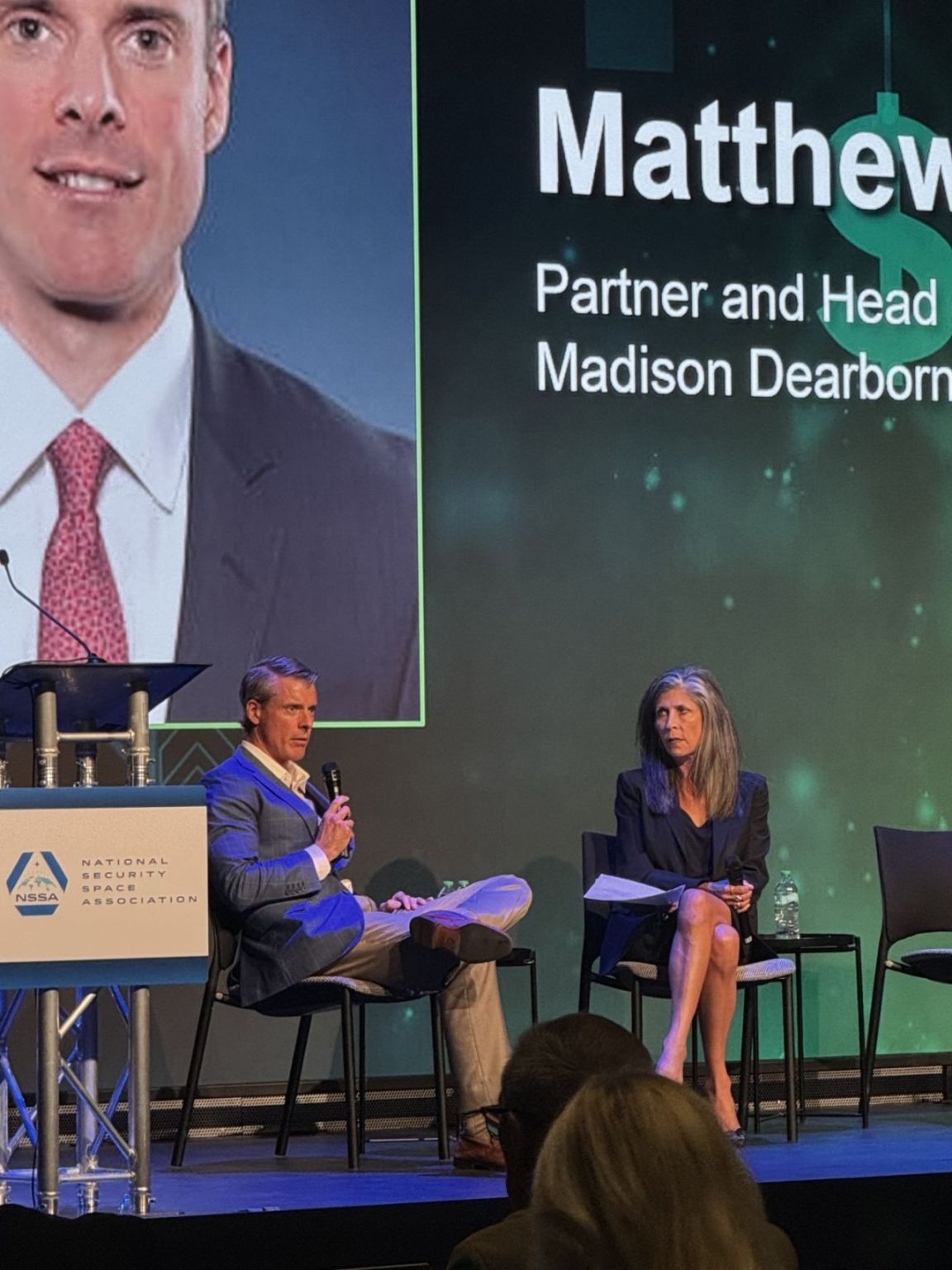
Norton’s public appearances bring these interests together. He joined the National Security Space Association’s board in 2024. At its 2025 Space Investors Forum in Arlington, Virginia, he was a keynote speaker, while MDP colleague Brandon Levitan also participated. The event placed private capital in conversation with the businesses and institutions working in national security space.
In March 2026, Norton sat down with Nasdaq’s Kristina Ayanian to discuss his background, defense technology investing, AI and partnerships with founders and executives. The subjects were consistent with the preceding transactions. His public role was expanding from explaining individual investments to discussing the conditions under which technology businesses could grow.
His board history also includes City Year Chicago and the Illinois Venture Capital Association. Those affiliations put a civic and regional dimension beside the national security work. Chicago remains part of the professional picture even as his investment interests extend into government agencies, aerospace companies and the space industry.
A familiar partner becomes a founder
Watch Point Capital changes Norton’s place in that picture. He now leads a firm devoted to the lower middle market in the fields that occupied much of his later MDP career. Pequet’s arrival as co-founder and COO reconnects former colleagues at the start of a new organization. Their announced focus is specific enough to make the continuity apparent.
There is a distinction between advising the builders of companies and building an investment firm. Norton’s career has now crossed it. The earlier record supplies a set of experiences: working with management teams, serving on boards and supporting businesses whose customers need technology to perform under demanding conditions. Watch Point gives those experiences a new institutional home.
His story is still being written in the ordinary units of business life: a leadership appointment, a development decision, a partnership, a new firm. For an investor who has spent years discussing what comes after an acquisition, the next question has become personal. What comes after two decades at the same firm? In Norton’s case, another company to build.