Robert Thompson put a restaurant inside a bowling business and then watched the restaurant take over the receipts. During his years running Punch Bowl Social, he said food and beverage accounted for 90 percent of sales. The bowling balls did their work elsewhere: they gave people a reason to arrive together, stay longer, and order something else. A strike was good for morale. Dinner was good for the business.
That distinction helps explain a career that can look, from the pavement, like a collection of enormous rooms with improbable furnishings. Thompson has worked with billiards, bowling, boutique hotels and a proposed soccer arena. He keeps returning to a question familiar to anyone who has organized a night out: how do you get a group to agree on somewhere to go?
His answer involves giving the group several answers at once. Someone can care about the kitchen. Someone else can care about the games. The person who mainly wants to talk still needs a comfortable place to sit. Thompson builds around the negotiation, and makes room for another round.
A substantial first wager
Before the national brand, there were shifts waiting tables and tending bar in the United States and Britain. In 1997, aged 25, Thompson opened Buffalo Billiards & Havana Lounge in Nashville. It combined a large billiards operation with another hospitality concept under the same roof. The preference for generous square footage was present early. His first restaurant was already a project that required customers to make choices once they got inside.
He went on to develop independent restaurants as well as entertainment venues. By the time he began working on Punch Bowl Social in 2010, he had experience of both the ambitious idea and the awkward business of operating it. His later account of that period included failures and a moment when he considered leaving restaurants altogether. Stubbornness, as he described it in a 2019 podcast conversation, helped keep him in the trade.
The first Punch Bowl Social opened in Denver’s Baker neighborhood in 2012. The former Big Lots occupied roughly 24,000 square feet. Converting it required more than enthusiasm for shuffleboard. Thompson later said he had personally guaranteed $1 million in capital and contingent liabilities, breaking his own professional rule about such commitments. Construction costs and disagreements among shareholders tested the opening before there was a customer to entertain.
He remembered getting the doors open as a point of pride. There is a useful corrective here to the cheerful vocabulary of restaurant invention. A room can look spontaneous only after somebody has spent a long time worrying about it. The casual evening comes with a rather formal set of obligations behind the scenes.
Food & beverage at Punch Bowl Social during Thompson’s tenure
The building gets a speaking part
Thompson’s design vocabulary made unusual company: Victorian details, industrial materials, a mountain lodge and midcentury modern furniture. Calling the result “dirty modern” was an economical way of acknowledging that the pieces did not come from the same drawing room. They were meant to work together anyway.
For him, the local building supplied another ingredient. In San Diego, Punch Bowl moved into a former boxing arena. In Denver, it restored the base of the old Stapleton airport control tower, with an air travel theme suited to the address. Dallas’s Deep Ellum suggested jazz and punk. The project in Northern Virginia drew on a story about escaped circus elephants. The address could provide material that a corporate decorating manual never would.
There was also a practical piece of stage management at the entrance. The diner and open kitchen occupied the way in, so visitors encountered the food operation immediately. A customer arriving to bowl first walked through a place where dinner was visibly being made. Architecture helped make the introduction.
Adaptive reuse carried its own inconveniences. Old buildings bring delays and constraints alongside their atmosphere. Thompson nevertheless treated their histories as assets. A former arena already has a relationship with a neighborhood; a tower already has a place in its skyline. Hospitality could give people another reason to enter buildings they recognized.
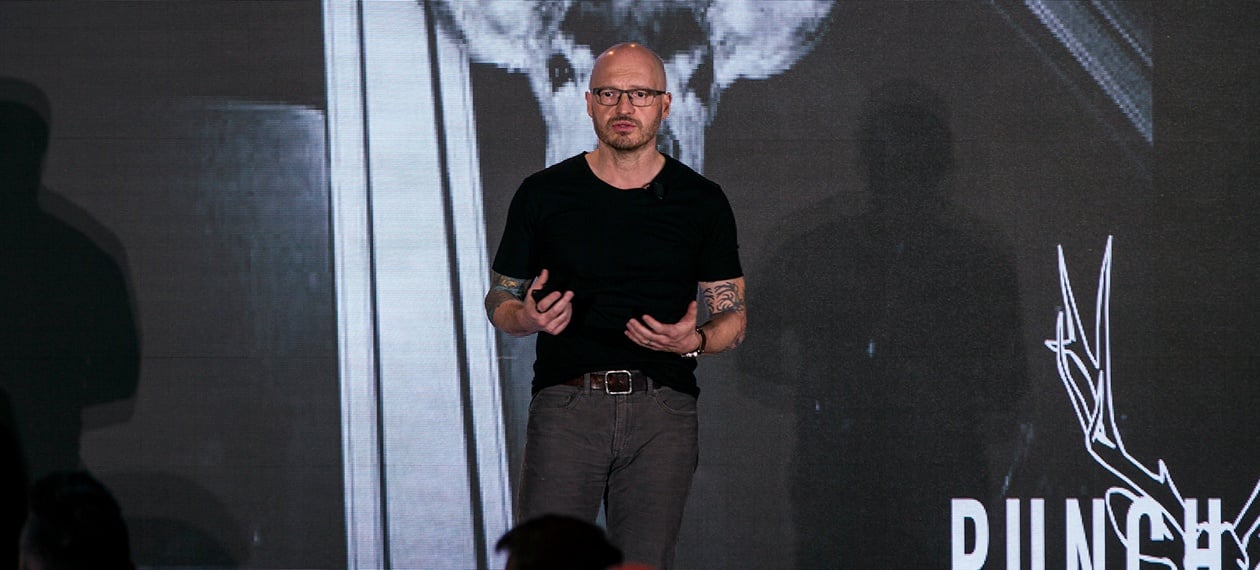
The company behind a casual evening
National growth required other people’s money and other people’s expertise. In June 2017, L Catterton’s growth fund invested in Punch Bowl Social. The business was expanding beyond its Denver beginnings, with locations in markets including Cleveland, Detroit, Indianapolis and Minneapolis. Culinary partner Hugh Acheson helped make the claim about serious food tangible. The kitchen needed an identity as clear as the games.
By November 2019, the company employed more than 3,000 people, with another Austin opening expected to take it to 20 locations. Recognition included a place on Fast Company’s 2019 list of the world’s 50 most innovative companies. Thompson had also received an EY Entrepreneur Of The Year regional restaurant award in 2017. A business built around an evening’s entertainment had become a substantial employer.
Growth did not simplify the evening itself. Thompson described the difficulty of serving the full menu throughout a sprawling venue: several unexpected groups could decide to eat at once. The flexibility customers enjoyed became the kitchen’s problem to solve. Every extra activity added another possible route through the night, and another demand on the people running it.
His interviews alternate between that operational precision and a dry amusement about the customers. Automatic dart scoring spared guests the indignity of doing arithmetic after drinks. Group events offered an alternative to the familiar corporate dinner. He could talk about dwell time and still recognize what an office party feels like from the wrong end of a banquet table.
“I don’t really know how to deliver an experience.”
Robert Thompson, discussing Punch Bowl Social’s emphasis on visits in person
That remark captures his commitment to the physical address. The building, the food and the other people had to meet in the same place. It also explains why his later projects continued to involve rooms, even as their names and activities changed.
Families were part of the audience, too. In Denver, the children’s menu included choices such as turkey meatballs and tempeh tacos, while weekend mornings made the games available to younger visitors. Thompson connected those choices to the food he would serve his own child. The same venue could support brunch with children and an evening with friends. That range depended on ordinary details: the hour, the menu, the seating, and how much noise a room could comfortably absorb.
A new address, with bedrooms upstairs
In August 2020, Thompson resigned as Punch Bowl Social’s CEO. The company he founded continued on a separate path. His own next phase included Angevin & Co., a hospitality business whose ambitions extended to hotels, bars and restaurants. Leaving the company did not end his interest in the kind of places it had taught him to assemble.
In 2021, he moved with his family to New Orleans. Angevin bought the Frenchmen Hotel, a 27-room property in an 1860 building. A hotel offered another version of the question he had been asking in restaurants: where would people gather once they arrived? His plans gave the bars, courtyard and shared spaces a prominent role.
He also described a proposed hotel identity through a fictional Irish immigrant who ran a flower shop and visited speakeasies. Inventing a character provided a framework for the design, food and drinks. Thompson had studied philosophy and history at Regis University; the career he constructed gave narrative a commercial use, down to the room in which somebody might order a cocktail.
These experiments had limits. Three Saints Revival, his Mediterranean restaurant beside Denver’s Hotel Indigo, opened in 2021 and closed in February 2024. Its vivid, dream-inspired design had attracted attention, but the business did not last. The closure belongs beside the openings in any account of his work. A persuasive concept still has to pay for its address.
Another game, the same dinner question
Jaguar Bolera opened in Raleigh in May 2024, pairing duckpin bowling and other activities with a kitchen led by Manny Barella. Its Southern and Mexican influences gave the food a specific direction. Self-pour drinks and counter ordering changed how guests moved through the space. Thompson was revisiting a familiar proposition while changing the mechanics of service.
There was room for the ridiculous, too: activity kits included needlepoint, and the design imagined an exuberant host with a fondness for bold patterns and entertaining. At this scale, a restaurant can risk feeling anonymous. Giving it the tastes of an imagined person was one way to make the choices cohere.
Camp Pickle, another concept associated with Thompson, illustrates why announcements need dates attached. In November 2025, he said he had resigned from a contracted management role more than a year earlier, had not been an owner, and was outside its current operations. The planned Centennial site had not become the venue described in its earlier publicity.
His next announced project, Valhalla SC Arena, combined soccer training, games, food and a sports bar. He introduced the idea publicly in April 2025; by November he described it as “early and exploratory.” The ambition was to serve families, players and spectators within one facility. An announcement is the beginning of that work.
Across these projects, Thompson’s recurring subject is the gathering itself. The activity changes what people can do together; the kitchen changes whether they want to stay for dinner. His career has included a national chain, smaller ventures, closures and plans still taking shape. He keeps returning to the floor plan, leaving space for people who came for different reasons to spend an evening in the same room.
Stay for the conversation
Explore Thompson’s work and hear him explain the rooms.
Robert Thompson on LinkedIn ↗Angevin & Co. ↗Watch: the RestaurantSpaces talk ↗Listen: food, games and the business of staying ↗Listen: Valhalla on Profluence, April 2025 ↗Read: Thompson’s New Orleans chapter ↗Read: the November 2025 Camp Pickle update ↗