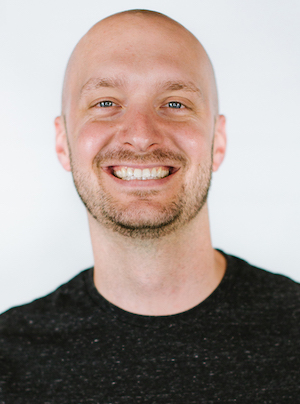
The Man Who Writes Books About Twitter in 2009 and Wins
In 2009, Kyle Lacy co-authored a book called Twitter Marketing for Dummies. Twitter had roughly 30 million users. Brands were just figuring out what a "tweet" was. His blog was already on AdAge's list of the 150 most influential marketing blogs in the world. He hadn't turned 30 yet.
That's not precocity. That's pattern recognition. Kyle has always shown up a beat before the rest of the room - and then built something real while everyone else was still reading the room.
He grew up in Indiana. He went to Anderson University - a small Christian liberal arts school outside Indianapolis - and graduated with a marketing degree. He didn't end up at a big agency or a coastal tech company. He stayed in Indianapolis, founded a social media shop called Brandswag, and started meeting five to seven new people every week. Not as a tactic. As a practice.
"Attribution is an input, not the gospel truth."
- Kyle Lacy
ExactTarget found him. Or he found them. Either way, by 2012 he was building a content team from scratch across six countries, generating roughly $15 million in sales pipeline per quarter. This was before "content marketing" was a line item on most SaaS budgets. ExactTarget was acquired by Salesforce for $2.7 billion in 2013. Lacy moved with it, leading global content and video for Salesforce Marketing Cloud across seven countries.
What he describes from this era isn't the org chart - it's the discipline of building systems in a company moving at acquisition speed. Managing teams across time zones and cultures when Salesforce is both your employer and your identity. Maintaining editorial coherence when everyone suddenly wants a piece of the content engine.
The OpenView Chapter: Teaching Others to Fish
In 2016, Lacy moved to OpenView Venture Partners in Boston as VP of Marketing Strategy. OpenView is one of the more unusual VC firms around - they're famous for their "expansion stage" thesis and for actually helping portfolio companies do the work, not just sending advice over email.
For Lacy, it was a two-year master class in patterns. He saw what worked across dozens of SaaS companies at the $5M to $50M ARR stage. He studied personas, positioning, category creation, and the exact ways that marketing leaders destroy trust with their boards. He left with a template that he'd spend the next seven years field-testing.
Kyle set a personal goal to become a CMO by age 35. Lessonly hired him in 2018. He was 32.
The company made training software. It had 8 people in marketing. Kyle left with 70+ people in marketing, a company at 230+ employees, and a sale to Seismic that valued the company at north of $170 million. Twenty times revenue growth. He didn't do it by spending more. He did it by building a machine.
Lessonly's story is worth sitting with. Indianapolis. Training software. Not a category that makes the cover of TechCrunch. What Kyle built there was a demand generation engine that treated the entire buyer journey - not just the bottom-of-funnel - as a marketing problem. Brand, enablement, and pipeline weren't separate budgets. They were one organism.
When Seismic acquired Lessonly in August 2021, Lacy followed as SVP of Marketing - overseeing design, growth, customer marketing, field, and sales development at a much larger company. He spent about a year there, navigating the peculiar physics of post-acquisition integration, before leaving to become Jellyfish's first-ever CMO.
"Marketing's job is to make sales easier. Sales' job is to support marketing to take risks."
- Kyle Lacy
Engineering Management, Explained by a Marketer
Jellyfish builds software that gives engineering leaders visibility into how their teams actually spend time - so they can have real conversations with the business, not gut-feel conversations. When Jellyfish raised a $71 million Series C in late 2022 and named Lacy as their first CMO, it was a bet that the engineering management category needed to be built from scratch.
Lacy described Jellyfish's mission at the time: "By giving engineers the same data and insights that Salesforce gave to sales, Jellyfish is helping them understand their impact." That framing - engineering operations as a marketing problem - is peak Kyle Lacy. Find the horizontal story. Translate it for the executive buyer. Connect it to revenue.
He spent about two and a half years at Jellyfish, building out the brand, positioning, and GTM motion. In April 2025, he became CMO at Docebo.
Revenue Diaries: The Anti-Work-Talk Podcast
In 2024, Lacy launched the Revenue Diaries podcast. The format is unusual by design: raw conversations with revenue leaders about family, life, fears, and faith. Guests never see the questions in advance.
There's no slide deck. No marketing-speak. No "three frameworks for pipeline generation." Just: what's keeping you up at night, and does it have anything to do with your quarterly number?
It has 62+ episodes. It is, in some ways, the opposite of his day job - and also the clearest expression of what he actually thinks about. The book on World War II sitting on his shelf. The two boys. The faith he doesn't hide. The imposter syndrome he insists on naming instead of burying.
"Channel the imposter syndrome to get better at what you do, not let it be detrimental."
- Kyle Lacy
What He Actually Believes About Marketing
Kyle Lacy has accumulated enough scar tissue to have opinions that don't come from conference slides. A few that show up consistently:
On attribution: "An input, not the gospel truth." He's watched too many marketing teams become hostage to multi-touch attribution models that produce precise answers to the wrong questions.
On the first 100 days as CMO: If you're building attribution models in your first hundred days, you're doing it wrong. Understand the business first. Learn who's in the room. Figure out what the CEO actually worries about at midnight.
On brand vs. revenue: There is no versus. Brand initiatives that can't be connected to revenue outcomes don't belong in the boardroom. But that's a solvable problem, not a permanent condition.
On sales-marketing alignment: He's a believer in marketing as the hub-and-spoke of the go-to-market model. That comes with responsibility to force alignment, not wait for it.
The Bad Boy of SaaS Marketing
The nickname "Bad Boy of SaaS Marketing" is funny mostly because it's true. He challenges orthodoxy. He says things in public that other CMOs think privately. He has strong takes on what marketing leaders actually die from (vanity metrics, board decks that don't connect to revenue, not building trust with sales fast enough).
None of this is edgy for its own sake. It's the point of view of someone who's been in three significant company exits, built teams from single digits to dozens, and sat in a lot of rooms where the wrong thing was being measured with extraordinary precision.
He's based in Indianapolis. He's not in San Francisco making the rounds. He's in the midwest, working, building, talking honestly about the parts that don't make the press release. He's a speaker represented by the Premiere Speakers Bureau and has trained over 175 companies on marketing strategy. His blog was AdAge 150. His books are in five languages.
Kyle Lacy is the kind of executive who could have been a bigger name if he'd moved to New York in 2010. Instead he stayed in Indiana, wrote books that aged well, and built companies that sold for real money. There's a version of that story that's a cautionary tale. This is not that version.