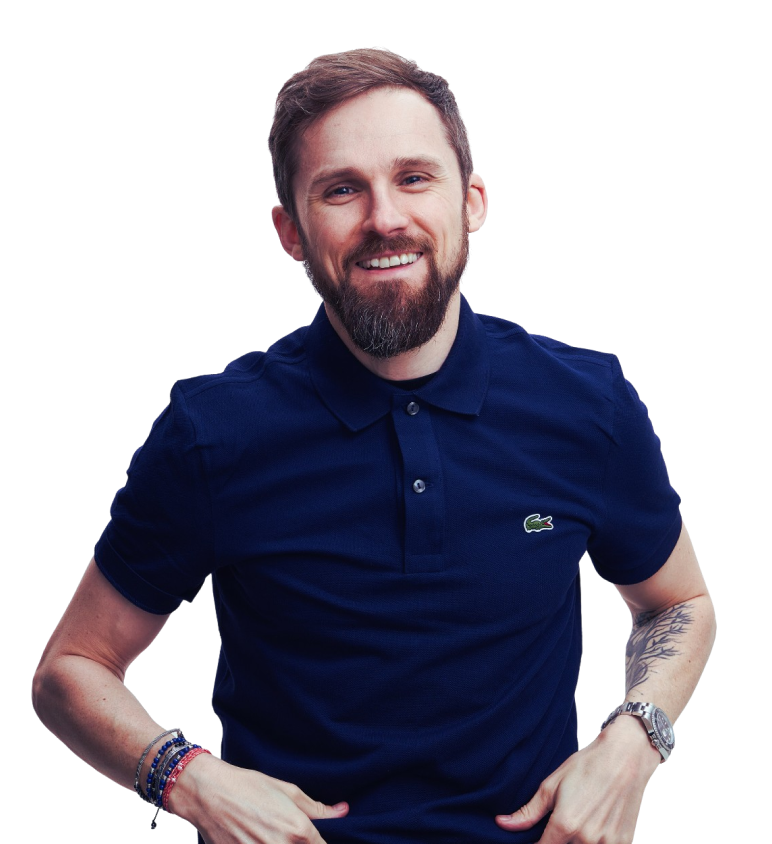
There is a particular kind of person who looks at a blank sheet of paper and sees a system. Kieran Flanagan is that person - except the blank sheet turned out to be all of HubSpot's international marketing, and the system he built ran for a decade and touched 190 countries.
He started as a software engineer, which tells you something important: when Flanagan talks about growth, he means it in the same way a programmer thinks about optimization. Measurable inputs, predictable outputs, no wasted cycles. He carried that logic into marketing at Salesforce and Marketo, honed it at HubSpot across nearly ten years, and now deploys it as CMO of Zapier - one of the most-used automation platforms in the world.
But Flanagan is not a spreadsheet in a polo shirt. He is also the person who, after a candid 360-degree feedback review called him "robot-like and metrics-focused," actually changed. He talks about that moment openly. It reshaped how he builds teams, how he has difficult conversations, how he thinks about leadership as something that includes people rather than just produces results from them.
The arc from Salesforce to Marketo to HubSpot to Zapier looks clean in retrospect. It was not clean in the living. At HubSpot, Flanagan was the first marketer hired outside Cambridge, Massachusetts - which meant he was, in practice, a team of one building an international operation in Dublin from zero. The Dublin office went from 12 people when he arrived to over 1,000 by the time he left. That is not a career footnote; that is an institution.
He quadrupled HubSpot's marketing demand generation during his tenure. He built the media team. He oversaw the acquisition of The Hustle, the irreverent media publication that gave HubSpot a voice in the inbox of hundreds of thousands of readers who had never typed "CRM software" into a search bar. That acquisition was a signal: Flanagan understood before most that owned media was becoming as important as paid media.
In 2023 he moved to Zapier as CMO - a company whose product is, in many ways, the physical manifestation of his philosophy: remove friction, automate the repeatable, and let humans do the work that actually matters. It is hard to imagine a better fit.
Flanagan's most interesting bet right now is not a company - it is a thesis. He believes B2B marketing is about to have its "creator moment," the same transformation that reshaped consumer culture when individuals with cameras and an internet connection started outperforming traditional media. In B2B, the equivalent is marketers building direct audiences, publishing with a point of view, and treating content as a relationship rather than a funnel step.
He puts his name on this thesis literally. His Substack newsletter, The AI Marketing Generalist, has grown past 12,000 subscribers. He co-hosts Marketing Against the Grain with HubSpot CMO Kipp Bodnar - a detail that deserves a moment's attention: this is a man running marketing at Zapier who has a weekly podcast with the CMO of a company he used to work for. That is not a conflict of interest; it is a collaboration across company lines that most corporate legal teams would quietly advise against, and which both parties do anyway because the audience finds it valuable.
The podcast has grown to over 70,000 monthly downloads. Episodes go out every Tuesday. The topics range from AI's real impact on marketing teams to contrarian takes on conventional wisdom - hence the name. "Against the grain" is the operating philosophy, not just a title.
On AI: Flanagan is neither a prophet nor a skeptic. He is an operator. His newsletter is specifically for marketers who want to use AI for actual growth - not theoretical discussions about what AI might eventually do, but practical playbooks for what it can do this Thursday morning. Paid subscribers get monthly deep-dive AI playbooks. The content drops, like clockwork, Thursday or Friday mornings. This is not content marketing performed by a marketing department. It is one person who believes something, writing about it for an audience that wants to act on it.
As a Sequoia Scout and angel investor in eight-plus companies, Flanagan brings the same framework. He backs B2B tools and platforms where he can genuinely see the growth mechanics - where his decade of experience gives him an edge in evaluating whether a go-to-market motion will actually work at scale. He also advises companies including Sowork and Postal.io, often in the same areas where he has built teams himself.
What makes Flanagan interesting, beyond the career trajectory, is a certain honesty about what marketing has been and what it is becoming. He is not protective of old methods. He does not argue for the brief, the campaign, the traditional funnel. He says the brief is dead. He says prototyping is the new planning. He says AI will separate the marketers who understand systems from the ones who just write copy. These are opinions with sharp edges, and he holds them in public, with his name on them.
The robot-like engineer from the early 360 review is still in there, running the systems, measuring the outputs, optimizing the loops. But somewhere along the way he picked up a microphone, started a newsletter, and decided that broadcasting his own thinking was the most efficient distribution method available. He was, of course, right.