Kristen Rachels has worked in enterprise software long enough to know that every revolution eventually asks for a slide deck. Cloud had one. Mobile had several. Network automation arrived with a thicket of diagrams. Now agentic AI has entered the conference room, speaking confidently, moving quickly, and asking for permission to touch production infrastructure. Rachels, the Chief Marketing Officer of Atlanta-based Itential, has the wonderfully awkward job of making that proposition sound both consequential and sane.
Her answer begins with a boundary. AI can reason. Production systems still need control. Between those two facts sits a company story about permissions, audit trails, deterministic execution, and the kind of trust that survives contact with an actual enterprise. It is technical material. It is also a marketing problem in the richest sense: a new capability has arrived before most people have agreed on the language for it.
Rachels has made a career in that interval - after the technology changes and before the market catches up. She led marketing at StarMobile, moved through its 2016 acquisition by PowWow Mobile, and joined Itential in 2018 as vice president of marketing. Today her remit as CMO reaches beyond brand and campaigns into demand, communications and analyst relations, outbound sales, and revenue enablement. She is also an Operating CMO Advisor to Elsewhere Partners and an advisory board member of the US Networking User Association.
A number beats an acronym
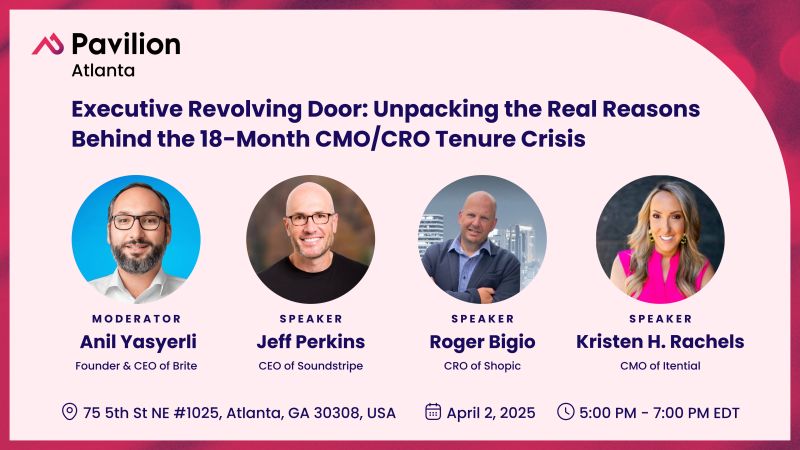
At a Pavilion Atlanta panel in April 2025, Rachels distilled her view of executive marketing into three imperatives. Evolve with the business. Own a number. Stop translating your function and start partnering with the people who run the company. Her point was not that brand or demand had become irrelevant. It was that the familiar playbook had stopped evolving while the business kept moving.
Own a Number (not an MQL target).Kristen H. Rachels
That distinction is small enough for a sticky note and large enough to reorganize a department. A marketing-qualified lead is a metric the marketing team can admire in private. Pipeline, sales velocity, retention, and efficiency are shared consequences. They force a CMO into useful arguments about pricing, product, sales execution, and capital. They also make it harder to hide a broken strategy under an attractive campaign.
Her range at Itential reflects that philosophy. The job is not simply to make the company visible. It is to construct a go-to-market system around a difficult product, then keep rebuilding the system as both the product and the buyer change. Colleagues writing publicly about her describe someone who studies analysts, understands the technical conversation, builds leaders, and turns a lean team into a broader operating force. One recommendation calls her an “analyst whisperer.” The phrase is funny because the underlying skill is serious: she knows that attention follows comprehension.
The accountability ladder
Learning the difficult product
The through line begins before the executive roles. Rachels graduated from Darlington School in 2005, then earned a communications degree from the University of Georgia. An old art teacher remembered a student who looked at other artists for inspiration but insisted on making the result her own. “You could always see the wheels turning,” the teacher said. Long before Rachels had to explain multi-domain orchestration, she was already practicing the useful art of influence without imitation.
Enterprise mobility became her first sustained technical category. At StarMobile and PowWow Mobile, the promise was to transform established business applications into usable mobile experiences. She worked in that market for nearly a decade, through a corporate acquisition and a shift in buyers' expectations. In 2017 she joined the advisory board of Enterprise Mobility Exchange, bringing a marketer's view to conversations about the future of work.
Then came networks. When Itential hired her in July 2018, the company described software becoming a driver of innovation across every industry. Its product connected network automation across complex, multi-vendor environments. This was not a purchase anyone made because the logo looked friendly. The story had to carry technical weight while clarifying an economic point: manual operations could not keep pace with software-defined infrastructure.
A career across category shifts
Rachels learned enough of the product to make the market argument herself. Her articles range from NetDevOps and infrastructure as code to hybrid cloud networking, automation platforms, and the difference between automation and orchestration. The vocabulary is not decoration. It gives her permission to reduce complexity without flattening it.
When the assistants begin to act
The latest category shift raises the stakes. An assistant suggests. An agent can take action. In infrastructure, that action may change a configuration, enforce a policy, or move across a network of systems with consequences measured in outages rather than typos. Rachels's writing returns repeatedly to the same human question: can we trust it?
Itential's answer pairs probabilistic reasoning with deterministic execution. The agent can interpret an ambiguous situation, but its available tools and boundaries are defined in advance. Approvals, roles, auditing, and governance remain part of the operating path. It is less cinematic than a free-roaming digital employee, which is precisely the appeal. Enterprises do not need their infrastructure to improvise jazz at two in the morning.
Separate the place where judgment happens from the place where change is executed. The first can be flexible. The second should be governed, observable, and reversible.
FlowAI, unveiled in private preview in November 2025 and made generally available in July 2026, gave that story a product. In August, Itential announced that Gartner had included it among five Coolest Vendor Innovations in agentic AI for enterprise networking. Rachels framed the recognition as the result of a decade spent building deterministic orchestration before adding agentic reasoning. The order matters. Trust is not a paragraph pasted onto an AI launch. It is accumulated architecture.
She is applying a similar idea to marketing itself. Her public bio describes a focus on building and scaling agents inside her craft. Recent remarks call for AI-enabled generalists and a go-to-market model in which AI is operational infrastructure, not a novelty tab left open beside the real work. Here, too, she emphasizes clarity. If an agent can increase output but the team cannot say which business result it owns, speed merely delivers confusion before lunch.
AI doesn't make leadership easier - it makes clarity unavoidable.Kristen H. Rachels
The human system underneath
Rachels's language can be blunt, but her record suggests that rigor and warmth are not competing management styles. In 2020, she described an international marketing team that was already distributed before remote work became universal. The transition made the group more efficient, she said, and also more connected as people and friends. The systems were ready. The surprise was social.
Her connection to Darlington offers another view. She has served on its Alumni Council, participated in Career Day and Leadership Darlington, and volunteered as a Fairy DarMother to female boarding students. In May 2023, she began serving as president of the Alumni Council. She credits the school with teaching her to challenge the status quo, remain curious, push boundaries, and keep seeking. Those are elegant values for an alumna. They are also a serviceable operating manual for anyone whose market changes every few years.
The word that keeps earning its place is curiosity. Colleagues describe a leader hungry to learn what is changing before she chooses a strategy. Her own path supports the claim. She moved from communications and creative work into technical categories that punish superficial understanding. She did not become an engineer. She became fluent enough to ask better questions, find the consequential distinction, and build a story around it.
That may be her most transferable lesson. Marketing at its best is not the cheerful wrapping applied after the product is finished. It is the discipline of noticing how technology changes work, how buyers describe risk, and where a company can make a precise promise. The CMO's influence grows when that work connects to the number the business owns together.
Rachels now stands at an interesting junction. The product she markets gives agents the guardrails to operate on infrastructure. The function she leads is learning how agents should operate inside marketing. Both projects require judgment about what should remain flexible and what must become explicit. Both reward a leader who can move between a technical diagram, a financial conversation, and a sentence that people remember.
The AI era will produce a great many new tools and a regrettable number of new acronyms. Rachels's rule is handier. Own the number. Learn the product. Give intelligent systems boundaries. Keep the human appetite for curiosity. A playbook can age overnight. Those habits travel.