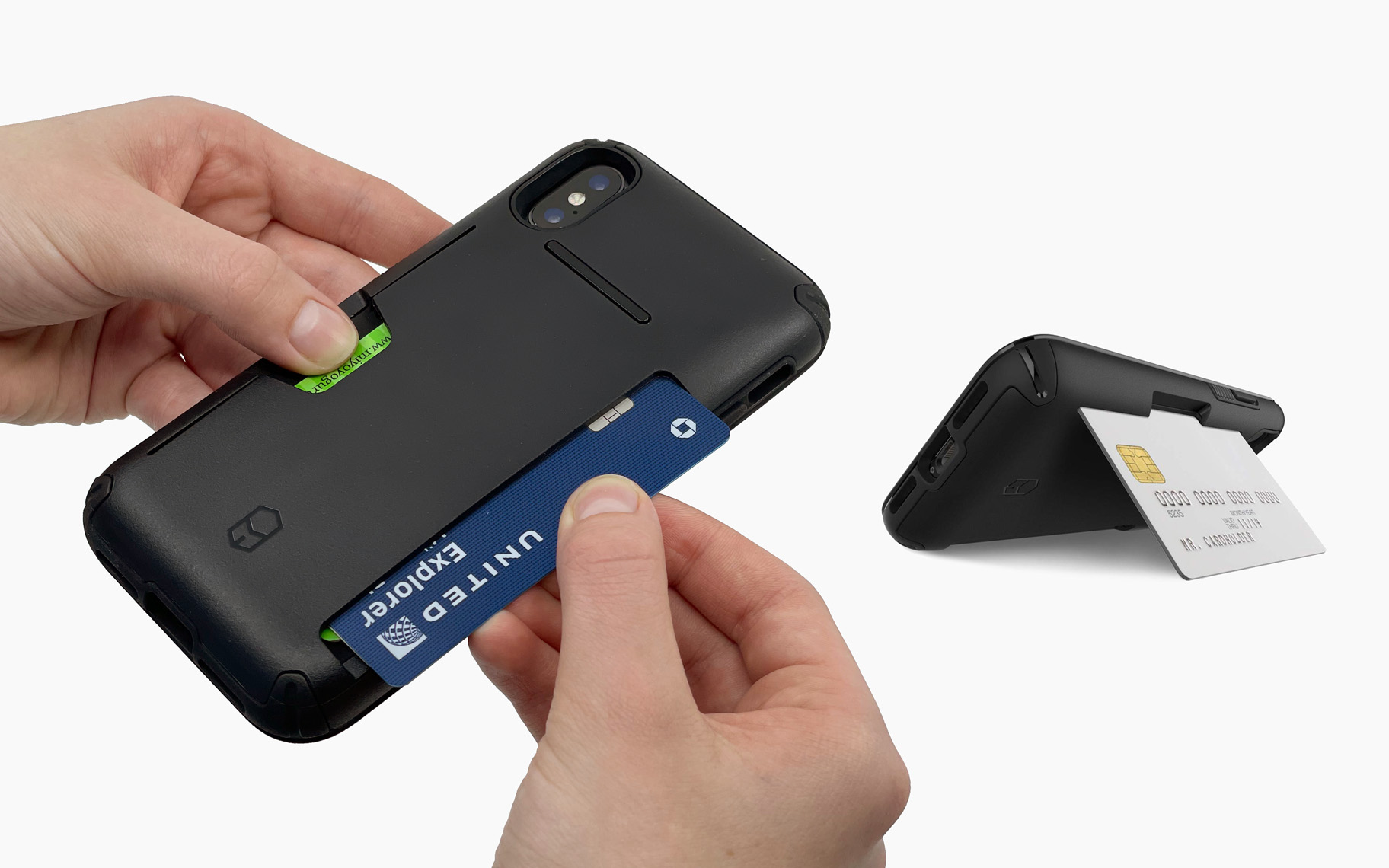
A wallet case has a small but irritating job: keep a credit card from escaping when it is alone, then make room when two friends join it. Add a latch, a spring or another sliding component and the solution starts collecting complications. For Patchworks, KEYDESIGN took a different route. It put the movement into the material itself.
The 2018 design pairs a rigid polycarbonate outer shell with a flexible thermoplastic polyurethane inner wrap. Bumps in the softer material flatten as cards slide in, then recover when the cards come out. One card, two cards, three cards: the same flexible geometry adjusts its grip. Two parts do the work. It is a modest object with a useful argument inside it: before adding a mechanism, examine what the existing material can do.
That argument runs through the portfolio of KEYDESIGN, the industrial design consultancy founded in 2001 by George and Antonija Campbell. Its work ranges from phone accessories and retail displays to luggage, solar lights and wearable thermometers. The family resemblance is less a signature shape than an interest in making an object easier to handle, assemble, understand or live with.
The studio sells design services to businesses developing physical products. Its customers include startups trying to establish a first product and established brands extending a range. Behind the finished objects sits an unusually readable record of tradeoffs: when to use existing components, when to commission custom hardware, and when a better product can begin with one fewer thing.
“Our mission is to design products that enrich users’ lives and help our clients succeed.”KEYDESIGN
A checkout counter, in three acts
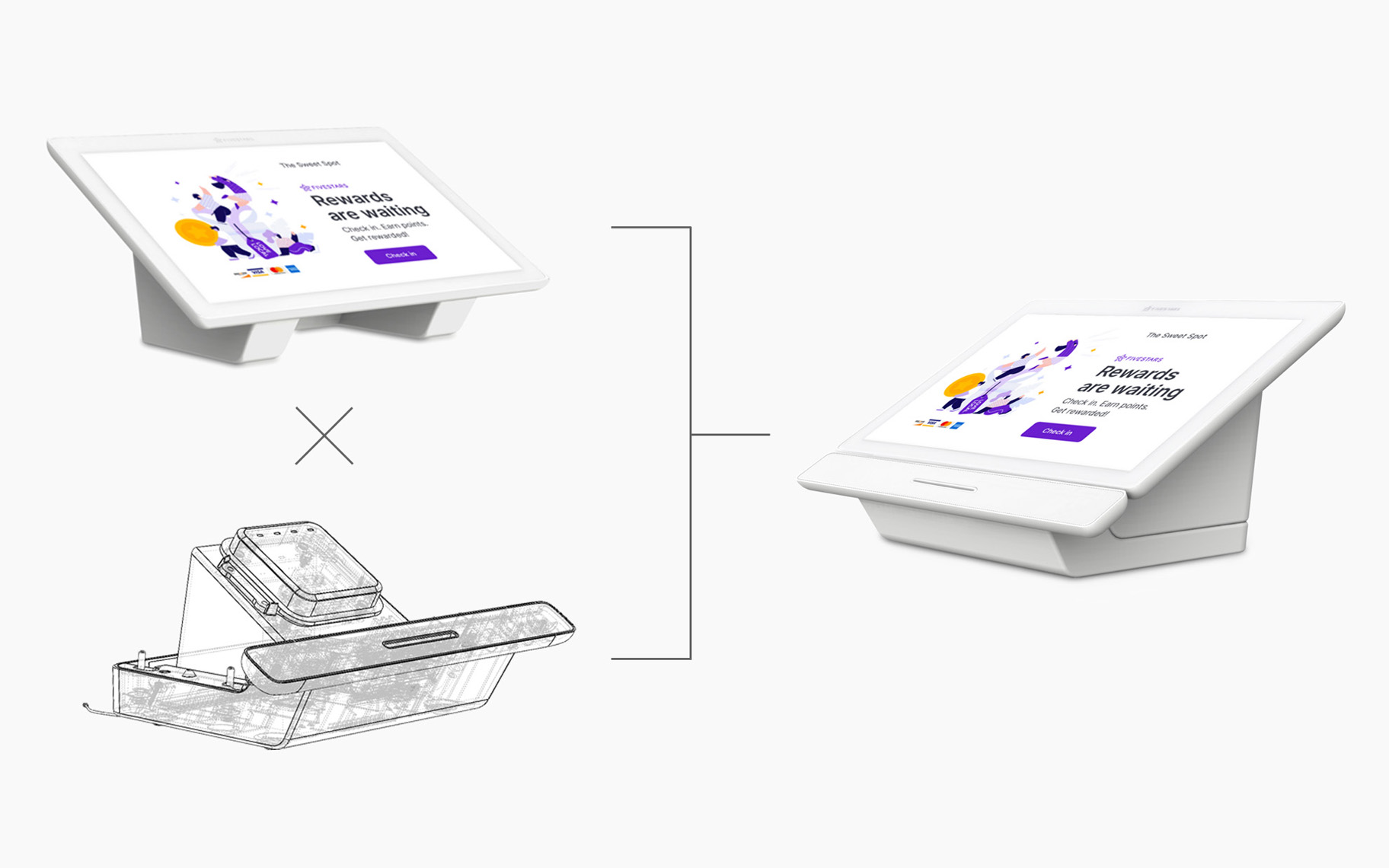
The Fivestars relationship makes those decisions visible over time. The loyalty and payments company needed hardware that customers could approach at a shop counter without a lesson. KEYDESIGN’s first-generation case study, dated 2018, describes a low-cost tablet enclosure designed to test the market. Easy customer input mattered; so did access for maintenance. The enclosure came apart into two pieces.
Then the brief changed. According to KEYDESIGN’s account, merchants wanted payments alongside loyalty rewards. The 2019 generation incorporated off-the-shelf parts to meet the expanded requirements while retaining the recognizable Fivestars appearance. This was a business adding a capability, with industrial design responsible for making the extra complexity usable at the counter.
By the third generation, dated 2020, the company wanted fully custom hardware and a stronger visual identity. KEYDESIGN designed a modular arrangement: the loyalty device could operate on its own, while merchants wanting payments could add a payment base. The studio reports that the shared architecture reduced production and distribution costs. The important decision was to accommodate two kinds of customer without treating them as two unrelated products.
Fivestars subsequently became a substantial acquisition. SumUp completed its purchase in October 2021 for $317 million in cash and stock, announcing access to a network of more than 12,000 small businesses. That transaction supplies context for the client’s development, rather than a price tag for KEYDESIGN’s contribution. The design story is the progression from an affordable enclosure to more specialized hardware as the business requirements expanded.
The charger that disappeared
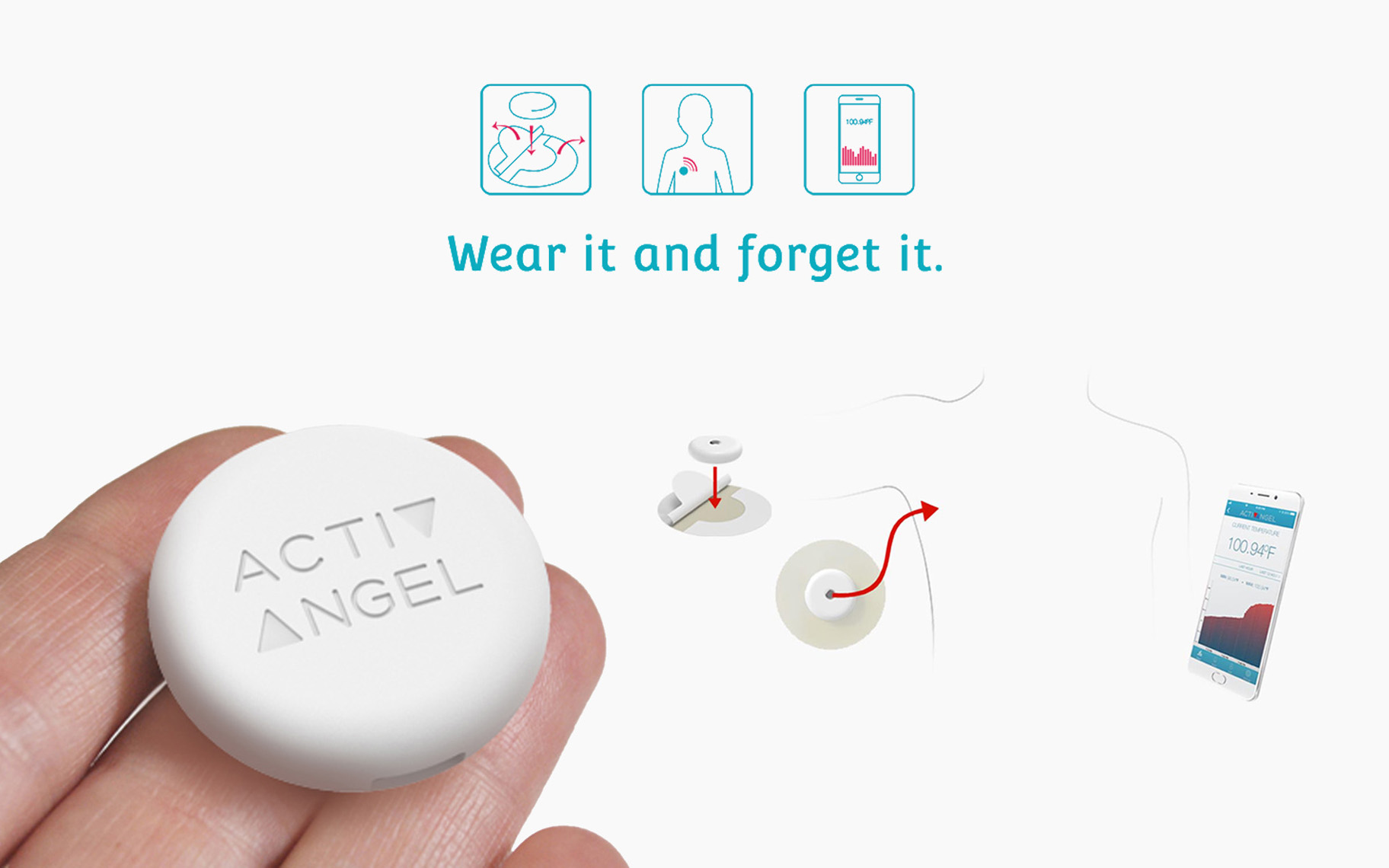
A second sequence begins with Stemp, a wireless temperature-monitoring startup. Its founders arrived with a working circuit-board prototype and needed a housing, a peel-and-place adhesive attachment and graphics for an Indiegogo campaign. KEYDESIGN’s 2017 case study describes work on both the physical product and the way it was explained to prospective backers.
The next brief came after initial customer feedback and the sourcing of a better thermal sensor. For the 2018 ActivAngel thermometer, the founder wanted something easier to use and less expensive to manufacture. KEYDESIGN describes a pebble-like body intended for prolonged wear, with comfort and hygiene guiding the design. A small charging port eliminated the separate charging sled, removing an accessory from the system.
Here, the documented turning point is concrete: customer feedback and a component change opened the door to a redesign. The cost story is also specific in mechanism. Removing a charging accessory changes what must be made and supplied. KEYDESIGN’s case study reports savings, while the useful lesson for another product team is to inspect the whole collection of objects a customer needs, including the pieces that sit beside the main device.
The same instinct appears in Zuslab’s Armor Shield phone case. Its 2017 redesign replaced a more complicated construction with two parts and used surface textures to express the rugged styling. KEYDESIGN reports lower material costs and reduced manufacturing time. In these examples, appearance and production economics are decisions made together: the texture, the material and the assembly belong to the same brief.
Clay first. Bright red later.
Some of the best details are wonderfully low-tech. For a gaming case around the Apple TV Siri Remote, KEYDESIGN began with clay to explore a comfortable grip. It then refined that shape into a cleaner geometric form suited to the device. The case study identifies Jame Technology as the client and describes a request from Best Buy for a protective silicone gaming case.
Research supplied another problem: people struggled to find the small remote. The response was bright red. The color suited the intended gaming audience and made the object easier to spot. A hand and a missing remote had each supplied part of the design brief. Neither problem required another button.
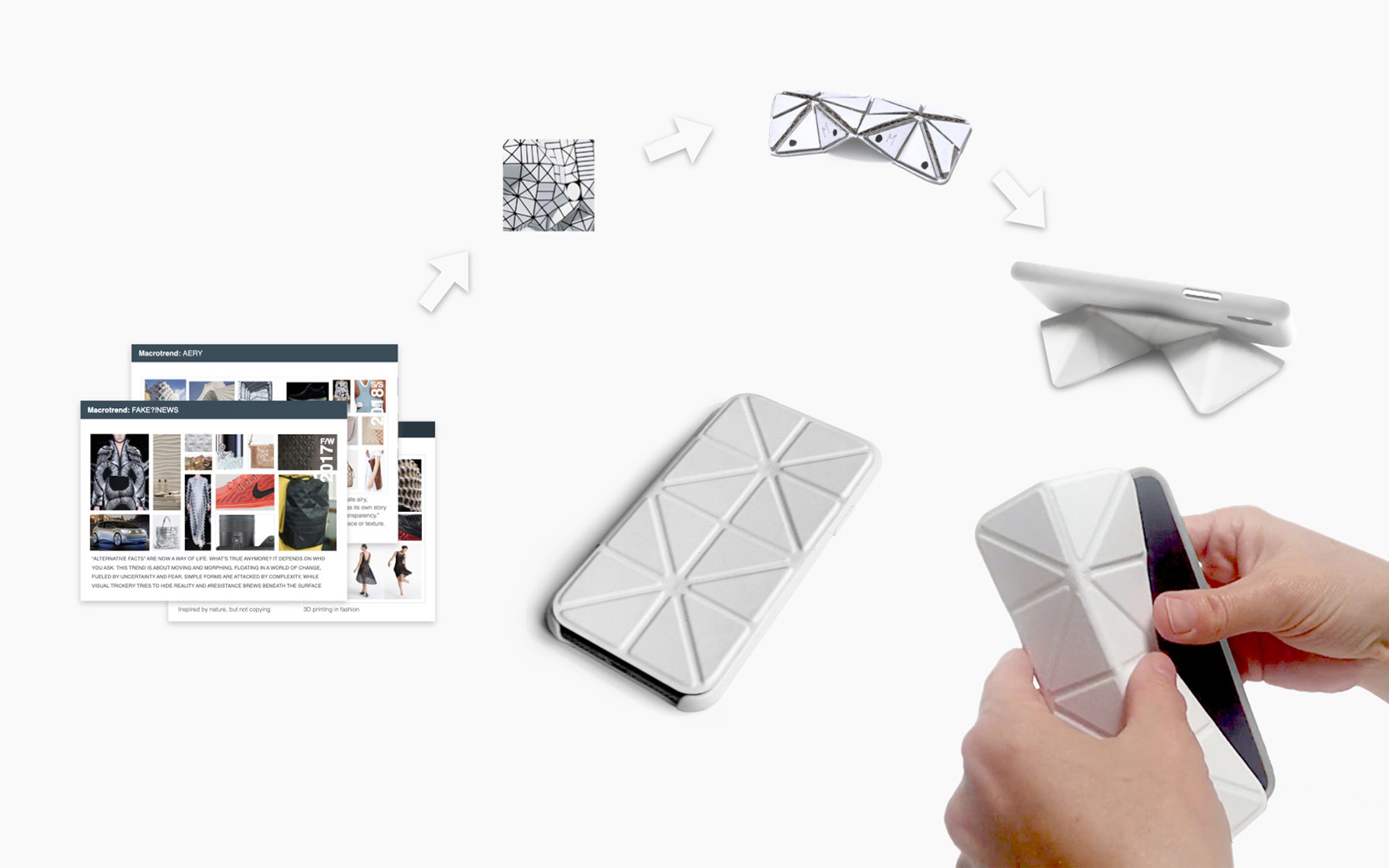
The 2018 transforming iPhone folio for Jame Technology takes its cue from fashion. Inspired by the mobile, geometric surfaces of Issey Miyake’s Bao Bao bags, its cover folds into a stand using built-in magnets. The stand appears when the user needs it and folds away afterward. This is the more theatrical side of the portfolio, but the intended benefit remains practical: combine a cover and support without the bulk of a separate stand assembly.
Osmo’s carrying cases reveal a different kind of observation. The 2020 brief was to keep an iPad and game pieces together, accessible and less likely to vanish around a playroom. KEYDESIGN describes an internal arrangement that lets younger children dump pieces in and older children sort them. Order becomes a choice matched to the user, rather than a storage system that demands the same tidiness from everyone.
Two designers, many kinds of ordinary
George and Antonija Campbell are a husband-and-wife team, both industrial designers. Their account of the studio’s journey runs through Boston, Nashville, Palo Alto and London. The company’s stated mission is to “design products that enrich users’ lives and help our clients succeed.” That pairing of customer experience and client economics is also the subject of its writing about design.
The range is broad enough to resist a single consumer-electronics label. For Optari in 2005, KEYDESIGN designed an EVA tote with holes for decorative charms, translating a brief inspired by Crocs into a customizable fashion accessory. Follow-on backpack and handbag work extended the idea. For Golden Trees, a 2016 solar lamp used a flexible neck that could stand on a surface or attach to objects.
Other briefs concern what surrounds a product. Tilt Five commissioned a keepsake box for its augmented-reality glasses after its Kickstarter campaign; KEYDESIGN’s 2022 packaging work used graphics, color and gold foil to frame the unboxing experience. Livecopper’s smart desk accessories required a visual identity connecting an Apple-oriented audience with hacker and gamer tastes. These are different assignments, united by the need to make a physical product legible to its intended buyer.
The studio also separates client work from concepts. Its ideas include an hourglass teacup and a chocolate-decorating pen inspired by 3D printing pens. Those explorations show curiosity about small rituals, without needing to be mistaken for a catalog of products available to purchase. A five-minute tea ceremony sits comfortably beside an inquiry into where melted chocolate makes a mess.


Bring the designer in before the board is fixed
KEYDESIGN’s market position is an external industrial design practice working between a client’s product ambition and engineering implementation. Its services include research, concept development, prototypes, detailed CAD, renderings and specification documents. Mechanical engineering, packaging and manufacturing expertise can also come through its partner network. For a buyer comparing options, the relevant alternatives are an internal industrial designer or another consultancy able to work with the engineering team.
The deliverables explain the business model more clearly than a slogan. A client commissions development work; the studio helps define and document a product for further engineering and manufacture. Its stated process includes testing prototypes, producing a technical specification pack and supporting the intended design through production. The engagement therefore reaches beyond a presentation image into decisions another team must implement.
One blog post makes a pointed recommendation about timing. A startup that finalizes its circuit board before considering the user’s hand or body can leave the industrial designer fitting a housing around constraints already fixed. KEYDESIGN proposes testing functionality with flexible development platforms, defining the product’s form and user experience, then designing the custom board to fit.
The advice has conditions. The same post acknowledges that limited space, demanding power or signal requirements, and early compliance needs can require custom electronics sooner. In that situation, close collaboration between engineering and design matters from the beginning. A workflow is useful only if it accommodates the technical demands of the actual product.
For a founder preparing a brief, the portfolio suggests useful questions. Which component exists only because an earlier design required it? Can a shared base serve different buyers? Will someone understand the object on first contact? What changes when a child, a hurried shopper or a person wearing a sensor handles it? KEYDESIGN’s most persuasive answers are small physical decisions: a flexible bump, a removable base, a red case. They give the next team something tangible to examine.
Explore the work
KEYDESIGN portfolio ↗Design services ↗Studio essays ↗LinkedIn ↗Instagram ↗Fivestars acquisition news ↗