NB Patil came to Bose with an exit plan. Arrive in Massachusetts, see how things went, then perhaps move to Detroit, where friends with similar experience had landed. Returning to India was another possibility. A few months would be enough to decide. He arrived in the United States on June 15, 2000. Almost 22 years later, he was still at Bose.
That small miscalculation gave him much of his working life. It also supplied the people, experience, and unfinished business behind his next one. Today, as co-founder and CEO of Ozlo Sleep, Patil is building an independent consumer-electronics company around a product concept his former employer stopped pursuing.
There is an easy version of this story in which the engineer leaves a large company and finally gets to do things his way. His own farewell makes that version awkward. He liked the place. He thanked the people. He credited Bose with preparing him for the challenge ahead. Entrepreneurship, in this telling, arrived carrying a considerable debt of gratitude.
The few months that became 22 years
Patil joined Bose as a firmware engineer. His work eventually took him into leadership of engineering and business development for new consumer-electronics concepts. The distance between those roles matters. Firmware lives close to the machinery; new-business work asks whether the machinery deserves a business around it. His career came to encompass both questions.
When he announced his departure in March 2022, he remembered finding a sense of belonging at Bose Automotive in Framingham. The plan to move on had quietly lost its appeal. He wrote about support, encouragement, mentors, and the feeling of being part of a larger family.
“Bose has a special place in my heart and will be there forever”
NB Patil · March 2022
He also called starting something of his own a lifelong dream. That puts a different emphasis on the departure. Twenty-two years had given him reasons to stay and the preparation to leave. The decision required holding both thoughts at once. A comfortable job is particularly persuasive when you have spent two decades learning where everything is.
A prototype needs allies
By 2019, Patil was heading Bose’s Corporate Concept Group. He described an organization designed to move ideas between disciplines and toward working prototypes. Software people could find hardware people. Teams could bring in the skills an idea required rather than wait inside their own departments.
His explanation was practical: show concepts to users early, learn from their responses, and adapt. Evidence could make a proposal easier for another team to take forward. People carrying an idea from its first experiments toward a product helped preserve the reasoning behind it.
Anyone who has inherited a project knows the alternative. The files arrive. The decisions do not. Soon someone is rebuilding a thing because nobody trusts why it was built that way in the first place. Patil was working on the organizational version of a familiar engineering problem: keeping the connection intact.
This history makes his move into a startup easier to understand. He had already spent years thinking about how unfamiliar ideas earn support inside an established business. Owning the business would change the setting and the stakes. It would still require people to understand why a particular idea was worth carrying forward.
What survived the handover
Ozlo began in 2022 with Patil and fellow Bose veterans Brian Mulcahey and Charles Taylor. They acquired assets and licensed technology associated with Sleepbuds. The distinction is useful: experience and intellectual property gave them a starting point, while Ozlo would have to make its own case to customers.
Patil was also a user of the earlier product. He described loving it and seeing gaps that another version could address. That combination gave the project its tension. Familiarity supplied conviction; dissatisfaction supplied a reason to change things.
At the 2023 introduction, he explained changes including a different battery and the ability to stream audio from a phone. The earlier Bose product had been limited to a selection of sounds. An audiobook, podcast, or another audio source could now become part of the experience. These were specific choices about how an object would fit into someone’s evening.
The form remained recognizable. That was deliberate. Starting again did not require declaring every earlier decision a mistake. For an engineer, restraint can be as consequential as invention. A familiar shape may represent years of useful work, even when the electronics inside it need another pass.
Before making those choices, the founders examined feedback on Amazon, Best Buy, and other channels. Patil described looking for what customers valued and what they wanted changed. The reviews became part of the brief. Occasionally, the instructions for your next product are already online, expressed with fewer pleasantries than an internal presentation.
Even naming the company became an exercise in limits. Patil said the team went through more than 500 candidates before settling on Ozlo, adapted from Oslo with a Z. He wanted something easy to pronounce and easy to print on hardware. There was no direct connection to the Norwegian capital. A short name had to fit both a tiny object and a business that might eventually make other things.
That detail is a useful glimpse of the founder beyond the circuit board. A logo has to survive contact with the product, just as a technical feature has to survive contact with the customer. The four letters were another design decision, with practical constraints of their own.
The unglamorous test
Bringing a product back gives a founder a satisfying origin story. Shipping it introduces a less accommodating editor. Connections drop. Updates take time. A feature discussed before launch can still be missing when a customer opens the app.
A December 2024 review praised the comfort of Ozlo’s earbuds but found the promised monitoring feature still marked as coming soon. The review also described waiting for a connection. These observations put a useful boundary around the excitement: a product could deliver something customers appreciated while still leaving work unfinished.
For Patil, that unfinished work was now attached to his own company. An inherited audience arrives with expectations as well as affection. Its members remember what worked before. They also remember the frustrations they hoped the new team would remove.
In May 2025, Ozlo published a firmware update with a note signed “NB.” It acknowledged problems with Bluetooth reliability and outlined improvements to connections, reconnection, alarms, and the update process. The language was unusually revealing for a founder profile because it concerned the ordinary work between announcements.
There is no glamorous photograph of a more reliable reconnection. The benefit appears when someone stops having to think about it. For a company selling a small object used repeatedly at home, that is a serious kind of progress. The launch earns attention once. Dependability has to earn its place again each time.
An award you can hold
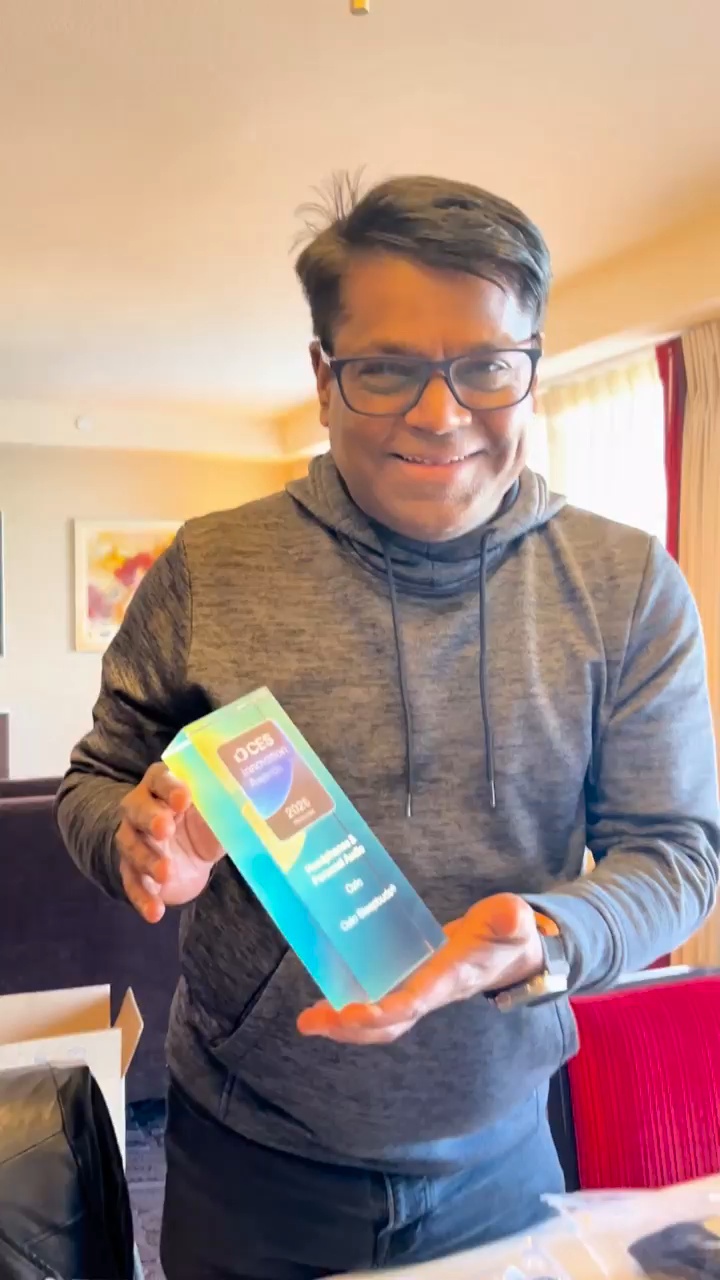
One of Ozlo’s more personal public moments is a short video shared after CES in January 2025. Patil holds the company’s Innovation Award, looking down at the object and then toward the camera. It is a modest scene, with the award still close to its packaging.
Sleepbuds had been named an honoree in the Headphones & Personal Audio category. Here was a piece of hardware celebrating another piece of hardware. At least this one would never need a firmware update.
Later that year, TIME included Ozlo Sleepbuds in its Best Inventions list, in Wearables. Patil’s public response returned to the founding team and the product’s earlier life at Bose. He named Mulcahey and Taylor and described acquiring and licensing the technology. The recognition belonged to an ongoing project with several authors.
That habit of including other people also appears in his discussion of partnerships. When Ozlo introduced a limited-edition collaboration with Calm, Patil thanked colleagues on both sides. He singled out a detail on the case: Calm’s phrase, “Take a Deep Breath.” An engineer who had spent years building internal systems was also paying attention to the words printed on the outside.
The next version has other authors
By July 28, 2026, Ozlo had introduced Sleepbuds 2. The announcement identified Patil as co-founder and CEO and emphasized longer battery life, connectivity changes, and easier controls. These are the sorts of improvements that make a product announcement sound, usefully, like a response to its owners.
“Sleepbuds 2 is the product our customers helped us build”
NB Patil · July 2026
Read alongside his earlier work, the sentence has a familiar rhythm. Put an idea in front of people. Learn where it falls short. Keep the useful parts. Try again. At Bose, that process helped a concept find its way through a large organization. At Ozlo, it helps determine whether a small company deserves another purchase.
Patil has advised founders to consider the brand and future generations of products before launching the first one. It is sensible advice from someone whose own story crossed a corporate boundary without losing its connection to earlier work. A company needs room for what comes after its opening argument.
His first plan for Bose lasted a few months on paper and almost 22 years in practice. Ozlo began with another decision about what deserved more time. This time, he and his colleagues would be responsible for making sure the next chapter was worth the wait.
Follow the work
Conversations, updates, and the people behind the product.