Before music, there is administration. The cable that has wandered under the sofa. The metronome app that needs an update. The guitar string whose opinion of concert pitch has changed overnight. For a musician eager to play, tuning is a small customs desk between intention and sound. Hassane Slaibi helped build a company around making that desk quicker.
The premise behind Roadie Music is almost comic in its specificity: place a handheld device on a tuning peg, pluck the string, and let a motor finish the argument. Yet the smallness of the task is precisely what gives it force. A product does not need to occupy the whole ritual. It can earn its place by removing the fussy minute before the ritual begins.
Slaibi came to that problem with an unusual set of instruments. He is a computer and communications engineer, a flute player and, by his own account, someone with absolute pitch. He could tune an instrument easily. His former bandmate Bassam Jalgha, an oud player and mechanical engineer, knew the opposite experience. As a student, Jalgha had struggled to keep his twelve-stringed instrument in tune between visits from his teacher. Where one heard notes almost instinctively, the other felt the practical drag of finding them.
“I happen to be blessed with absolute pitch, it’s easy for me to tune any instrument, and I’d love to make this accessible to all musicians.”Hassane Slaibi
Two ears, one useful disagreement
The pair met through the music club at the American University of Beirut. Slaibi graduated in 2009 with a degree in computer and communications engineering. Jalgha had already carried his automatic-tuning idea onto the television program Stars of Science, where he won first prize in 2009 and developed a prototype. In 2011 he returned to his old bandmate with a disarmingly plain invitation: “Dude, I need your help, let’s work together on this tuning problem.”
That phrasing deserves to be framed above a workbench. It contains no market category, no majestic vision and no attempt to make the peg sound like destiny. There is a problem. Let’s work on it. Slaibi brought software and audio processing; Jalgha brought mechanics, mechatronics and the original ache. In 2012, they founded Band Industries.
Slaibi was already at home among makers. At Lamba Labs, Beirut’s first hackerspace, he was a founding member and served as “Tool Master,” parenthetically translated on his public profile as “ToyMaster.” His job was to care for the space and its tools, keep things organized, and help everyone remain in what he called “creative mode.” It is difficult to imagine a better minor title for his later career: part custodian, part engineer, part permission slip to tinker.
The factory is an unforgiving co-author
In 2013, the founders entered HAX, the hardware accelerator that took them to Shenzhen. Software allows a young company to revise its mistakes while customers sleep. Hardware puts the mistake in a box, gives it a tracking number and sends it across an ocean. The founders had to secure a supply chain, prepare for manufacturing and convince strangers that the object would eventually exist.
Their first Kickstarter asked for $60,000. It closed in January 2014 with $178,613 from 2,002 backers. That number was capital, certainly, but it was also a queue of 2,002 expectations. Roadie shipped that year, and the device won the Audience Choice award at TechCrunch Disrupt New York. Recognition helped; repetition mattered more.
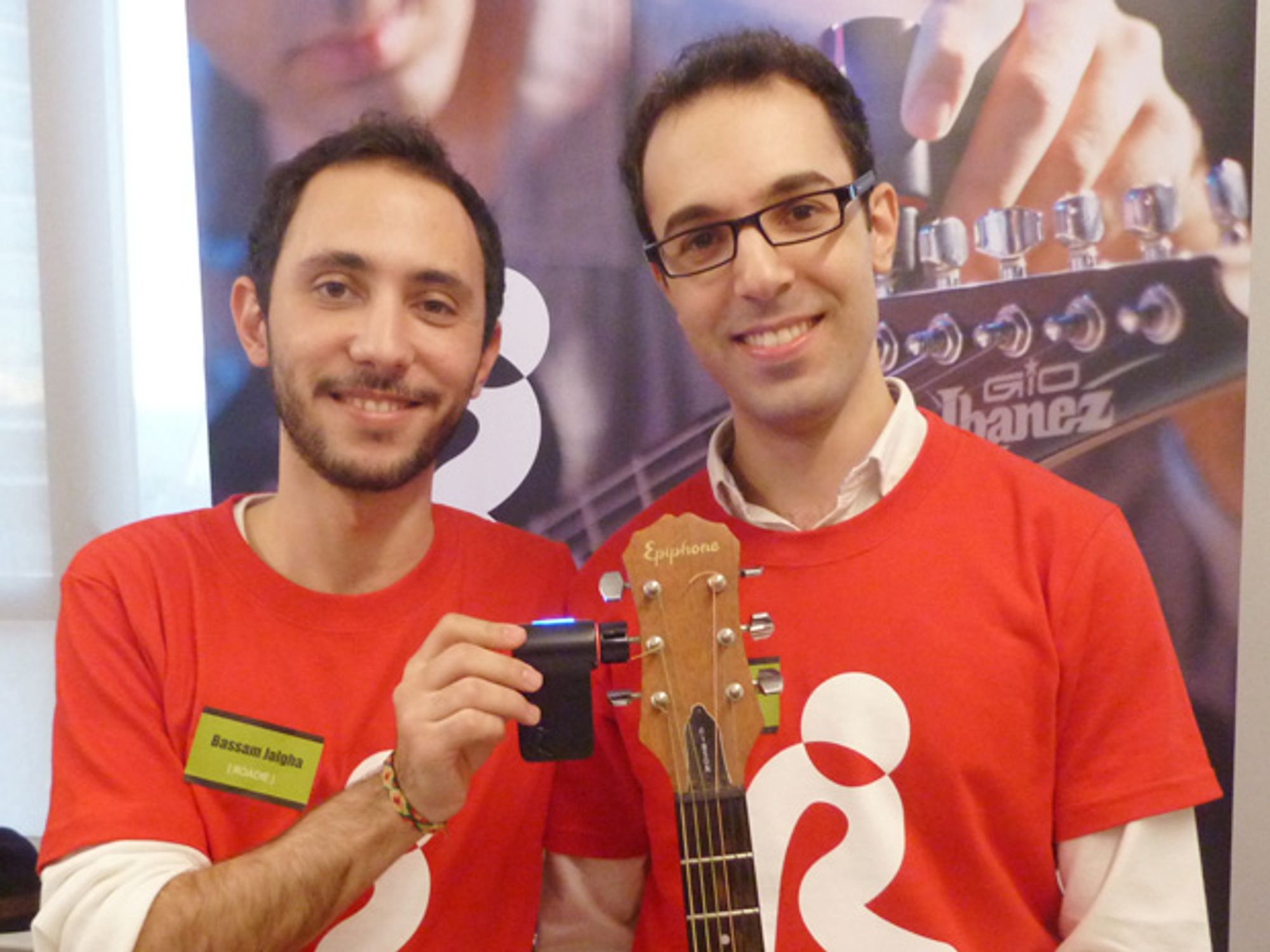
The early photographs capture the useful awkwardness of that stage. Two founders in matching red shirts stand beside a guitar, one hand holding a black prototype against the machine head. The object has to be demonstrated because its category is not yet familiar. A phone app can identify a pitch, but Roadie crosses the boundary from advice into action. It physically turns the peg. That final inch, where analysis becomes movement, explains both the product’s appeal and its manufacturing burden. The software must hear correctly; the enclosure must sit comfortably; the connector must meet an unruly population of pegs; the motor must be firm without becoming reckless. Even a tiny robot inherits the variety of the world it touches.
For the next two years, Slaibi and Jalgha bootstrapped. “We grew our sales, logistics, customer support, we dealt with everything ourselves,” Slaibi later recalled. The sentence is a compact antidote to founder mythology. Consumer hardware is a procession of ordinary verbs: source, test, pack, answer, replace, explain. A clever mechanism opens the door. Logistics decides whether the guest ever arrives.
The company also made a consequential choice about where to build its team. Slaibi argued that Lebanon offered access to strong talent rather than the “left over talent” a small company might compete for in Silicon Valley. Beirut was not presented as an easy base. Political and economic instability complicated global operations. It was, however, a place where engineering ability, a growing startup ecosystem and the founders’ own network could be assembled into an advantage.
Crowdfunding as a recurring appointment
Roadie did not treat crowdfunding as a graduation ceremony. It kept going back. Roadie 2 and Roadie Bass attracted 4,741 backers from 93 countries and more than $500,000 in pledges. Roadie 3 arrived in 2020, during global uncertainty, alongside a $2.8 million Series A for Band Industries. In 2025, Roadie 4 reached its Kickstarter target in under three minutes, passed $140,000 within a day and eventually closed at $317,579 from 2,317 backers.
Campaign totals show repeated demand, but each bar also represents a fresh manufacturing promise.
The pattern reveals how the company prefers to learn. A campaign converts attention into orders before the production line is complete. It also invites judgment before the work is finished. Backers notice whether the connector fits their instrument, whether the screen is legible and whether a promised month quietly becomes another. Crowdfunding did not eliminate Roadie’s risk. It made the risk conversational.
Each tuner shows the accumulated conversation. The fourth generation adds a larger color display, a scroll wheel, broader peg compatibility, automatic string detection and improved noise immunity through vibration sensing. It stores more than 150 tunings and allows custom ones through its connected app. These are modest-sounding improvements, which is often how mature product work looks. The breakthrough earns the first customer. A better grip and fewer mistaken readings earn the next one.
Leave the sensor on
The more interesting expansion began with a counterfactual. Roadie’s sensor listened to an instrument while tuning. What might it learn if it stayed attached while the musician played? Slaibi said six years of work on vibration detection produced a “deluge” of new data points once the team asked that question. The result was Roadie Coach, launched in 2022 as a recorder, practice companion and MIDI controller.
Coach uses a contact microphone to capture the instrument’s vibrations and an ambient microphone to record sound in the room. It can organize sessions and expose practice metrics. The underlying recording approach later appeared in a US patent granted in August 2025, naming Slaibi and Jalgha as inventors. Another active US patent covers automatic tuning methods and systems. The company’s path from peg-turning to practice data was therefore more than a change in packaging. It was an extension of the same signal-processing base.
What happens when the sensor stays? A contact microphone hears the instrument through vibration while an ambient microphone hears the room. Together, they separate the act of playing from the air around it.
“We want as many people as possible to enjoy more time playing music and get inspired by our tech.”Hassane Slaibi
A company measured in minutes returned
Slaibi’s public language returns insistently to access. He has said he wants to make the world more musical because music is universal and peaceful. He frames the devices as a way to give people more time playing. It is an aspiration carefully matched to the scale of the objects. Roadie cannot make someone practice, write a song or love an instrument. It can reduce the minor discouragements that arrive before those things.
His own arc now spans Beirut, Shenzhen, Seattle-area operations and Port Townsend, Washington. Along the way came an AUB Young Distinguished Alumnus award, selection as an Endeavor Entrepreneur, design and innovation honors, financing, patents and several shelves of products. The connective tissue is less glamorous than the itinerary: hear a recurring nuisance, translate it into a system, put the system in a hand, then listen when the hand complains.
Roadie 4 is now shipping. Its motor rotates at 110 revolutions per minute; its detection range begins at 27.5 hertz; its screen is larger than its predecessor’s. Those specifications are the visible residue of a long education. The deeper product remains the same minute returned to the player. Attach, pluck, turn. The note settles. Administration ends. At last, the room can have some music in it.