In April 2016, Alex Zimmerman’s company won a vote. BrainSpec took the crowd-favorite award in the student business track of Harvard Business School’s New Venture Competition, along with $2,000. The amount would fit comfortably into a corporate expense report. For a young venture, the more interesting currency was attention: a roomful of people had heard the proposition and chosen it.
Zimmerman was completing her MBA. She had already been an engineer, and she had co-founded BrainSpec with Alexander Lin. The competition put a small public marker beside that partnership. An idea that had developed through an institutional connection was now being judged by people who could walk away and think about something else.
That is a useful place to begin her story. Entrepreneurship supplies plenty of photographs of founders holding prizes. The photograph rarely explains what the founder knew before arriving, who helped prepare the argument, or what happened when the prize money met the next set of expenses. Zimmerman’s career becomes interesting in those surrounding details.
A vote of confidence, with a $2,000 cheque
Harvard’s 2016 competition had several winners. In the student business track, Astraeus Technologies received the grand prize, Getaway was runner-up, and BrainSpec won the audience award. Keeping those distinctions intact gives the evening its proper scale. Zimmerman had won a particular kind of confidence: the audience’s willingness to back the idea after hearing it explained.
The same spring, BrainSpec won its track in Tufts University’s $100k New Ventures Competition. Eighteen finalist teams competed across three tracks. The event brought together ventures from different disciplines, and former Apple chief executive John Sculley spoke at the awards ceremony. For Zimmerman, who had earned her undergraduate degree at Tufts, the company was appearing on familiar institutional ground in a new capacity.
Both occasions asked a technical venture to be understood outside its founding partnership. A competition gives a founder an unusually compressed assignment. Explain the problem, explain the business, establish credibility, and finish before the audience begins mentally reorganizing its afternoon. The clock has little respect for a complicated education.
Zimmerman had quite a lot of education to compress. Her qualifications covered mechanical engineering at Tufts, biomedical engineering at Brown, and business at Harvard. The combination placed her across subjects that divide responsibility differently: what can be designed, what can be tested, and what sort of organization might carry the work forward.
The engineer arrives with a different toolkit
Before business school, Zimmerman worked in research and development at Johnson & Johnson’s DePuy Synthes. Her product-development experience included design, mechanical testing, and production-level manufacturing. There is a satisfying lack of glamour in that list. It describes the places where an idea must become specific enough for somebody else to examine it.
Design proposes an answer. Testing supplies questions that the design would perhaps rather avoid. Manufacturing adds another audience, with its own requirements. Those are different responsibilities, even when they belong to the same product. Zimmerman had worked across them before taking on the responsibilities of a founder.
At Harvard, she received the R.F. Jasse Distinguished Award in Entrepreneurship and Leadership. BrainSpec took shape during her second year. Her co-founder Lin brought his scientific expertise; the Brigham and Women’s Hospital innovation hub provided the connection. The venture’s early history belongs to that meeting of people with different kinds of training.
The iHub dates BrainSpec’s formation to a 2015 brainstorming session and describes its support in practical terms: developing ideas, matching people, coaching, strategy, and analysis. By 2017, the company was part of the Techstars Boston cohort. Between those points, the concept had acquired a company’s name and a succession of audiences.
Read that sequence as a solitary-inventor story and much of it disappears. The institutional setting matters. So does the division of expertise between the founders. A brainstorming session can put people beside one another; the subsequent venture requires them to keep making decisions together after the room has emptied.
Six founders, and the useful business of asking
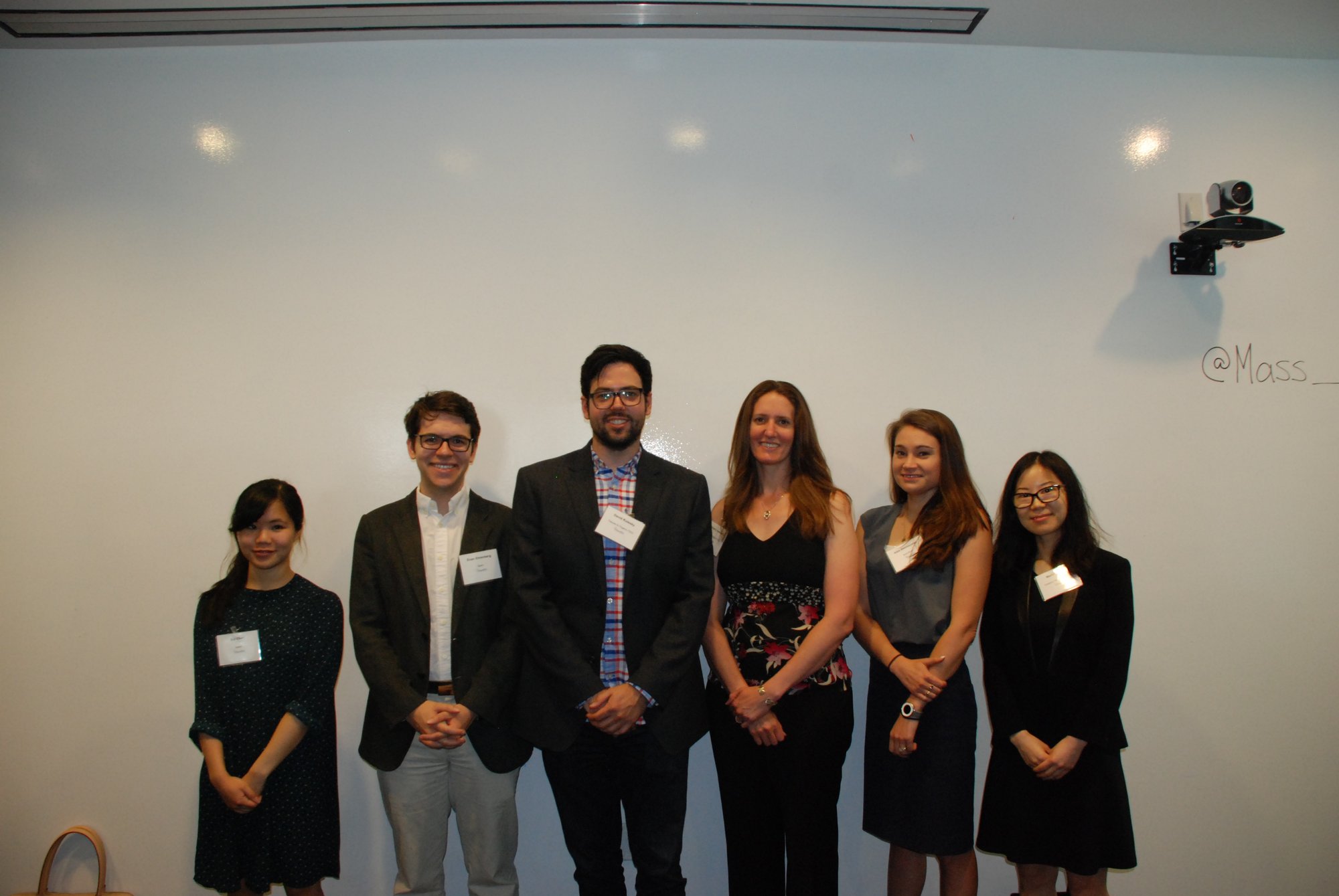
In July 2016, Zimmerman stood with five other entrepreneurs after their companies presented at MassBio’s MassCONNECT showcase. The group photograph offers a welcome change from the founder alone against a tasteful wall. Here, the frame contains several ventures, several sets of expertise, and the ordinary business of showing up with something unfinished.
BrainSpec had been selected for a new cycle of the mentorship program. At the showcase, entrepreneurs presented to industry executives and potential mentors for early feedback. They were then matched with teams whose experience suited their objectives and business needs. Coaching continued over two months, ahead of a final presentation to potential investors and partners.
It is an appealingly concrete arrangement. The first presentation opens the questions. The intervening weeks give the founders people to ask. The final presentation creates a deadline. Whatever romance attaches to entrepreneurship, an appointment remains a useful invention.
Zimmerman was also selected for Harvard’s 2016-2017 Blavatnik fellowship. Based at the university’s innovation lab, the program connected fellows with mentors and professional development in areas including intellectual property, finance, strategy, and business development. She had completed a business degree and was entering another setting for learning how a venture gets built.
- 01 / ConnectioniHub · 2015
- 02 / ExplanationUniversity competitions · 2016
- 03 / DevelopmentMassCONNECT + Blavatnik · 2016-17
- 04 / AccelerationTechstars Boston · 2017
Three minutes in San Francisco
The next competition carried a different address. In July 2017, Google Cloud held the final of its Machine Learning Startup Competition in San Francisco. More than 350 startups had applied; ten were selected as finalists. Each had three minutes to pitch and three minutes for questions, in front of judges and an audience representing more than 40 venture firms.
BrainSpec became Data Collective’s choice winner. Google’s announcement said the startups selected by Data Collective and Emergence Capital were eligible for investments of up to $500,000. PicnicHealth received the separate Built with Google grand prize. BrainSpec’s recognition was specific, substantial, and worth describing without borrowing someone else’s trophy.
The progression from university stages to this event gives Zimmerman’s early founding years an identifiable rhythm. An idea was being introduced in settings with different interests and different clocks. The scientific partnership remained at the center, while the surrounding business had to become understandable to people assessing a young company.
Three minutes sounds almost comically short for that task. It forces choices about which details establish the argument and which can wait for questions. A technical founder may possess years of relevant training. The listener still needs a way into the story before the timer makes its own editorial decision.
A company keeps its collaborators
By 2025, Zimmerman was appearing on a different sort of stage. Modev’s CES program placed her on “The Future of NeuroTech: Exploring Tomorrow’s Innovations,” alongside Hip Hop Science founder Maynard Okereke, Neurotech Network founder Jennifer French, PSYONIC’s Dale DiMassi, and BrainPatch chief executive Nickolai Vysokov. The panel video preserves the event as a conversation among several organizations.
A panel makes collaboration visible in a way that a company title cannot. The program puts Zimmerman beside people with their own organizations, backgrounds, and questions. The CEO and co-founder designation identifies her responsibility at BrainSpec. The wider group gives that responsibility a setting beyond her own team.
In September that year, BrainSpec announced an agreement with the University of Minnesota to commercialize AutoVOI, software developed at its Center for Magnetic Resonance Research. The exclusive license was managed through the university’s technology-commercialization operation. Director Gülin Öz and her team were the academic collaborators in this next chapter.
“Our goal was to make this type of technology easier to use.”
Alex Zimmerman · September 2025
The university’s software page independently identifies BrainSpec as the exclusive commercial license holder. That detail gives the partnership a concrete shape. There is a research team, a piece of software, intellectual property, and a company taking on commercialization. Each has a role; the announcement joins them without erasing their separate contributions.
Zimmerman’s language about the collaboration emphasized practical tools. In an interview that September, she described the company’s goal in terms of making technology easier to use. The phrasing brings the story back to a recognizable engineering question: how much knowledge should a person need before a tool becomes useful to them?
Her career has moved through places that ask different versions of that question. Product development, business school, a university competition, a mentorship showcase, an investor audience, an academic licensing agreement. Each adds people who need to understand enough of the work to make their own decision about it.
That is the education of this particular idea. Zimmerman’s degrees are easy to list. The company-building years add a less tidy curriculum, organized around collaborators, explanations, and commitments. The early audience prize supplies a pleasing opening scene. The later licensing agreement supplies something equally revealing: named people, defined responsibilities, and another piece of work ready to leave the room.