The most interesting button on an MRI console may also be one of the least used. Press it, run the right sequence and the scanner stops behaving only like a camera. It becomes something closer to a chemistry lab, listening for the faint signatures of molecules inside tissue. The technique is magnetic resonance spectroscopy, or MRS. It has been studied for decades, yet its output still looks to many clinicians like a row of mysterious peaks. BrainSpec exists to make those peaks less mysterious.
The Boston company does not build magnets, coils or scanning rooms. It builds the software layer after acquisition: a web interface that processes spectroscopy data, measures metabolites and presents the result in a report. Its language is deliberately familiar. BrainSpec calls the result a “virtual biopsy” and says it wants MRS to feel as readable as a blood test. The analogy has limits - spectroscopy does not remove tissue and cannot replace pathology in every case - but it captures the product ambition neatly. Make invisible chemistry legible without adding an incision or radiation.
A spectrum is not a diagnosis
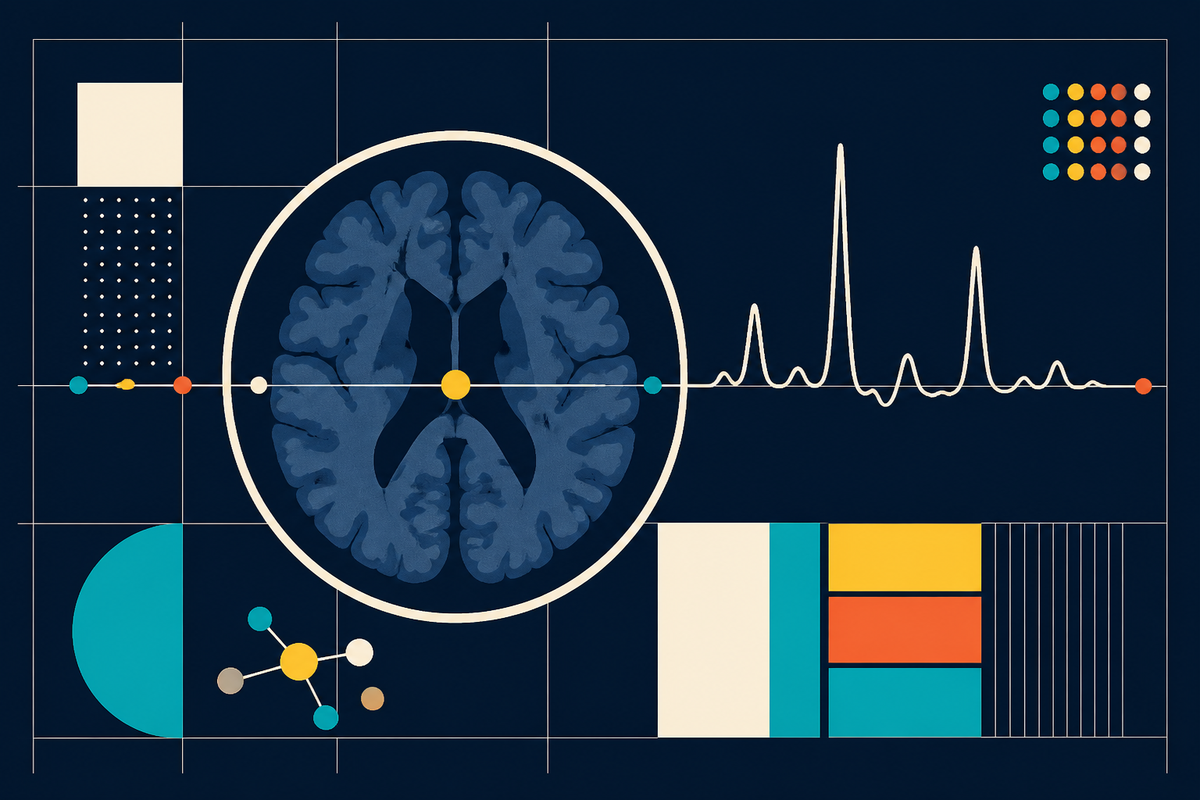
A conventional brain MRI is excellent at anatomy. It can show the size and location of a lesion, swelling, bleeding or tissue loss. MRS asks a different question: what is the tissue doing chemically? Peaks in a spectrum correspond to compounds associated with neurons, cell membranes, energy metabolism, inflammation and other processes. BrainSpec Core quantifies seven named signals: N-acetylaspartate, choline, creatine, myo-inositol, Glx, lactate and 2-hydroxyglutarate, usually shortened to 2HG.
That last molecule is especially relevant in glioma. 2HG is an oncometabolite associated with mutations in isocitrate dehydrogenase genes. BrainSpec received an FDA Breakthrough Device designation in 2022 for estimating IDH status in glioma patients for whom a physical biopsy is inadvisable. A designation is not marketing clearance. The next regulatory milestone came on November 14, 2023, when the FDA granted 510(k) clearance to BrainSpec Core as a Class II medical image management and processing system.
The cleared software supports specified pulse sequences from GE, Siemens and Philips 3.0-tesla scanners. A user accesses it through Google Chrome, uploads the acquired data and receives a processed spectrum and metabolite measurements. Where a reference interval exists, ratios can be compared with percentile data aggregated from adults without known neurological or major psychiatric disorders. The database is an important part of the proposition. A number in isolation is only a number; a reference range gives it context.
The product is the missing workflow
MRS is not new, and BrainSpec is not claiming to have invented it. That matters because the company’s actual competitive insight is more useful than an invention myth: mature scientific tools can remain commercially underused when the workflow is awkward. Spectroscopy has required specialized acquisition knowledge, spectral fitting, quality control and expert interpretation. Scanner vendors offer basic tools, while academic packages such as LCModel, TARQUIN, jMRUI and Osprey serve specialist users. BrainSpec packages processing, visualization, reference data and reporting in a browser.
Acquire a supported spectroscopy sequence on a 3.0T MRI.
Upload the spectral data through a web browser.
Process peaks into metabolite measures and ratios.
Review visual output and reference intervals in a report.
This is a business-to-business product. The likely users are neuroradiologists, neurologists, oncologists, MRI technologists, imaging-core teams and clinical researchers. BrainSpec names research sites including Brigham and Women’s Hospital, Massachusetts General Hospital, Dana-Farber, Mayo Clinic and Swedish Medical Group. It does not publish customer numbers or pricing. The commercial logic is enterprise medical software: sell access and implementation to institutions that already own MRI capacity, then make the extra spectroscopy sequence and processing step worth the time.
The scan begins before the upload
Software cannot rescue every acquisition problem. Before there is a spectrum to process, someone must decide where in the brain to sample. That region, called a volume of interest, is commonly positioned by hand. A misplaced or inconsistently placed voxel can change what tissue is measured and make comparisons across people, scanners or time harder. This is the unglamorous sort of problem that determines whether a research technique survives contact with routine practice.
A chemical fingerprint, simplified
In September 2025, BrainSpec and the University of Minnesota’s Center for Magnetic Resonance Research announced an exclusive-license collaboration to commercialize AutoVOI. Developed by the CMRR spectroscopy group, the patented pipeline automates voxel placement using anatomical landmarks. Chief executive Alex Zimmerman compared its role to navigation: it supplies repeatable coordinates instead of relying on personal directions. The move extends BrainSpec upstream, from interpreting data to improving how it is collected.
That combination is the company’s best answer to competitors. Broad radiology AI companies usually analyze anatomical images. Research spectroscopy packages can be capable but demand expertise. Vendor tools live inside one equipment ecosystem. BrainSpec is trying to occupy the narrow space between them: vendor-spanning acquisition support, cloud processing, reference comparisons and a regulated clinical interface focused on chemistry. The moat, if it develops, will be less about one algorithm than about the accumulated system - protocols, data, workflow, regulatory clearance and institutional trust.
Where BrainSpec sits
Above MRI hardware and pulse sequences, below the clinical decision. It translates chemical signals into material a trained reader can use.
What it replaces
Not the scanner and not the physician. The target is manual processing, fragmented tools and the decision to skip spectroscopy altogether.
Evidence arrives one condition at a time
Brain chemistry is not one market disguised as seven molecules. A glioma team looking for 2HG has a different question from a multiple sclerosis researcher tracking inflammation or a traumatic brain injury specialist looking for chronic abnormalities. Each application needs its own evidence, protocols and clinical interpretation. That is why BrainSpec’s public work reads less like one sweeping diagnostic claim and more like a collection of condition-specific projects. In a 2024 peer-reviewed study of people with chronic traumatic brain injury, researchers used the FDA-cleared software to process spectroscopy from 42 participants and flag metabolite measures outside BrainSpec reference ranges. The study evaluated a broader battery of quantitative imaging measures; it did not establish BrainSpec as a stand-alone TBI diagnostic.
The company’s recent conference updates point in the same incremental direction. Team members have discussed pediatric hypoxic-ischemic encephalopathy and collaborative work with Massachusetts General Hospital and the Martinos Center on adrenoleukodystrophy, a rare disorder that damages myelin. These projects illustrate BrainSpec’s expertise in the connective tissue of clinical translation: matching pulse sequences to a biological question, controlling data quality, quantifying metabolites and presenting uncertainty without pretending that a colorful table makes the decision. The addressable users extend beyond hospitals to academic imaging cores, pharmaceutical trials and life-science research groups, but the buying case will be made disease by disease.
Born in a hospital, built like software
BrainSpec began in 2015 at a brainstorming session run by the Brigham and Women’s Hospital Innovation Hub. Scientific co-founder Alexander P. Lin had spent years on clinical spectroscopy. Alexandra Zimmerman, an engineer with graduate training in biomedical engineering and an MBA, became chief executive and co-founder. An iHub account describes a deliberately mixed founding group: clinical researcher, postdoctoral scientist, business student, designer and software engineer. BrainSpec later joined Techstars Boston’s 2017 class.
The cross-disciplinary origin still shows. Public company updates move between pediatric neuroradiology, brain tumors, traumatic brain injury and rare metabolic disease. They also occasionally break character: in 2025 the company celebrated lead software engineer Samir Reddigari for constructing an Apple News+ daily crossword. For a small regulated-software company, the culture appears equal parts conference poster, clinical collaboration and startup improvisation.
Funding disclosures are less tidy. The supplied company record puts total funding at about $1.83 million and lists a $30,000 debt financing in April 2020. Public databases disagree on the lifetime total, though investors and programs consistently associated with BrainSpec include Techstars, DCVC, Right Side Capital Management, Dorm Room Fund, Tuesday Capital and Creative Destruction Lab. The company does not disclose revenue, valuation or current customer count.
The adoption test
BrainSpec’s opportunity is also its central difficulty. Hospitals already possess the expensive machine. The incremental scan can be measured in minutes, not a new building. Yet clinical habits, protocol consistency, evidence, reimbursement, training and regulation all stand between technical possibility and routine use. MRS has accumulated a large research literature without becoming a default part of every neurological MRI. Better software addresses several barriers, but not all of them.
The company therefore sits in an unusual market position. It competes partly with other software and partly with inaction. Its strongest pitch is not that every MRI needs spectroscopy. It is that, in carefully chosen cases, chemistry can answer a question anatomy leaves open - and the result should not require a spectroscopy specialist and three days of manual work. If BrainSpec can make acquisition repeatable and interpretation ordinary, the virtual biopsy will feel less like a slogan. It will look like one more report in the radiologist’s queue.
Keep exploring
BrainSpec’s own site explains the product and its clinical applications. The FDA record contains the cleared indications and technical summary; the company’s LinkedIn feed carries its most recent research and conference updates.