The origin of BrainSpec fits inside one brisk sentence. In a room at Brigham and Women’s Hospital, Alex Zimmerman listened to spectroscopy scientist Alexander Lin explain a technology with a communication problem. The science could reveal chemical information that ordinary images did not. The workflow, however, belonged mostly to specialists. Zimmerman saw the gap and said, “Let’s build something here.” It is hard to improve on the economy of that line. No prophecy. No theatrical claim about changing everything. Just a proposal to make the useful thing usable.
Zimmerman was unusually equipped to recognize what “build” would demand. She had studied mechanical engineering at Tufts and biomedical engineering at Brown. At Johnson & Johnson’s DePuy Synthes, she worked in research and development on custom spinal implants and instruments. Her job crossed product design, mechanical testing, and production manufacturing. In other words, she had already learned that an elegant drawing is not a product. A product must tolerate the factory, the rulebook, the user, and the unforgiving physical world.
By the time she entered Harvard Business School, she could speak in materials and tolerances. The MBA added markets, organizations, and capital. Then the hospital session supplied the problem. Lin had scientific depth in magnetic resonance spectroscopy, or MRS. Zimmerman brought the instinct to translate. Their partnership became BrainSpec during her second year at HBS.
A founder built for the handoff
Deep technology lives or dies in handoffs. A scientist passes an insight to an engineer. The engineer passes a system to a user. The company passes evidence to a regulator. At every border, context can leak away. Zimmerman’s career looks like training for preventing that leak.
Even her early published research sits at a revealing intersection. In 2013, under the name Alexandra Ross, she co-authored work on color-coded titanium devices. The problem joined a practical operating-room convention with questions about material surfaces and biological function. It was engineering in its most grounded form: preserve what helps the user, improve what the material does, and test the result. That same logic would later reappear in software. Preserve technical rigor. Remove unnecessary friction. Make the output easier to act upon.
“Let’s build something here.”Alex Zimmerman, at the Brigham and Women’s Hospital iHub session
The early BrainSpec pitch had a memorable phrase: make the virtual biopsy a reality. In 2016, Zimmerman delivered it during the Harvard New Venture Competition, where BrainSpec won the business-track crowd vote. The company also won the health and life sciences track of the Tufts $100K New Ventures Competition. Prize stages are good at creating clean moments. Founding a regulated company is mostly the opposite: revision, documentation, patient iteration, and conversations whose success is measured by the next conversation.
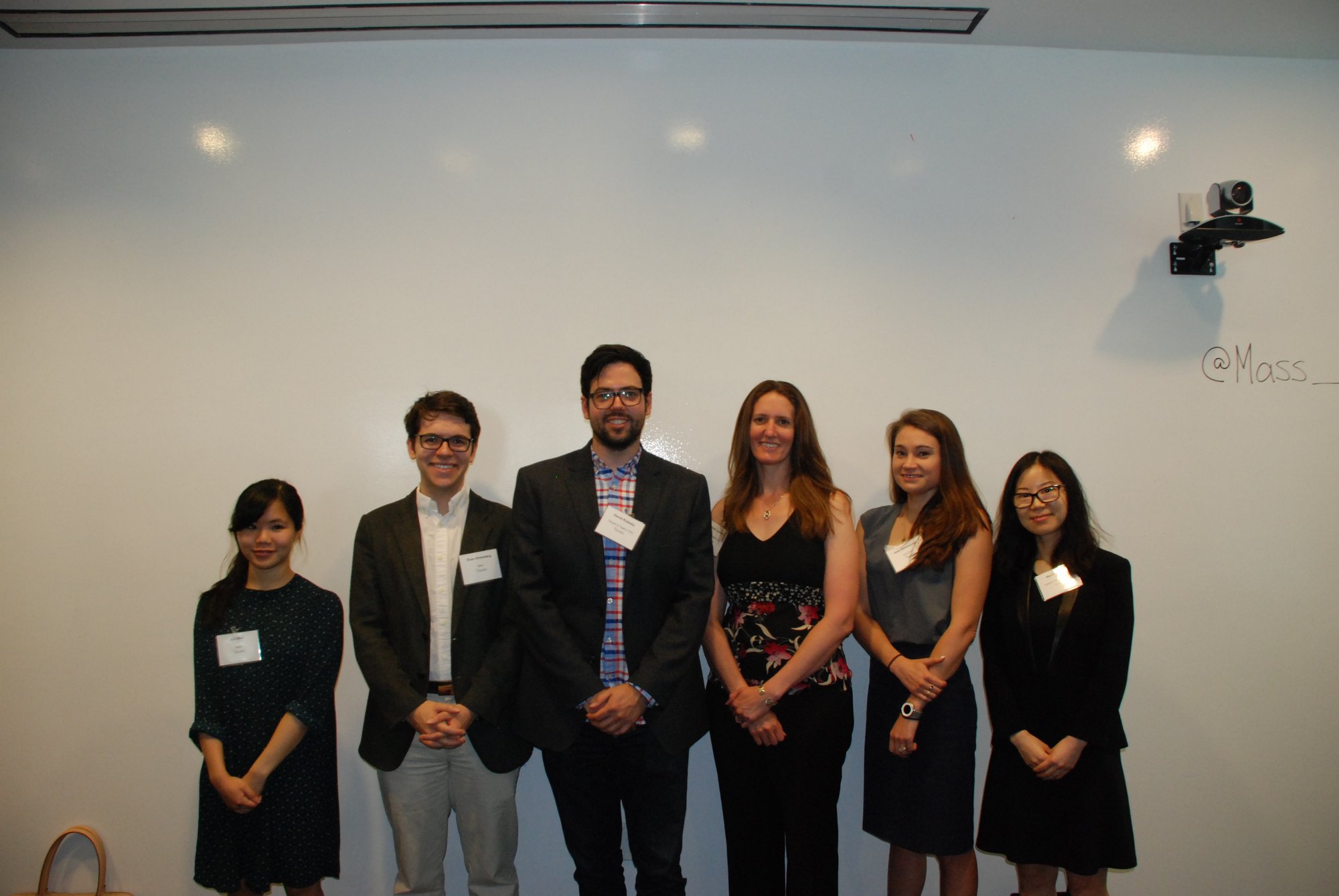
That summer, MassBio selected BrainSpec for its MassCONNECT mentorship program. Harvard then named Zimmerman a 2016-2017 Blavatnik Fellow in Life Science Entrepreneurship. The fellowship gave a small group of alumni time, mentors, and access to experts in intellectual property, regulatory affairs, financing, and business development. The curriculum reads like the list of things a scientific founder discovers cannot be delegated to fate.
The sequence matters. A competition can test whether strangers understand the premise. A mentorship program can expose the weak seams in a plan. A fellowship can create enough protected time to repair them. None substitutes for company building, but each can make the next expensive mistake slightly less likely. Zimmerman used Boston’s institutional density as a workshop: a hospital for the original connection, universities for technical and commercial training, and an industry network for candid scrutiny.
Her advantage was not simply access to those rooms. Plenty of promising ideas pass through rooms. The advantage was the ability to return with a sharper version of the same proposition. BrainSpec’s public language became clearer as the product matured: take an expert analytical process, support it with software and reference data, and reduce the distance between a complicated signal and a usable result. That clarity is less a gift for slogans than evidence of repeated explanation.
The business is the translation
MRS produces spectra, not the familiar anatomical pictures most people associate with an MRI. Peaks in those spectra correspond to chemical signals. The data can be rich, but richness is not the same as readability. BrainSpec’s proposition was to combine processing software, reference information, visualization, and reporting in a web-based workflow. The intended result was a simpler route from raw data to an interpretable analysis.
This is where founders can be miscast as either visionaries or operators, as if the two jobs occupy separate chairs. Zimmerman’s record suggests a more useful role: translator in chief. She must help a software team understand a scientific requirement, help collaborators see a product path, and help a regulatory process see evidence rather than enthusiasm. Fluency matters, but so does humility. Each domain contains experts who know what the others do not.
The date that hides the work
On November 14, 2023, the FDA recorded its decision on BrainSpec Core. The software was cleared as a Class II medical image management and processing system for evaluating magnetic resonance spectroscopy data. A date like that can make a company’s history look punctual. In reality, regulatory milestones are sedimentary. They compress years of product choices, risk analysis, testing, and documentation into a single row in a database.
Zimmerman’s earlier work at DePuy Synthes had exposed her to full product lifecycle development. Her Blavatnik year offered additional instruction in regulatory affairs and commercialization. BrainSpec made those lessons concrete. The founder who once designed implants now led a software company through a different version of the same question: how do you prove that a complicated tool behaves as intended?
A clean report is the last page of a much longer argument.
There is an appealing modesty in this kind of company building. The work does not ask software to replace expertise. It asks software to organize complexity so expertise can travel farther. That distinction matters. BrainSpec’s platform is built around analysis, comparison, and presentation. Its value rests not on making the underlying science vanish, but on making the path through it repeatable.
Removing the fiddly step
The next chapter follows the same pattern. In September 2025, BrainSpec announced a collaboration with the University of Minnesota’s Center for Magnetic Resonance Research involving AutoVOI. In spectroscopy, a user must select a volume of interest, the region from which data will be gathered. Done manually, that step requires experience and can introduce variation. AutoVOI is designed to automate the placement.
Zimmerman described the work as a commitment to turning innovation into practical tools. Her phrasing is consistent with the company’s origin. The opportunity is found at the point where a powerful method meets an awkward task. Remove the awkwardness carefully, and more people can use the method with greater consistency.
This is also the clearest lesson to borrow from her career. Startups often go hunting for enormous problems and return with enormous slogans. Zimmerman’s record suggests another route. Find the exact step that makes an expert workflow brittle, slow, or intimidating. Learn why it is hard. Respect the people who already do it. Then build a bridge narrow enough to finish and sturdy enough to trust.
Her path from Tufts to Brown to Harvard can look, in retrospect, almost excessively well matched to BrainSpec. Mechanical engineering supplied physical intuition. Biomedical engineering connected it to research. Business school opened the institutional map. But tidy biographies cheat. None of those chapters guaranteed a hospital meeting, a willing scientific partner, a decade of persistence, or an FDA decision. The through-line was not destiny. It was a practiced appetite for useful precision.
The sentence after the idea
Zimmerman is not the loudest character in BrainSpec’s public story. She appears in competition reports, fellowship announcements, regulatory records, conference programs, and partnership news. Piece them together and a distinct portrait emerges: direct in the room, comfortable among specialists, and willing to stay with an idea long after its pitch-deck glow has faded.
“Let’s build something here” is charming because it sounds like a beginning. A decade later, it reads more like a method. Here is a signal. Here is a cumbersome step. Here is a scientific collaborator. Here is a regulatory threshold. Each time, the response is to build the missing layer between expertise and use.
The romance of invention belongs to the flash of insight. The comedy of invention begins the next morning, when somebody has to schedule the meeting, document the requirement, revise the interface, and explain the thing one more time. Zimmerman has made a company in that less glamorous tense. BrainSpec’s progress is measured in the accumulated proof that translation can itself be a technology.