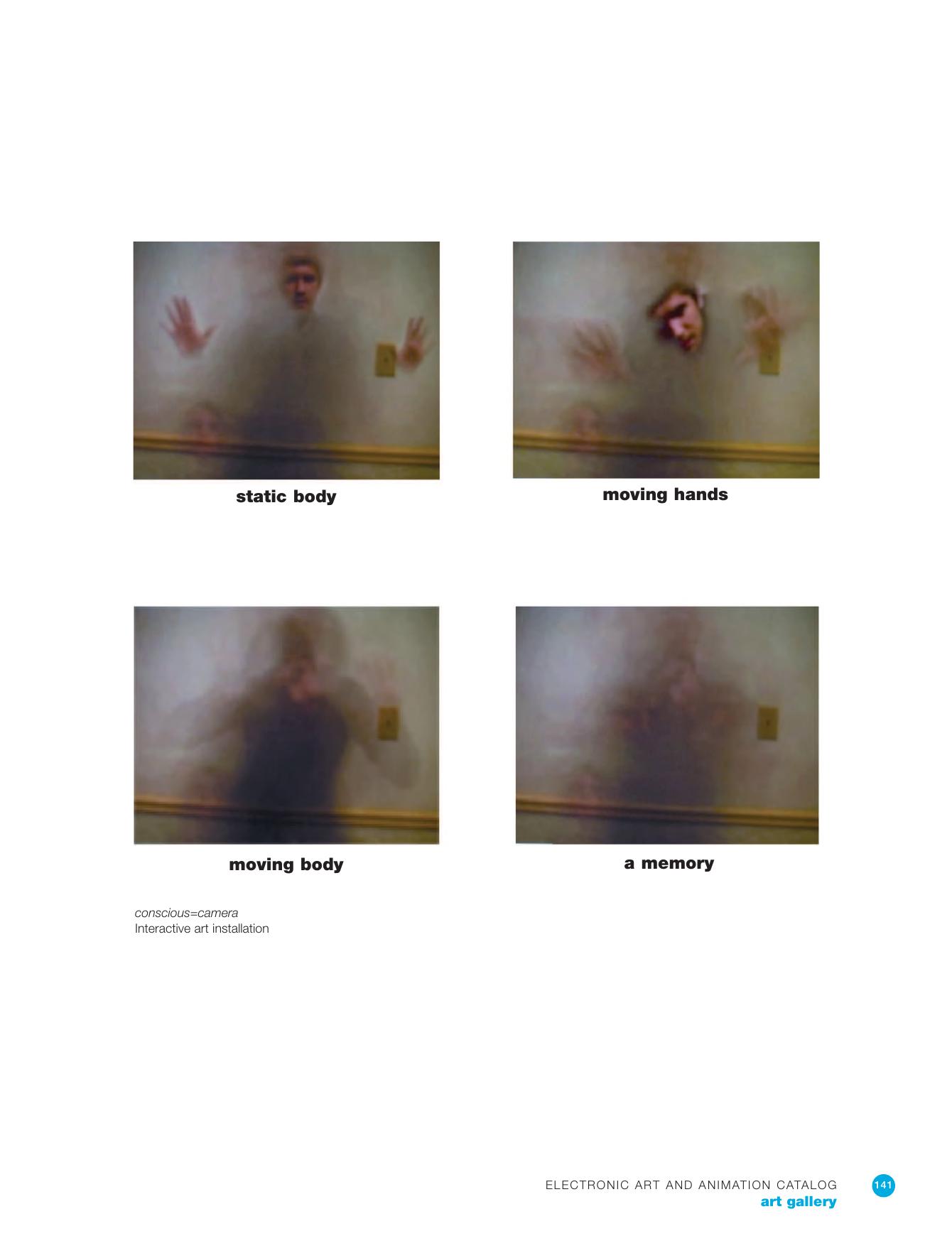
In 2005, Kevin Quennesson built a camera with a memory problem. It watched a person move, picked out a face and hands, and left their outlines hanging in the frame like steam on a bathroom mirror. Slow movement produced a recognizable person. Faster movement dissolved identity into a trail. Then the marks faded. He called the installation conscious=camera, which is not the name of a product that survived a focus group. It is, however, the name of a young engineer thinking seriously about what an image remembers and what it forgets.
The project appeared in the SIGGRAPH Electronic Art and Animation Catalog. Quennesson’s artist statement wandered happily through Sartre, Bergson and Cartier-Bresson before arriving at statistical body tracking. Philosophy upstairs, C++ in the basement. The combination would become familiar. Across two decades, Quennesson has kept working at the border between dense visual systems and ordinary human attention.
That border has taken him from Georgia Tech research to Apple’s graphics group, from an adored photo startup to Twitter’s machine-learning organization, and from there to Braid Health, the San Francisco company he co-founded in 2018. The résumé looks like a sequence of sharp turns. Seen through the lens of images, it is closer to a straight line drawn with a slightly eccentric ruler.
“Each consciousness shown leaves a mark on the background, which will very slowly vanish. This represents the memory.”Kevin Quennesson, conscious=camera artist statement, 2005
An artist carrying wavelets
Quennesson trained at École Polytechnique in applied mathematics and computer science, then at Georgia Tech in information design and technology. His research there covered motion-capture synthesis, computer vision and responsive media. In 2006, he co-authored a paper on classifying human motion with wavelet statistics. A wavelet, roughly speaking, lets a system notice both the broad shape of a signal and its quick changes. It is excellent machinery for distinguishing a gesture from a mere collection of coordinates.
He also presented Traces at SIGGRAPH in 2006. The title is nearly too perfect. Quennesson’s later work would keep looking for traces inside enormous visual collections: the one photograph worth seeing, the video snippet worth previewing, the structure inside a stack of images. Even his public GitHub profile reads like an attic of that curiosity, with code around C++, video processing, image APIs and the Swift package manager.
Apple, when the glass was new
Apple hired Quennesson in 2006. He became project lead for Quartz Composer, a visual programming environment for motion graphics. Quartz Composer let creators connect patches into animated systems rather than write every effect from scratch. The interface looked approachable because an impressive amount of complexity had been packed beneath it. Quennesson also worked on the first iPhone SDK, built early public applications against version 1.0, and delivered an early WWDC session introducing the SDK to developers.
This was useful schooling in platform work. A platform must be rigorous enough for engineers and legible enough for people who do not want to admire the plumbing. It also taught a lesson that would echo through Quennesson’s products: visual computing feels magical only after someone has made its technical burden disappear.
motion
photos
models
images
Four different products. One recurring job: reduce the distance between pixels and understanding.
The beautiful product that lost
Quennesson left Apple in 2009 and worked at Cooliris, another company fascinated by visual interfaces. In 2011, he co-founded 33cube with Pierre-Olivier Latour and Wayne Fan. Its product, Everpix, promised to collect a person’s scattered photos and make the whole library enjoyable again. Quennesson had identified the paradox neatly: people took more photographs and became less connected to them.
Everpix used serious image analysis to make itself feel simple. It pulled photographs from devices and online services, removed the clerical work, and surfaced memories without demanding folder archaeology. Reviewers admired it. Users paid for it. By the time the company closed in 2013, it reportedly held hundreds of millions of photos. It was a lovely house with an expensive roof and not enough road leading to the front door.
The company’s post-mortem became more famous than most startup launches. The team had spent too much time refining the product and too little on distribution, positioning and growth. It tried to raise more capital and explored an acquisition, but neither route closed in time. Everpix refunded subscribers and gave users a way to retrieve their pictures.
There is dignity in a technically gifted team explaining that technical excellence did not save it. The confession is also practical. Product quality and company survival overlap, but they are not synonyms. Everpix had solved the visible problem brilliantly. The invisible problems arrived with invoices.
Three portable lessons from Everpix
- Distribution deserves product-level attention before the runway becomes a countdown.
- A calm interface can conceal enormous operating cost. Simplicity must work in the ledger too.
- A candid ending preserves useful knowledge for the next company and the wider founder community.
Inside Twitter’s AI build-out
After Everpix, Quennesson joined Twitter. His public biography at City Embrace, a nonprofit where he has served as secretary, says he worked with corporate development to shape the company’s AI and deep-learning strategy. That period included Twitter’s acquisitions of Madbits in 2014, Whetlab in 2015 and Magic Pony in 2016. Quennesson moved from engineer to manager in Cortex, Twitter’s machine-learning organization.
The work widened the frame. At Apple and Everpix, he had helped build specific visual tools. At Twitter, he was part of assembling capabilities, people and infrastructure. He spoke publicly about using GPUs to train advanced models in hours while saving capital expense compared with CPUs. The sentence is pure operator: model speed in one hand, budget in the other.
At a 2015 Silicon Valley panel, someone asked AI executives what frightened them about super-intelligent machines. Quennesson answered that he was more worried about global warming. The remark was concise, dry and grounded in the problems already in the room. It also resisted the favorite trick of technology panels, which is to make the distant hypothetical more glamorous than the immediate obligation.
Back to the image
Quennesson founded Braid Health with Alessandro Sabatelli, an Apple and Twitter design veteran, in 2018. The company raised a $3 million seed round that year and announced a $9 million Series A in 2020, led by Lux Capital with 01 Advisors and Rucker Park Capital participating. Braid’s premise brought Quennesson back to a familiar technical object under far stricter conditions: large, complicated images that need to load, travel and make sense.
Braid built browser-based tools for medical imaging, including a zero-footprint viewer, image sharing, AI-assisted workflows and interactive reports. Its current site says the platform is used by providers and more than 650,000 patients. Quennesson is named on Braid patents covering volumetric imaging techniques that combine and losslessly compress slices before sending them to a client device. The legal prose is dense. The user-facing ambition is plain: let an enormous visual object move quickly and remain useful.
This is where the old art installation becomes more than a charming opening scene. conscious=camera asked how software might choose what to reveal from a stream of visual data. Everpix asked which memories should return from a giant library. Twitter Cortex trained systems to find structure at platform scale. Braid asks how a difficult image can become available, shareable and intelligible on the screen already in someone’s hand.
The résumé changes industries. The craft stays put: hide the machinery, preserve the meaning.A 20-year pattern in Quennesson’s work
The useful stubbornness
Founders are encouraged to become missionaries for a market. Quennesson’s career suggests a more personal form of persistence: remain loyal to a type of problem. His problem is the distance between an image and understanding. Sometimes that distance is philosophical. Sometimes it is a graphics pipeline, a bankrupt storage bill, a GPU cluster or a file too cumbersome for the browser. Each version requires a different kind of company and a different tolerance for constraint.
The path also carries an antidote to tidy founder mythology. There is a failed company in the middle. There are years spent inside large organizations. There is art before enterprise and infrastructure after interface. No chapter cancels the previous one. The failure supplies operating memory; the research supplies technical taste; the corporations supply scale; the startup supplies urgency.
In his first published installation, a body moved across a screen and left a trace that slowly vanished. Quennesson has spent the years since building systems that decide which traces should remain. The medium has changed. The question is still looking back through the glass.