David Moodie’s early demonstration was a metal bracket. It had been made with borrowed equipment and materials, and it gave an investor something more useful than a handsome prediction: an object to examine. Before there was a casting system to sell, there was this small piece of evidence that his experiments might lead somewhere.
The investor was Laura Faulconer of WNT Ventures. In Moodie’s recollection, she had visited one of his clients and had time to spare before a flight. She asked about his other work. He showed her the backyard project. An airport departure had briefly left room for a different destination.
An hour before the flight
Moodie had been trying to solve a problem from his working life. He was an industrial designer, accustomed to helping other people get products made. His experiments offered a way of producing cast metal parts without the usual preparation of a conventional foundry. They were promising enough to invite a closer look, and unfinished enough to require one.
He later recalled that he had produced parts without yet having a complete system. That distinction is the hinge of the story. Making a part proves something. Building equipment that another person can operate, repeatedly, for a useful purpose, requires a different order of patience.
“I had cast a few parts but not a full system.”
David Moodie, on the early investment
The bracket made a conversation possible. The company would have to make a dependable process possible. Between those two achievements lay the work that rarely fits into the photograph of a founder beside a machine: investigation, design revisions, materials knowledge and the awkward question of whether the economics would survive contact with a customer.
A designer meets the wrong specimen
Moodie studied industrial design at Victoria University of Wellington. After university, he worked at Designbrand in Island Bay, then established Makegood. He spent time at 1st Assembly, the creative hub in Lower Hutt, where independent practitioners could exchange help as well as ideas.
That professional route puts the casting experiments in context. His starting point was the job of getting a design into production. Drawings and models belonged to a longer chain of decisions, ending in an object that would have to perform its intended function. The gap that bothered him appeared within that chain.
A metal prototype can resemble a proposed casting without behaving the same way. For a designer trying to understand strength or heat dissipation, resemblance alone leaves important questions open. The manufacturing process matters alongside the outline. A specimen can look persuasive on a desk and still be the wrong thing to put through the intended test.
Moodie wanted a practical route to cast prototypes. Conventional tooling made small quantities difficult to justify. Direct metal printing offered another route to a metal object, with its own material characteristics. He kept returning to the requirement of the eventual product: if production would involve casting, the prototype needed to help answer casting questions.
His explanation was plain: “If your parts will be cast in production - they should be cast in prototype.” It is a designer’s argument, grounded in what a test needs to establish. Much of Foundry Lab’s subsequent work follows from taking that requirement seriously.
Give the printer a different job
The company’s historical timeline places domestic microwave experiments in 2017. That detail has obvious conversational appeal. It also risks allowing the appliance to steal the entire story. The interesting engineering lies in the combination of a printable mold, suitable materials, heating, cooling and a workflow an operator can follow.
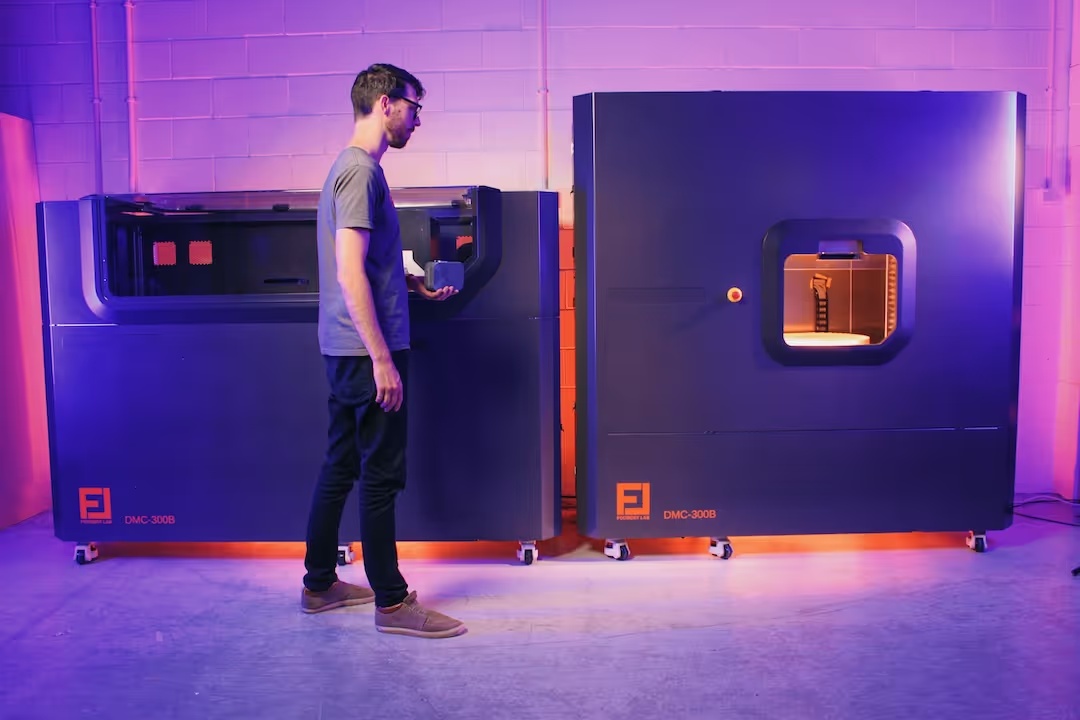
Foundry Lab prints a ceramic mold from a digital design. Metal feedstock goes into it. Heating melts the metal within the mold, which supplies the geometry of the eventual component. After cooling, the solid part can be removed. The process avoids a separate pouring step and the conventional hard tooling that can burden a short run before its first useful part exists.
- 01DesignDefine the part in CAD.
- 02PrintBuild the ceramic mold.
- 03CastMelt metal inside it.
- 04RemoveCool and extract the part.
The diagram shows the sequence, not cycle times or a guarantee of suitability for every component.
In 2021, the team demonstrated aluminum brake shoes made from CAD files in less than eight hours. The value of that example was its specificity. A brake shoe is a recognizable component, and a casting is a physical result. The demonstration gave the time-saving proposition something firmer than an adjective.
There is an appealing economy in assigning 3D printing to the mold. It lets a digital tool do preparatory work while the metal takes its final shape through casting. Moodie’s contribution began with asking which part of an established process could be changed without losing the qualities he needed from the result.
From CAD files to cast aluminum brake shoes. A specific early result, rather than a universal delivery promise.
The useful company around the inventor
WNT announced its investment in Foundry Lab in December 2018. By August 2019, Faulconer was describing months spent examining the opportunity with technical specialists, market researchers and intellectual-property advisers. The discussions included financial models and the question of whether the technology could sustain a defensible business.
Her account gives Moodie credit for working through obstacles, while showing how much company-building happened in conversation. An inventor can recognize a technical possibility before understanding the full market for it. An investor can see an opening while still needing evidence that the equipment will work. The early partnership had room for both kinds of uncertainty.
Other expertise mattered too. Access to a powder ceramicist through Callaghan Innovation helped the team develop its materials. Student interns supported through the organization’s grants later became employees. A business that began with improvisation increasingly depended on people with quite specific knowledge.
The public record of the invention also contains several names. A US patent titled Casting mould, granted in May 2024, lists David John Moodie alongside William Robert Wiles, Lance Molyneaux and Joshua Joseph McIntosh. The document describes a mold and casting system, including ways of heating feedstock within a printed mold and cooling it afterward.
There is something usefully corrective about that inventor list. The founder is the person most often asked to explain the machine. The machine carries the work of a team. Moodie’s story becomes more interesting when the specialists remain in the picture.
A steel pin makes the argument
The investor group widened. Blackbird led a US$8 million Series A in 2021. The wider circle of backers included Rocket Lab founder Peter Beck, former Autodesk chief executive Carl Bass and Motional chief executive Karl Iagnemma. These were connections to people familiar with the inconvenience of making complicated physical things.
Customer applications supplied another kind of evidence. In work with Eaton announced in 2023, Foundry Lab produced aluminum components containing stainless steel pins. The point was to preserve a conventional casting method and material while gaining flexibility in how the parts were made.
For Moodie, that application brought the original design problem into focus. A customer with an existing component cannot always change its process and material simply to suit a new machine. Every departure may introduce more engineering work. The steel pin was a small feature with an unusually clear account of why continuity mattered.
The next year brought a purchase with a broader manufacturing purpose. New Jersey Innovation Institute announced in November 2024 that its defense team had bought a DMC-3 system. The US commercial launch had taken place that June. NJII’s interest included bringing casting capability to partners and engaging a workforce with limited practical experience of the process.
That is a considerable distance from a bracket shown during a spare hour. The customer now had institutional requirements, people to train and work to perform. An idea about making prototypes had become equipment expected to take its place in somebody else’s operations.
Austin, with the workshop still in the picture
Moodie has since moved to Austin. Foundry Lab’s current offering includes an on-demand casting service, FoundryLab Direct, while research and development remain in New Zealand. The company advertises a 72-hour route from CAD to production parts. Its ambitions now include production and sustainment alongside the early concern with prototypes.
His public conversations have widened accordingly. In 2025 interviews, he discussed casting capacity, manufacturing skills and the company’s move toward the United States. The designer’s frustration with obtaining a useful test part had become part of an argument about where industrial capability should reside and how people could gain access to it.
He still allows room for smaller observations. After moving to Texas, he joked about the limited need for company sweaters in Austin. It is a pleasingly ordinary adjustment in a career involving rather unusual heating equipment.
The most durable thread in Moodie’s work is his concern with what an object can tell you. The early bracket let an investor examine a possibility. A cast prototype lets an engineer examine a design. A customer’s working part puts the method to a further test. Each has to earn the next step. For a designer who built a company because an imitation would not answer his question, that seems an appropriate way to proceed.
Follow the work
Conversations, further reading and updates from the workshop.