A satellite has an awkward relationship with change. The customers below it move. Their businesses evolve. Demand appears in places nobody expected. Meanwhile, a spacecraft built for a particular assignment can spend years faithfully doing the job it was given. Shey Sabripour spent enough time designing satellites to appreciate the workmanship, and enough time thinking about telecommunications to question the arrangement. A machine that takes so much trouble to put into space ought to have some room for a second thought.
That question runs through his career, from large aerospace programs to the company he founded in January 2017. CesiumAstro builds software-defined communications systems: hardware whose behavior can be changed through software, with antennas that direct their beams electronically. The ambition is practical. Capacity should follow the people who need it. A satellite operator should have more choices after launch than a hopeful glance at the original specifications.
By October 2026, the question had become a substantial management assignment. CesiumAstro had launched Element-1, its own integrated spacecraft, and reported more than 850 employees. Sabripour was overseeing a business adding factory capacity and buying capabilities in chips, analysis, and mission software. His career had carried him from designing within an established aerospace organization to building an organization that could deliver designs of its own.
A spacecraft with a stubborn job description
Sabripour’s interest in active phased arrays reaches back to satellite work in the early 1990s. Traditional geostationary communications spacecraft could take three to five years to build and cost hundreds of millions of dollars. Their coverage reflected their intended use. A satellite built to broadcast television across the United States could have fixed beams shaped around that market. The business plan had, in effect, acquired a very expensive outline in the sky.
Military systems showed him another possibility. Active arrays allowed operators to steer beams electronically and alter power allocations. The underlying technology already existed. Making its flexibility available through a different kind of product business was the opportunity that stayed with him. It is an engineer’s version of a recurring thought: surely we should be able to use this more often.
He would later explain the attraction through an everyday comparison with cellular networks. One enormous coverage area has limits; smaller beams let capacity be directed and reused. For a satellite operator, that means adapting to where customers actually are. Sabripour’s interest extended beyond whether an antenna worked. He cared about how the resulting system could make communications more economical.
“Lockheed’s a great company, but I wanted to bring this technology to the masses.”Shey Sabripour
The long apprenticeship
He earned his electrical and electronics engineering degree at North Dakota State University in 1985. Early in his working life, RCA’s history of spacecraft manufacturing left an impression on him. The attraction involved the place as well as the machines: an engineering organization could turn difficult ideas into equipment that went to space. That experience would become a reference point for the kind of workplace he wanted to build.
His 24-year career described in public biographies as Lockheed Martin Space Systems included design engineering, program management, and eventually responsibility for spacecraft design. In that last role, his organization comprised 370 engineers, scientists, and business professionals. From 2001 through 2005, he directed the Agile Payload Program, including the development and flight of Lockheed Martin’s first commercial active phased-array payload.
There was an entrepreneurial detour before CesiumAstro. In 2010, he established Altumaxis Technologies, a venture his historical personal biography described as developing renewable-energy platforms. The subject differed from spacecraft communications, but the move put him in the position of organizing a business around technology. His working life had already widened beyond the boundaries of a single aerospace employer.
From September 2014 through December 2016, he served as chief technology officer of Firefly Space Systems in Austin. His responsibilities included technical and program management of the Alpha rocket. The engineering team grew from 11 to more than 160, and won a NASA Venture Class Launch Services mission and two DARPA contracts. It was a different scale of organization, with the immediate demands of a startup and the unforgiving requirements of flight hardware.
North Dakota State
Firefly Space Systems
CesiumAstro
reaches orbit
A coffee shop, then a product company
CesiumAstro’s beginnings included a coffee shop in Westlake, Texas. Sabripour chose to build in the Austin area after coming to appreciate its lifestyle and engineering talent. The choice gave the company a home in a city he already knew through Firefly. A founder can spend considerable time describing a market; somebody still has to decide where the first colleagues will turn up for work.
The company grew around a suite of communications products that could be assembled into larger systems. In November 2024, it had more than 250 employees and was discussing its integrated Element satellite. The move from modules to spacecraft enlarged the assignment while keeping communications at its center. A radio, an antenna, and a processor become more useful when someone has worked through how they behave together.
That product thinking also helps explain Sabripour’s public emphasis on teamwork, discipline, and scalability. His company’s 2025 leadership biography described those habits alongside his technical background. It reported three issued and three pending U.S. patents and his selection as a finalist for an Austin Business Journal CEO award. The particulars suggest a founder still concerned with engineering, while increasingly responsible for the conditions under which other people can do it.
How to move a beam without moving a dish
A phased array steers signals electronically. The antenna can remain stationary while its beam tracks a satellite or changes its coverage. CesiumAstro combines arrays with radios, processing, and reconfigurable hardware. Operators can update beam plans, waveforms, and routing after launch. Multiple beams can support separate connections from the same payload. The useful distinction for a customer is the ability to alter coverage without replacing the physical equipment.
The same general problem follows communications beyond orbit. CesiumAstro’s Skylark terminals are designed for fixed and moving platforms, with applications that include aircraft, maritime vessels, and uncrewed systems. A moving customer and a moving satellite make a demanding pair. Sabripour’s company works on both the space equipment and the terminals that connect to it, bringing the engineering question closer to the person or machine using the link.
The factory becomes the assignment
In February 2026, CesiumAstro announced $470 million in growth capital. The composition matters: $270 million was equity, led by Trousdale Ventures, and $200 million was financing involving EXIM and J.P. Morgan. Plans included a 270,000-square-foot headquarters and more manufacturing capacity. The numbers describe the resources for an expansion, rather than a count of satellites already delivered.
Sabripour described the business as moving from radios, arrays, and processors toward complete missions. The company would continue supplying partners while taking responsibility for more of the system. He also expected commercial applications to account for half the business by 2030, compared with a customer mix he described in early 2026 as roughly three-quarters defense and government. That was an aspiration for the business mix, with years of execution still ahead.
Three acquisition announcements made the direction more concrete. Vidrovr brought expertise in real-time signal analysis, with plans to embed more processing and decision-making into space systems. Jariet Technologies added semiconductor capabilities. The August acquisition of 1Aardvark brought mission software and systems engineering, including work on distributed systems operating with disrupted connections. Each purchase enlarged what CesiumAstro could develop within its own organization.
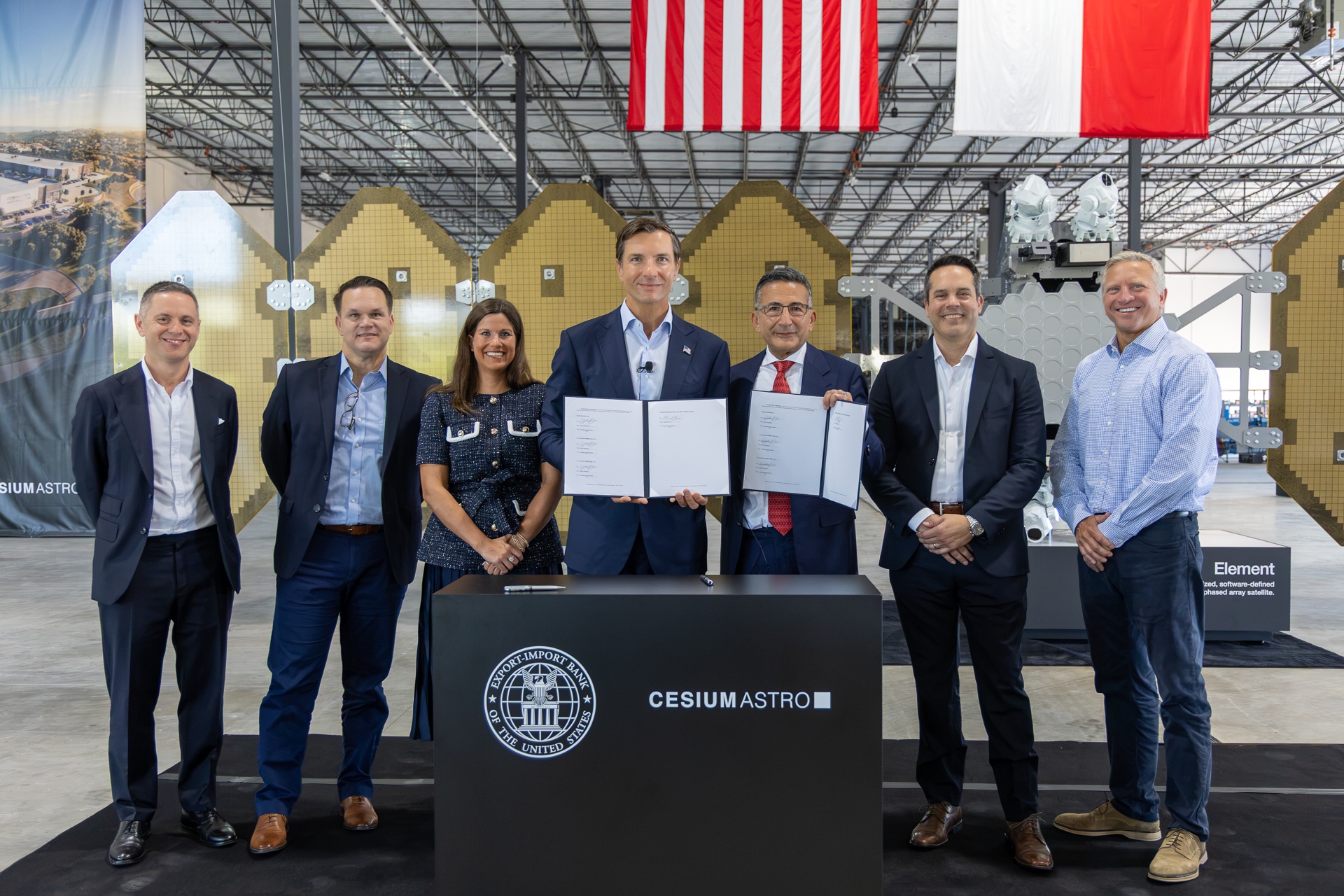
That September ceremony marked a $300 million EXIM credit agreement, including a $20 million revolving line from J.P. Morgan. It supported a five-year, $500 million Texas expansion plan expected to create more than 500 jobs. The setting was the company’s future headquarters and manufacturing complex. For Sabripour, the next stage of an idea conceived around adaptable spacecraft now involved buildings, hiring, and production capacity on the ground.
What the next engineer will see
In October, Element-1 reached orbit. Sabripour reported that the spacecraft had deployed its solar arrays and established bidirectional connectivity, with commissioning and testing to follow. It carried multiband communications and processing payloads. The account was characteristically specific: power, attitude control, the onboard computer, the sequence of work still to complete. Getting to orbit supplied another assignment rather than a convenient full stop.
On October 16, CesiumAstro announced plans for a $25 million engineering and manufacturing facility in Melbourne, Florida, with 100 new jobs expected over the following year. Its expansion continued to follow aerospace talent. The founder who had chosen Austin was now running a company whose operations extended across the United States, Europe, and Asia.
Sabripour has described wanting young engineers to walk into his company’s campus and feel the possibility he felt early in his own career. It is a revealing ambition for someone whose products operate far above their builders. The invitation is tangible: come into the workplace, see what people are making, imagine contributing. After years spent asking how a satellite might change its assignment, he is building places where an engineer might find one.
Follow the conversation
More from Sabripour and the work around him.
- CesiumAstro - company and technology
- Shey Sabripour on LinkedIn · X · Historical personal biography
- Watch: the Ex Terra conversation, November 2024
- Listen: phased arrays on Pathfinder, April 2023
- Watch: satellite strategy at the New York Stock Exchange
- Read: the 2026 growth-capital interview
- Read: the October 2026 Melbourne expansion
- Read: the September 2026 credit agreement