The awkward thing about a communications satellite is that the smallest-looking part can carry the business plan. In 2023, Viasat’s first ViaSat-3 spacecraft reached space. Then its reflector deployment went wrong. The satellite’s payload worked, but by October the company expected to recover less than 10 percent of its planned throughput. The rocket had done its job. The network still had a problem.
- Viasat sells internet, equipment and managed communications to people on land, in aircraft and at sea.
- Its Inmarsat acquisition added maritime reach and safety services.
- Two newer ViaSat-3 satellites entered service in 2026, while lower-orbit partnerships broaden its options.
That distinction explains this company better than a launch photograph. Viasat’s product is a working connection, assembled from spacecraft, antennas, ground infrastructure, software and support. A passenger sees a Wi-Fi icon. Behind it sits an engineering problem with an invoice attached.
Three engineers, one spare bedroom
In 1986, Mark Dankberg, Steve Hart and Mark Miller started Viasat after working together at Linkabit. Their first office was a spare bedroom in Dankberg’s house. They secured two government defense contracts in their first year, then $300,000 in venture capital. Early work included a signal-to-noise ratio device for the U.S. Army. There was a customer before there was a global network.
“Our first office was just a spare bedroom in my house.”Mark Dankberg, recalling Viasat’s beginnings
Its careers materials still emphasize curiosity, teamwork and challenging conventional wisdom. Those are the employer’s stated values; the more concrete evidence is its range of engineering work, from communications hardware to network software. Employees are building different pieces of the same service, which makes coordination part of the product.
The useful detail is the order. The founders brought specialist knowledge to a problem someone would pay to solve. Viasat subsequently expanded through communications equipment, acquisitions and its own satellite infrastructure. Buying WildBlue in 2009 helped move it into consumer broadband services. The business could supply the machinery and collect the recurring service revenue.

The customer is moving
Consider the customers. A rural household wants broadband where a suitable wired connection may be missing. A ship needs business communications and a way for its crew to reach home. An airline needs hundreds of passengers to connect while its aircraft changes position. A military customer adds security and operational requirements. Each buys connectivity, but the engineering and service obligations differ.
Viasat works across those markets. Its expertise includes satellite payloads, terminals, antennas, encryption and managing the network between them. AMARA, its airline platform introduced in 2025, packages connectivity with digital services and connected applications. The company says it works with more than 60 airlines. Through Inmarsat Maritime, NexusWave combines multiple network layers into a managed service for ships.
Delta offers a concrete example of the business model. In January 2023, it announced free Wi-Fi for SkyMiles members on Viasat-equipped aircraft. Free describes the passenger’s experience. The airline still needs hardware and service. Viasat’s opportunity includes selling that infrastructure and the connection behind it, while the airline decides how connectivity fits its passenger proposition.
or ship
and antenna
network
and internet
The financial mix reflects that arrangement. In fiscal 2026, Viasat reported $4.64 billion in revenue: about $3.27 billion from services and $1.37 billion from products. Owning capacity creates the possibility of recurring income, but it also leaves the company responsible for infrastructure that must be financed before customers use it. The service promise rests on a substantial equipment business.
The bill arrives on Earth
The Inmarsat purchase made that service business broader. Announced in 2021 at a transaction value of $7.3 billion, including assumed net debt, it closed in May 2023. At closing, shareholders received about $551 million in cash and 46.36 million Viasat shares. Those figures describe different things: the announced deal valuation and the eventual cash-and-share terms. Mixing them produces a misleading price tag.
Then came the hardware trouble. Alongside ViaSat-3 F1’s reflector issue, Inmarsat-6 F2 suffered a power-system anomaly. Viasat’s fiscal 2024 satellite-related carrying-value reduction totaled roughly $1.67 billion, partly offset by $770 million in insurance receivables. That accounting covered several assets, including the ViaSat-4 program. Calling the whole amount the cost of one broken antenna would be wrong.
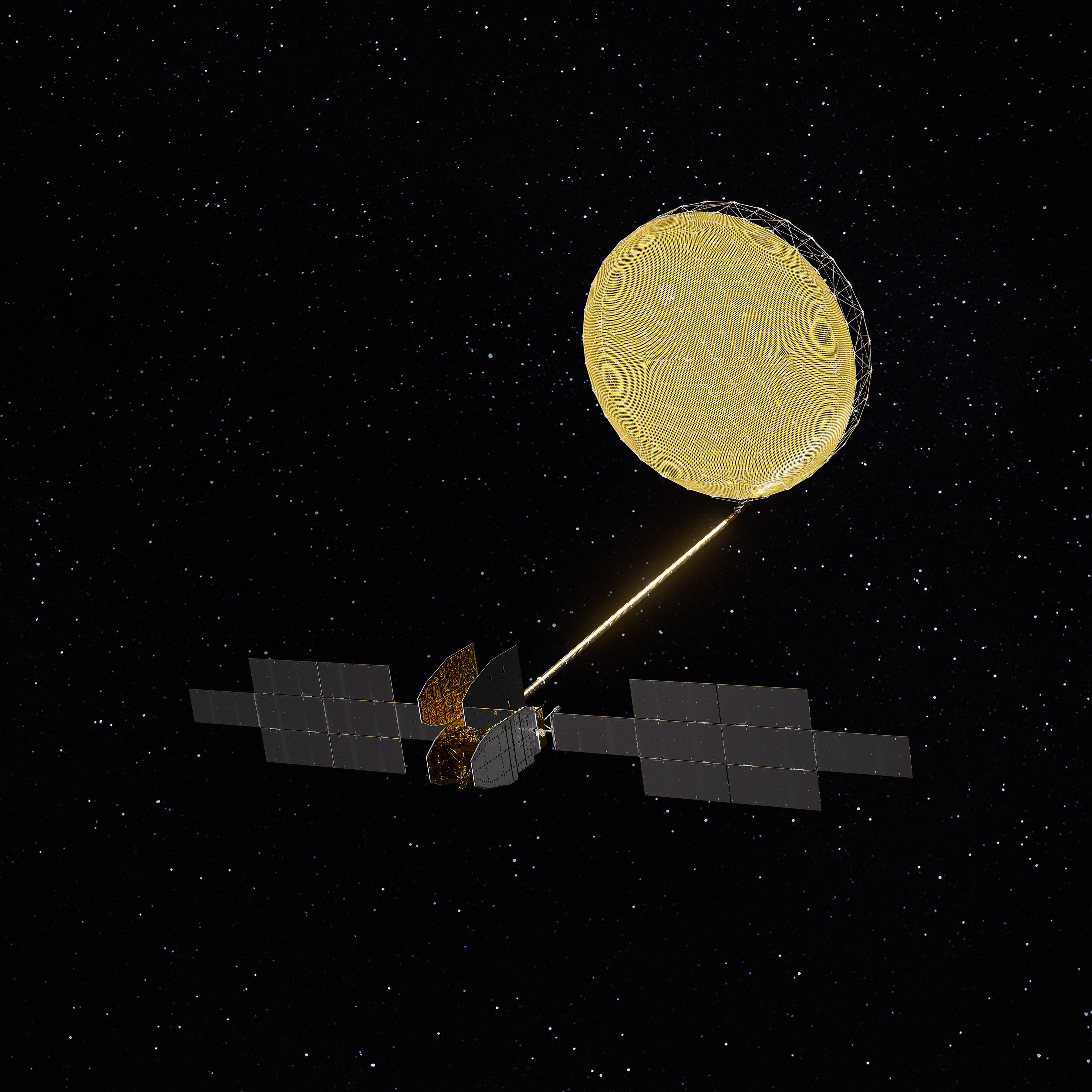
F1 nevertheless entered service in 2024. Its successors followed in an unexpectedly numbered sequence: F3 began serving Asia-Pacific in August 2026; F2 entered service over the Americas in September. F2 is designed for more than one terabit per second of throughput, with beamforming that shifts capacity toward busy routes and regions. That is shared network capacity, not a speed promised to one laptop.
Give the traffic another route
There is a physical catch. ViaSat-3 operates about 22,236 miles above the equator. Distance adds delay. Fast downloads and quick responses are different measurements; a geostationary connection can move substantial data while remaining a poor fit for latency-sensitive play. Buyers also need to examine installation, weather exposure, coverage and the actual service plan. A satellite footprint alone does not settle suitability.
Starlink’s lower-orbit network changes the competitive comparison, while Hughesnet, SES and Eutelsat serve overlapping markets. Viasat’s answer increasingly involves combining networks. In April 2025, it signed a multi-year agreement for Telesat Lightspeed capacity, intended to add lower-latency connectivity. The agreement documents an architectural choice. Future services still depend on deployment schedules and compatible equipment.
The commercial test is whether customers will pay for that combination. In September 2026, Viasat announced an initial $42 million Marine Corps task order under a seven-year contract capped at $307 million. The ceiling is potential business, not booked revenue. The assignment emphasizes integrated, managed connectivity. Viasat’s transferable lesson follows the same logic as its early contracts: understand the job someone needs done, then build the system around it.
Follow the connection
Products, company dispatches and a conversation with the founder.