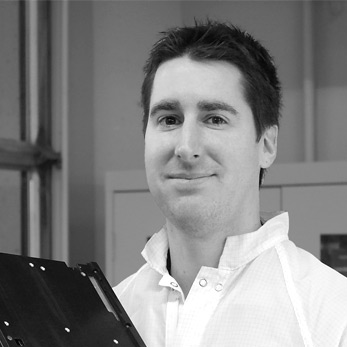
There is a moment in every aerospace career when you realize the rocket is just a delivery truck. What matters is the mission - what you're putting up there, why it needs to work, and how fast you can prove it. Chris Biddy reached that conclusion earlier than most, and built an entire company around it.
Biddy is the Co-Founder and CEO of Astro Digital, a company that started life in 2015 with a pitch about Earth observation constellations and quietly became something far more durable: a full-service mission platform for anyone who wants to operate in space without assembling a billion-dollar infrastructure team from scratch.
The numbers tell one version of the story. More than 35 satellites delivered to orbit. Over 10 active missions running right now. A modular satellite bus that spans applications from remote sensing to laser communications to in-orbit infrastructure. A funding history totaling $37.2 million. A Colorado expansion that added 141 aerospace jobs in a single announcement. Sony Space Communications as a customer. Astroscale as a sustainability partner. Star Catcher Network in the pipeline.
But the more interesting version of the story starts earlier - in the engineering labs of Cal Poly San Luis Obispo, where Biddy earned his Master's in Mechanical Engineering, and in the less-glamorous, pre-unicorn years of commercial satellite development, where he led the engineering team at Canopus Systems and worked hands-on at Stellar Exploration. By the time he co-founded Astro Digital alongside Bronwyn Agrios, Jan King, Kyle Leveque, and Mikhail Kokorich, Biddy already knew what it costs to build commercial satellite systems from the inside.
The Pivot That Proved the Point
In 2015, Astro Digital launched as an Earth observation constellation company. The pitch was clean: build a constellation, sell the data. It was a model that dozens of startups were running at the same time, from companies with far more venture capital than Astro Digital ever raised. Three years later, Biddy made a call that many founders wouldn't: he changed the model entirely.
By 2018, Astro Digital had repositioned as a Mission-as-a-Service provider. Instead of competing in the crowded Earth observation data market, the company would become the platform other organizations relied on to build and operate their own space missions. The shift wasn't a retreat - it was a sharpening. Biddy recognized that the biggest friction in commercial space wasn't the rockets or the data. It was the gap between "we have a mission concept" and "we have a working satellite in orbit."
"The biggest demand for small satellites is for remote sensing and communications applications."- Chris Biddy, Astro Digital
The modular satellite bus Astro Digital developed became the product. Configurable communications, flight-proven avionics, a platform that could handle proof-of-concept missions on accelerated timelines or scale up for full constellation deployment. The company didn't need to own the mission - it needed to make the mission possible for customers who couldn't afford to build the infrastructure themselves.
What "Mission-as-a-Service" Actually Means
The language of MaaS can sound like marketing until you look at what Astro Digital's customers are actually building. Science institutions running orbital demonstrations. Defense-adjacent commercial operators needing configurable communications. Earth observation companies that want a functioning satellite without a satellite manufacturing operation. Partnerships like the one with Sony Space Communications - announced in 2026 - where the platform is being used to develop micro-satellites with optical laser communication terminals, the kind of high-bandwidth space links that underpin next-generation connectivity infrastructure.
Each of these customers faces the same fundamental challenge: high costs, extended schedules, and mission risk that compounds when you're operating hardware you can't retrieve or repair. Biddy's response to all three is the same - a modular building block approach that reduces customization risk, compresses timelines, and brings decades of on-orbit heritage to bear on each new mission design.
The Astroscale partnership - announced in 2023 - added another dimension: Astro Digital's satellite buses now integrate Astroscale's Generation 2 Docking Plate, positioning satellites for end-of-life servicing and responsible debris management. It's a detail that says something about where Biddy is pointing the company. Sustainability in space isn't a regulatory checkbox; it's starting to become a commercial differentiator.
The Talent Equation
When Biddy explained the decision to expand into Colorado, he cited two things: the aerospace ecosystem and access to talent. That's a founder talking like an operator - not about the market opportunity or the tax incentives, but about the specific inputs a hardware company needs to execute. Colorado's aerospace corridor, anchored by companies like Lockheed Martin Space and United Launch Alliance, has been building engineering talent pipelines for decades. For a company like Astro Digital, that's infrastructure that money can't fully replicate.
The 141 jobs created by that expansion represent real scale for a company of 80 people. It signals a company not in survival mode, but in growth mode - adding capacity deliberately, in the right geography, with the right talent base.
"The aerospace ecosystem and access to talent are major contributors in our decision to expand into Colorado."- Chris Biddy on Astro Digital's Colorado expansion
The Industry He Helped Build
Chris Biddy came of age professionally during the era when commercial smallsats were still an argument, not an industry. CubeSats were a novelty. The idea that you could build a serious Earth observation or communications system on a small satellite bus that cost less than a traditional defense procurement was, in many circles, still controversial. He worked at companies building the early evidence base that changed that conversation.
By the time Astro Digital was founded, the conversation had shifted from "can this work?" to "how do we scale it?" Biddy was among the people who helped answer both questions. His 2017 appearance at SatSummit in Washington D.C. - the annual gathering of remote sensing and geospatial technology practitioners - placed him in a room of people trying to apply the satellite data revolution to real-world problems: agriculture, mapping, disaster response, climate monitoring. The applications Astro Digital's customers pursue today are downstream from that conversation.
He has also engaged directly with the broader space exploration community. His appearance on The Planetary Society's Planetary Radio podcast - speaking at the SpaceCom Expo in Houston alongside 1,600 space entrepreneurs - suggests someone who sees the commercial space mission and the exploration mission as connected, not competing.
What Comes Next
Astro Digital's partnership with Star Catcher Network in 2025, and its Sony Space Communications satellite agreement announced in 2026, both point in the same direction: the platform is expanding into higher-complexity missions. Laser communications, next-generation relay networks, multi-satellite constellations with sophisticated ground infrastructure - these are not the smallsat applications of 2015. They are the applications that will define the next decade of commercial space.
Biddy's Aquila Space venture - a newer project tied to his continued involvement in the commercial space sector - suggests he's still thinking beyond the current mission set. The pattern is consistent: identify where the friction is, build the platform that removes it, and stay close enough to the engineering to know when the approach needs to change.
In a sector full of founders who announce constellations and raise rounds and wait for the hardware to catch up to the vision, Chris Biddy built the hardware first. The vision followed from what the hardware could actually do. That is a rarer sequence than it sounds - and it is why 35 satellites are in orbit instead of 35 slide decks.