A satellite is an awkward thing to regret. Once it reaches orbit, the antenna cannot be exchanged because the market moved, or because the customer suddenly needs coverage somewhere else. The machinery leaves Earth. The assumptions tend to stay aboard.
CesiumAstro has built a business around loosening that attachment. Its software-defined radios and active phased-array antennas let operators alter communications behavior electronically. The appealing idea is flexibility after launch. The less glamorous requirement is making hardware that survives launch in the first place.
- The product: adaptable radios, communications payloads, mobile terminals and complete satellites.
- The buyers: spacecraft builders, government agencies and defense programs, including NASA and Taiwan’s space agency.
- The wager: common technology, larger factories and more control over the components inside.
01 / THE ORIGINAL INSIGHTA radio that can reconsider
Founder Shey Sabripour brought an unusually long apprenticeship to this problem. Before founding CesiumAstro in 2017, he spent 24 years at Lockheed Martin and served as Firefly Space Systems’ chief technology officer. He knew the established aerospace trade: ambitious specifications, intricate engineering, expensive qualification.
The alternative was modularity. Nightingale combines a radio and phased-array antenna into a single-beam payload. Vireo supplies multiple beams for more demanding communications architectures. Digital processors, computers and power modules form a reusable supporting cast. The company sells the pieces as well as the assembled systems.
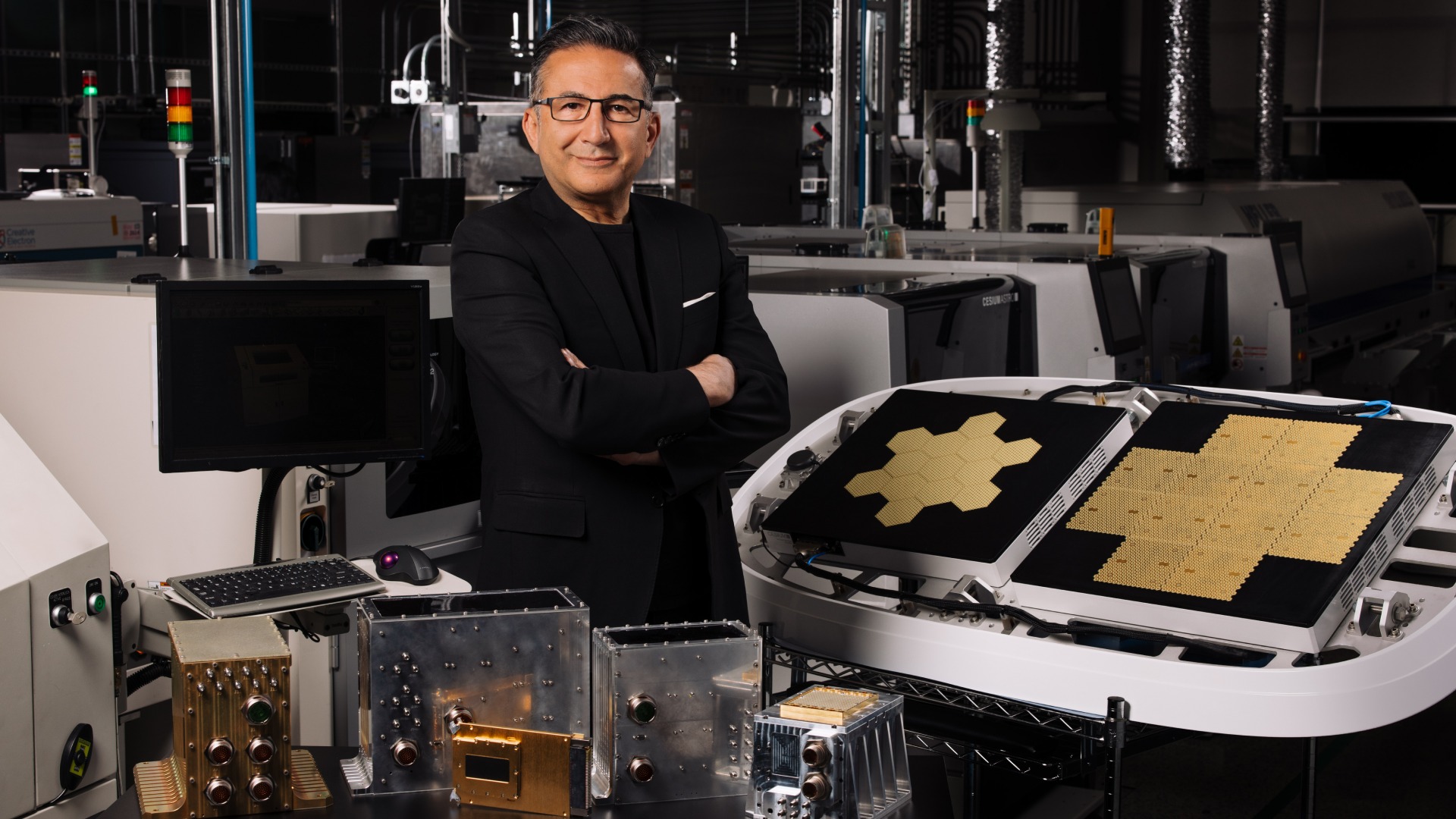
A phased array steers a beam by controlling signals across antenna elements. There is no need to swivel a dish. With suitable processing, several beams can serve different users, and coverage can follow demand. Software gives the operator choices within the hardware’s physical limits. It does not make those limits disappear.
02 / THE HARDWARE HAS CUSTOMERSThe customers buying the whole link
NASA’s Starling mission offers a concrete example. Its four CubeSats launched in July 2023 with CesiumAstro’s CommPack crosslink radios, supporting communications within a spacecraft swarm. Here, the useful output is a network between moving spacecraft. A component earns its place by helping the mission operate.
The defense business has a different scale. Rocket Lab selected Vireo communications payloads for 18 satellites in the Space Development Agency’s Tranche 2 Transport Layer program. CesiumAstro sits inside that supply chain: Rocket Lab builds the spacecraft, while CesiumAstro supplies a communications capability.
Taiwan’s space agency bought across the link. Its April 2025 contract covers Vireo space payloads and Skylark ground terminals for the B5G low-Earth-orbit program. Skylark is a flat-panel terminal for connectivity on mobile and fixed platforms. Supplying both ends gives CesiumAstro a broader integration role.
These are institutional purchases. CesiumAstro sells hardware and mission work to organizations building communications infrastructure. A terminal still needs a compatible network and service arrangement. The company occupies the machinery layer of satellite connectivity, where frequency bands, modems and qualification matter as much as download speeds.
The same radio expertise reaches beyond Earth orbit. In July 2024, NASA Marshall contracted with CesiumAstro for radio units compatible with LunaNet’s Augmented Forward Signal standard, supporting ground testing of future lunar navigation networks. The distinction matters: it is a development assignment for infrastructure that lunar missions could use, rather than a claim that CesiumAstro already operates a navigation service on the Moon.
03 / UP THE PRODUCT STACKFrom components to a 620-kilogram spacecraft
Element, unveiled in September 2024, makes the ambition visible. It packages the company’s communications technology into an integrated LEO satellite. Its published specifications include a 620-kilogram wet mass and a five-year lifespan at specified operating altitudes. The payload supplier is offering customers the spacecraft around the payload.
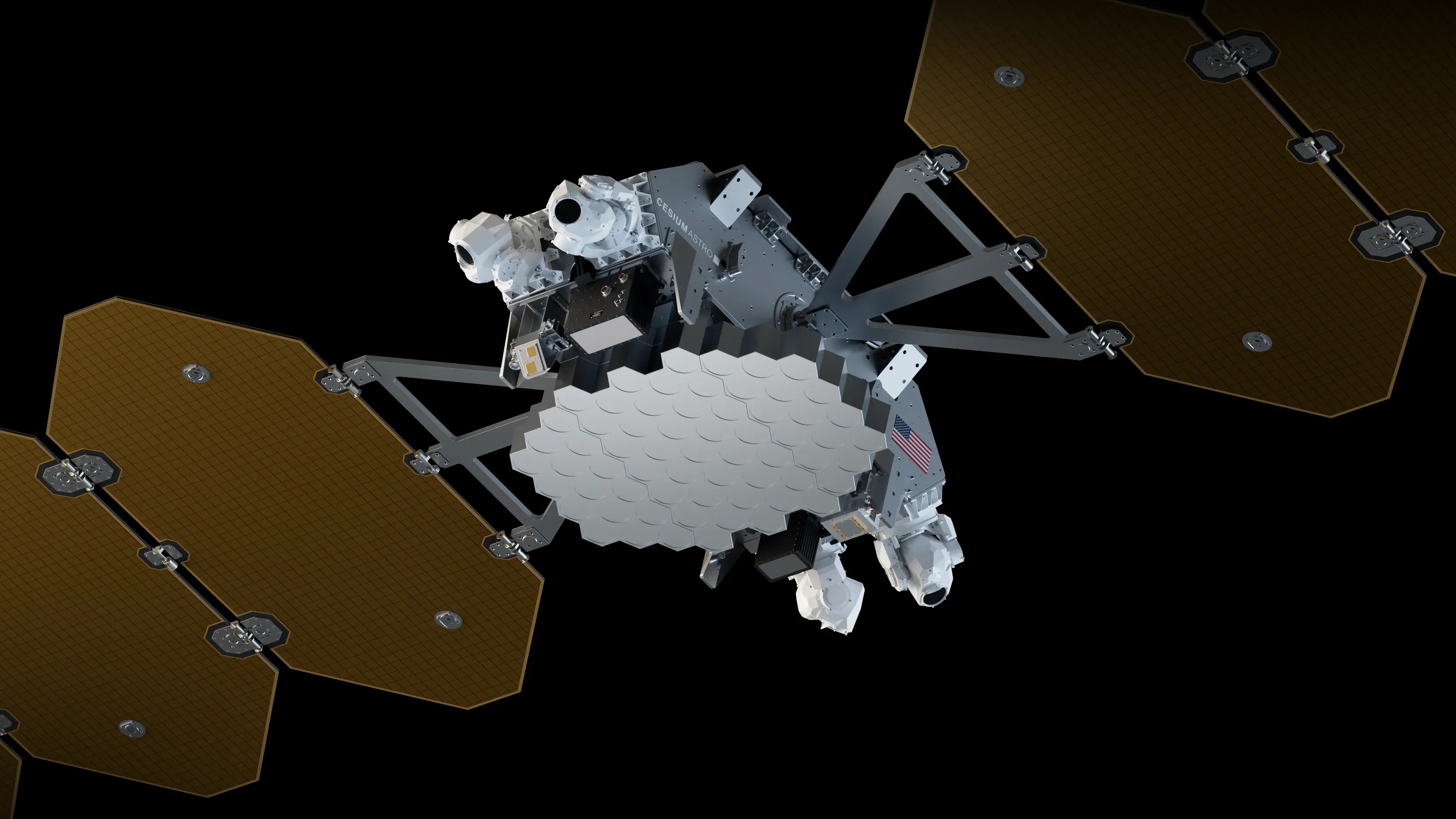
The commercial reasoning is straightforward: fewer interfaces for the customer to assemble, and more responsibility retained by the supplier. CesiumAstro announced eight SpaceX rideshare reservations in October 2025, with flights beginning as early as 2026. Launch access supports the roadmap; reservations alone do not establish orbital performance.
Flexibility is already a competitive category. Airbus’ OneSat offers reconfigurable communications from geostationary orbit. ALL.SPACE builds multi-link mobility terminals. CesiumAstro’s distinction is the span of its offering, from radio modules to terminals and LEO spacecraft, coupled with in-house design, manufacturing and testing.
04 / CAPITAL MEETS CAPACITYThe bill comes down to Earth
That scope requires capital. After a $60 million Series B in 2022 and a $65 million Series B+ in 2024, CesiumAstro announced a $470 million package in February 2026. Read the composition: $270 million in equity, led by Trousdale Ventures, plus $200 million in financing involving EXIM and J.P. Morgan.
“This is a scale moment.”Shey Sabripour / February 2026
In March, the company announced a planned $500 million Texas investment over five years, involving nearly 270,000 square feet of space. In September it signed a $300 million EXIM credit agreement, including a $20 million J.P. Morgan revolving line. Those announcements describe financing and planned capacity, rather than finished production.

05 / THE REPEATABLE PARTWhat another builder can borrow
The acquisitions follow the same expansion. Vidrovr added AI expertise in February 2026. Jariet brought RF semiconductor design in August; 1Aardvark added mission software later that month. Together, they extend control from the signal-processing silicon to decisions made by the spacecraft.
There is a practical lesson here: standardize what customers can reuse, preserve flexibility where missions differ, and keep design close to production. CesiumAstro’s careers material describes engineering beside manufacturing and teams owning hardware from concept to delivery. That is the company’s stated working method, and a sensible mechanism for shortening feedback loops.
The company’s expertise crosses several disciplines that customers otherwise have to coordinate: RF engineering, digital processing, firmware, software and spacecraft integration. Its AS9100D and ISO 9001:2015 certifications establish quality management processes. They are useful procurement credentials, while the delivered system still has to satisfy the particular mission. Repeatable architecture helps; environmental testing and operational evidence do the remaining persuasion.
The bargain remains conditional. A simple fixed mission may need less elaborate hardware. An adaptable system still needs enough power, thermal capacity and compatible network infrastructure. The factory must deliver those constraints reliably, unit after unit. CesiumAstro’s next test will be measured in the hardware leaving its doors.