In July 2022, an aluminum rolling mill in Indiana had a problem whose name was not aluminum. It was magnesium. The mill’s largest supplier of the alloying ingredient had stopped deliveries. Without enough of it, the Warrick mill could not maintain production of certain beverage and food packaging products. A business built around making enormous quantities of metal had encountered a bottleneck in the recipe.
- Kaiser makes specialty aluminum for aircraft, packaging, vehicles and industrial equipment.
- Its competitive argument is consistency: metal that behaves predictably in the customer’s factory.
- A $670 million acquisition exposed how much that promise depends on qualified suppliers.
The episode is a useful entrance into a company most people encounter without seeing its name. Kaiser sells semi-fabricated material: the plate, sheet, coil, rods, bars and tubes that other businesses turn into finished things. Its place in the economy is upstream of the familiar object, where a small change in material properties can complicate everything that follows.
The customer buys the next step
Consider the buyer’s problem. Aerospace manufacturers need strength without unnecessary weight. Can makers need sheet suited to forming and coating. A machine shop needs material that will behave under a cutting tool. The purchase has to survive a second manufacturing process. A bargain that creates extra scrap or unpredictable machining may stop looking like a bargain.
Kaiser’s answer is metallurgy married to process control. Its KaiserSelect range is engineered around more consistent characteristics, with the stated aim of improving performance and reducing waste. That is a testable industrial proposition: judge the material by what happens after delivery. For buyers, the useful question becomes the total cost of producing an acceptable part.
The customer list spans aerospace and automotive manufacturers, their suppliers, packaging producers and metal service centers. Those service centers help reach smaller industrial users. Applications can be unexpectedly intimate: Kaiser’s Chandler operation produces tubing used in a cryo nerve block device. The industrial catalog reaches from aircraft structures to a medical procedure.
The range is specific. Packaging buyers can source body stock as well as coated food, end and tab stock. Automotive offerings include driveshaft tubes, forging rod and material for ABS and manifold blocks. Aerospace buyers can specify plate and hard-alloy extruded shapes. Product choice starts with the application’s mechanical and processing requirements, then moves to the alloy, form and specification a buyer needs.
Henry Kaiser’s second act
The founder had already learned to think at industrial scale. Henry J. Kaiser’s wartime shipbuilding operations preceded his entry into aluminum in 1946, through government facilities leased and eventually purchased. The company later participated in an almost theatrical campaign to make aluminum familiar. Disneyland opened in 1955 with a Kaiser Aluminum Hall of Fame.
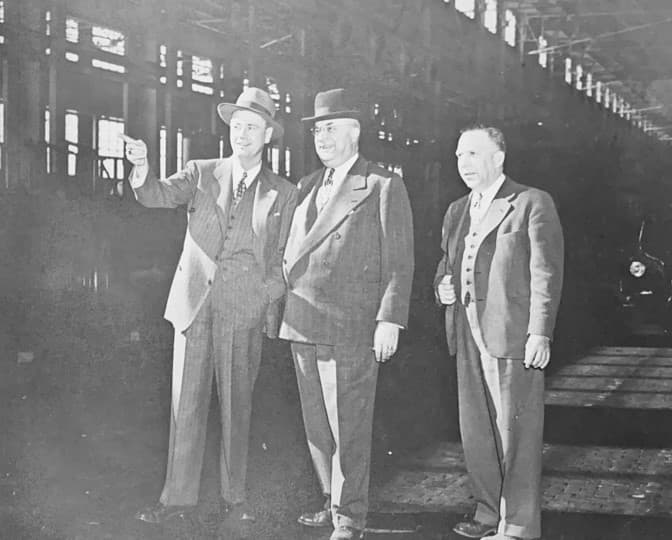
Scale did not guarantee permanence. Kaiser filed for Chapter 11 in 2002, began exiting primary aluminum operations in 2003 and emerged in 2006. The surviving business concentrated on value-added semi-fabricated products. Today, its specialized facilities apply that expertise to particular products and end markets, serving buyers whose processing requirements reward close attention to detail.
“We focus on demanding customers and the most demanding products to manufacture.”Neal West, on Kaiser Aluminum’s history page
The company’s published values put customer satisfaction beside safety, accountability and mutual learning. Its production approach emphasizes continuous improvement and eliminating waste. It describes those ambitions as becoming a preferred supplier and employer. Their commercial logic is straightforward: a promise about consistency has to be kept across shifts, equipment and facilities, long after a sales conversation has ended and the customer’s order enters production.
The $670 million boundary
Packaging returned to the portfolio through the 2021 purchase of Alcoa’s Warrick rolling mill. The consideration was approximately $670 million, including about $587 million in cash and $83 million in assumed retiree-benefit liabilities. This was a substantial acquisition of an operating business, with roughly 1,200 employees joining Kaiser.
The boundary of the deal matters. Alcoa kept the smelter, power assets and land. Metal supply and lease agreements connected the neighboring operations. Kaiser had bought a rolling mill whose performance still depended on other businesses. In 2022, magnesium shortages and problems with molten-metal supply made those dependencies painfully visible.
The company initially anticipated July production and deliveries falling 30% to 40%, with a larger reduction possible later in the quarter. The failure began upstream. Customer demand alone could not keep the line supplied. Nor could the acquisition price buy immunity from a missing ingredient.
A supplier must pass the test
By September, Kaiser had secured and qualified additional magnesium sources and lifted its force majeure. Its subsequent reporting described supply diversified across suppliers and regions. Qualification is the consequential word. In a technically demanding product, an alternative must meet the process requirements before it becomes a useful backup.
Other manufacturers can copy that discipline: identify the small inputs capable of stopping a large asset, then qualify alternatives early. The lesson has limits. Additional sources cost effort, and specialized requirements may leave few acceptable options. An approved supplier also needs dependable capacity. Diversification reduces a particular dependency; it cannot abolish production risk.
Read the revenue twice
Kaiser’s economics require similar attention to ingredients. Selling prices generally pass through metal costs. Conversion revenue subtracts the hedged cost of alloyed metal from net sales; it is a non-GAAP measure, not profit. A rising aluminum price can make the sales line grow without an equivalent improvement in manufacturing performance.
Conversion revenue removes hedged alloyed-metal cost. Operating expenses still have to be paid.
October 21’s results show the distinction: third-quarter sales reached approximately $1.21 billion, while conversion revenue was $439 million. Higher-value coated packaging helped the mix. Continued coating-line startup costs and operating inefficiencies still affected margins. Installing equipment and running it efficiently remain separate accomplishments.
Competition includes Arconic, Constellium and Novelis in aerospace and high-strength products. Kaiser’s claim on the buyer’s attention is practical: product breadth, technical knowledge and dependable processing characteristics. That claim earns its keep only when quality, availability and delivery hold up. Aluminum itself must also suit the application; a well-run mill cannot make every material trade-off disappear.
Fred Stephan is scheduled to succeed Keith Harvey as CEO on November 1, 2026. He inherits a business whose most revealing story may remain that missing magnesium. The finished object gets the attention. The quiet work is making sure the recipe arrives, the process repeats and the next factory can do its job.