The revealing page on Palitra3D’s website concerns an old printer. It promises to help people keep using equipment made by RIZE. For someone with a machine on a workbench, that is a consequential promise. Plastic must arrive. Software must run. Somebody must understand the error message. The company that sold the printer may have disappeared; the work waiting beside it has not.
- Full-color composite parts, printed to order.
- Glass- and carbon-fiber filament, plus compatible inks.
- Supplies, software and support for existing RIZE machines.
A company ends. The work carries on.
Palitra3D’s origin sits inside that awkward gap between a company’s lifespan and a product’s useful life. Eugene Giller founded RIZE, whose process married filament extrusion with inkjet printing. In March 2022, trade publications reported that RIZE had ceased operating. Palitra, whose LinkedIn profile dates its founding to 2021, became a continuation point for customers, materials and technology.
Its welcome page for RIZE owners offers filament, technical help, OneTouch software and printer firmware. It also states the next ambitions plainly: printing services and technology licensing. Read as a business choice, this is a move toward several ways of earning from the same technical knowledge. A customer can order an object, replenish a machine or discuss incorporating the process into another printer.
The money needs its own label. RIZE announced a $15 million Series B in February 2019, with investors including Dassault Systèmes, Innospark Ventures, Sparta Group and Converge. That was RIZE’s financing. Palitra is a later company. The distinction matters because a continuing technology can make two different businesses look deceptively like one uninterrupted success story.
“Palitra is committed to serving you and the equipment you purchased from RIZE in the past.”
Palitra’s promise to RIZE owners ↗
The layer has two jobs
Imagine a factory fixture that holds a component in place. Its shape tells the worker where the component goes. Printed instructions could explain its orientation; a warning could identify a hazard. Palitra’s printing service invites exactly this sort of use, alongside prototypes, artistic models and anatomical visualization. Color becomes another piece of the design specification.
The mechanism gives that idea substance. An extrusion system builds the thermoplastic part. Inkjet heads add color. In the XRIZE process, cyan, magenta, yellow and black inks create the image on the composite material. There is also a less photogenic ink with an excellent job: helping the temporary supports come off.
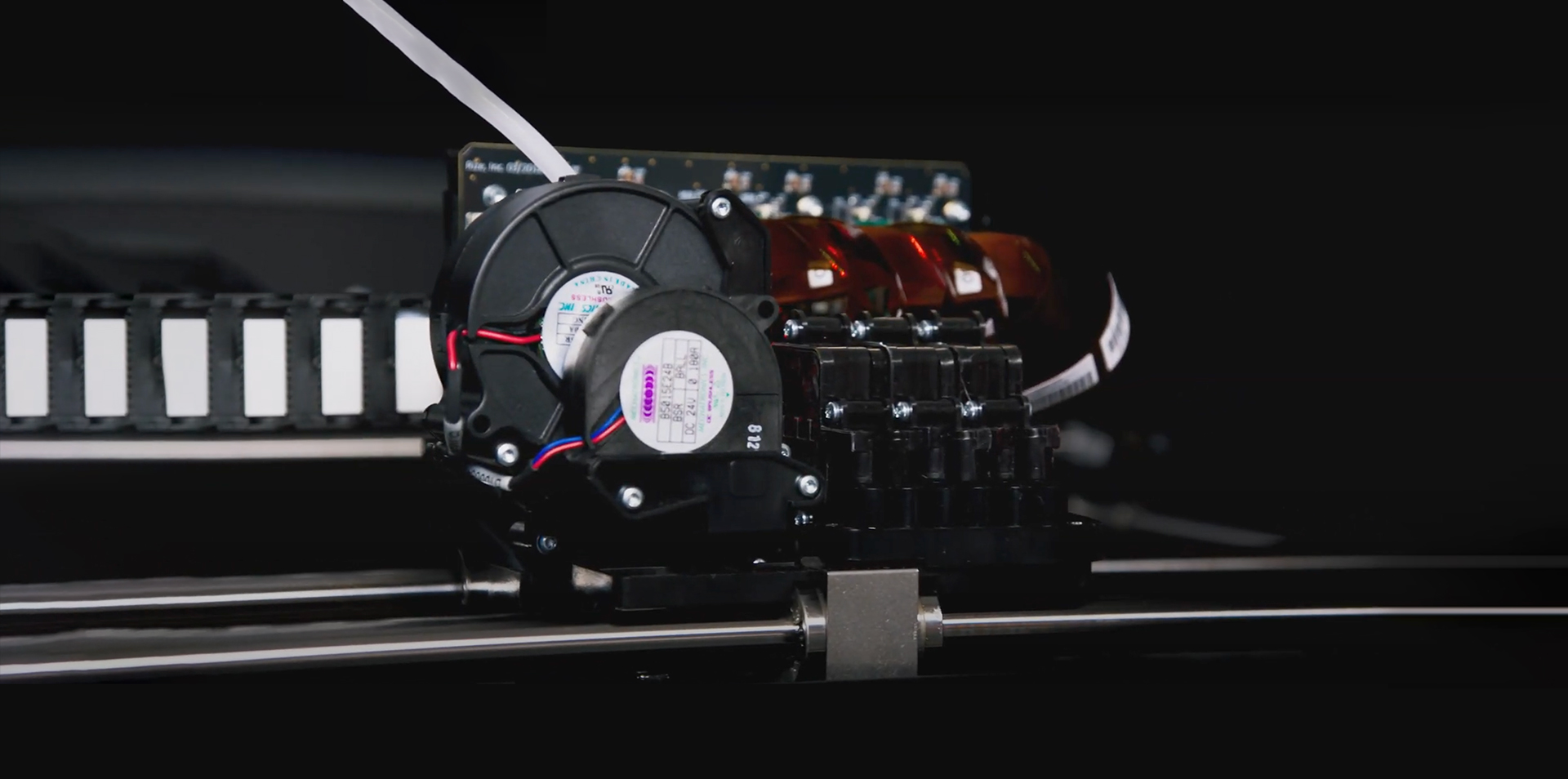
Supports are the scaffolding of a print. Necessary during construction, they become a nuisance afterward. Palitra’s Release One ink is deposited at the interface between support and part, weakening that bond. The aim is easier removal while preserving the surface that carries the color. One piece of chemistry helps the object stay together; another tells a specific attachment when to let go.
Composite thermoplastic is extruded to build the physical part, layer by layer.
Conceptual diagram. Select a function to explore.A heart with something to show you
A colorful heart model makes the proposition legible. Shape supplies the anatomy; color can distinguish structures that a single shade would make harder to read. Palitra displays anatomical examples alongside landscapes and engineering applications. Its pitch crosses professional boundaries because the underlying problem recurs: somebody needs to understand a three-dimensional thing.

There is a more playful commercial example. AG3Dprinting names Palitra3D as its production partner for custom fidget spinners. Buyers can add a company logo and a QR code. A pocket toy becomes a small advertising surface. The appeal is specific: geometry, branding and a scannable link arrive in the same object.
For a designer, the purchasing process starts with a color-capable file and instructions. Palitra lists OBJ, 3MF, FBX and PLY among accepted formats, then provides a quote. The practical advantage is access without buying the equipment. A 2021 account put the historical XRIZE retail price at approximately $40,000. Ordering a part changes the size of the commitment.
Other routes serve this market. Stratasys PolyJet systems build full-color models from photopolymers; Prusa’s MMU3 switches among five filaments. Palitra’s particular combination is a composite thermoplastic body with inkjet-applied color. Those differences make material requirements and image detail useful starting points for comparison.
The useful numbers have footnotes
Palitra’s materials story concerns familiar print frustrations: moisture, curling and weak bonds between layers. Its glass- and carbon-fiber composites are marketed as moisture-resistant engineering materials. The glass-fiber data sheet reports tensile strength of 57 MPa and moisture absorption below 0.01%. These are measured values with stated testing conditions, rather than a promise for every shape printed on every machine.
Reported glass-fiber tensile strength
Reported moisture absorption
Compatibility deserves equal attention. Palitra warns that its composites are abrasive and recommends hardened extruders and nozzles. Buying the filament also does not add an inkjet system to an ordinary printer. The feedstock and the full-color process are separate purchasing decisions. The sensible first trial is a representative part, evaluated for surface quality, handling and the information its colors must carry.
The file still has to behave
Palitra’s 2024 AMUG competition entry supplies a useful account of what happens before printing. The team generated or selected models, checked files in Microsoft’s 3D Builder, edited them when necessary and moved them into OneTouch for sizing, supports and slicing. Earlier AI-generated models needed more adjustments; later versions needed less intervention, according to the entry. It records a workflow experiment, rather than an award.
That is a lesson a reader can copy: inspect the handoffs. A promising image still needs printable geometry. A printable object still needs suitable material. A finished part still needs supports removed. Palitra’s particular expertise sits across those steps, where software preparation meets polymer chemistry.
In his 2023 company essay, Giller argued for color as a way to communicate designs and test realistic prototypes. The strongest version of that argument starts with a task. Ask what the object must explain, then decide whether printing that information into it earns its cost. A fixture with readable instructions has answered a better question than “How many colors can we print?”