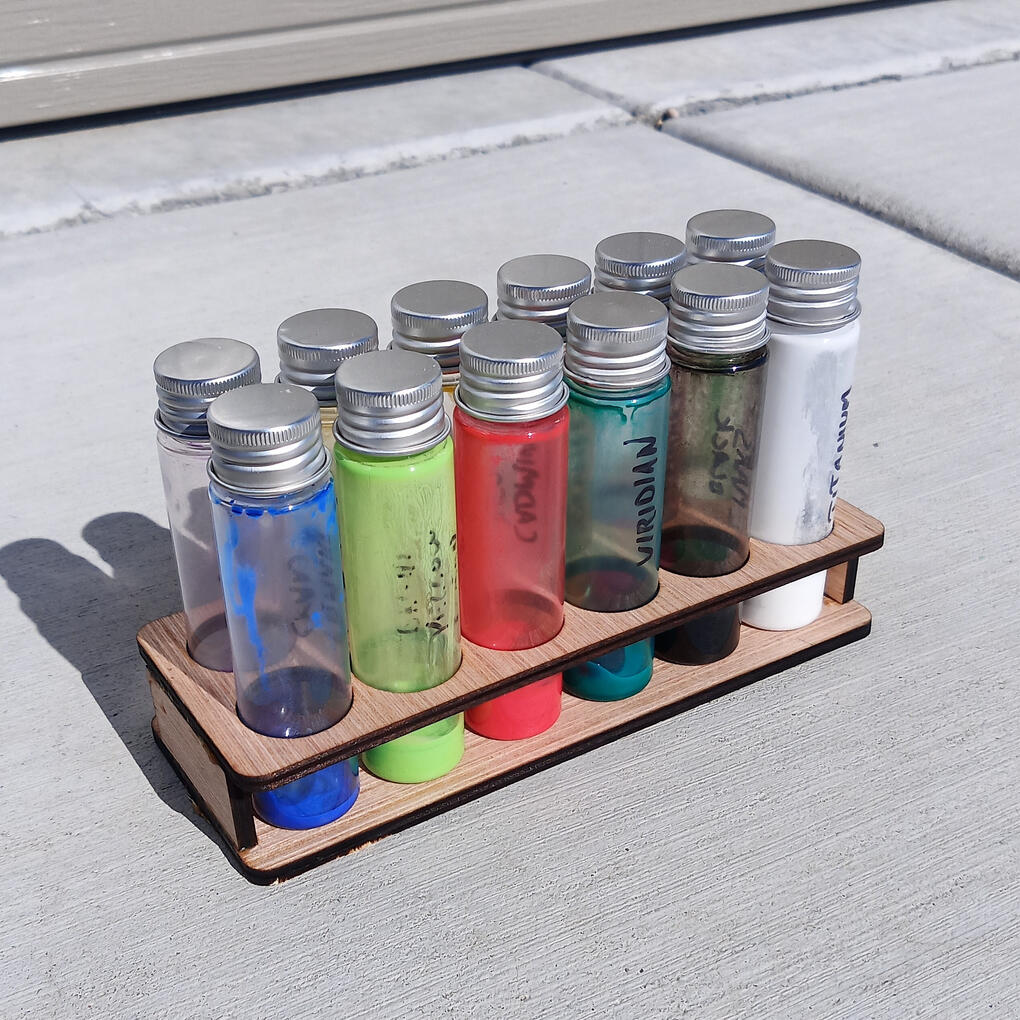
The paint tubes kept falling over. Dave Getchel made them a holder. In the photograph on his studio website, small glass containers stand in two tidy rows, their colors visible through the sides, their silver caps catching the sun. A laser-cut wooden rack does the unglamorous work of keeping them upright. Here is a design problem with an unusually agreeable ending: the objects that should stand up now stand up.
Making something useful has not always made Getchel a successful seller. In a 2019 account of his failed ventures, he described spending $800 on shirts without an audience waiting to buy them. A crowdfunded paint kit attracted support, then exposed weaknesses in production and international shipping. Those admissions give the designer behind DGDA an interesting credential: experience of the gap between an appealing object and a workable business.
DGDA offers creative assistance across digital and physical design. Its company profile identifies a self-employed business founded in 2017 in El Dorado Hills, California, with one employee. Getchel describes decades in design and computer work. “From digital to physical, I can help,” reads the company’s compact pitch. The phrase is broad; his collection of projects gives it texture.
A studio you can trace through its objects
Follow Getchel’s personal website today and the design link takes you to Dry Lake Design, an off-grid studio in Fallon, Nevada. That is the current studio he presents to visitors; DGDA retains its separate California company listing. The distinction matters when looking at the work and the prices. The Nevada portfolio offers a view of what this designer does now, without requiring the two business names to be treated as interchangeable.
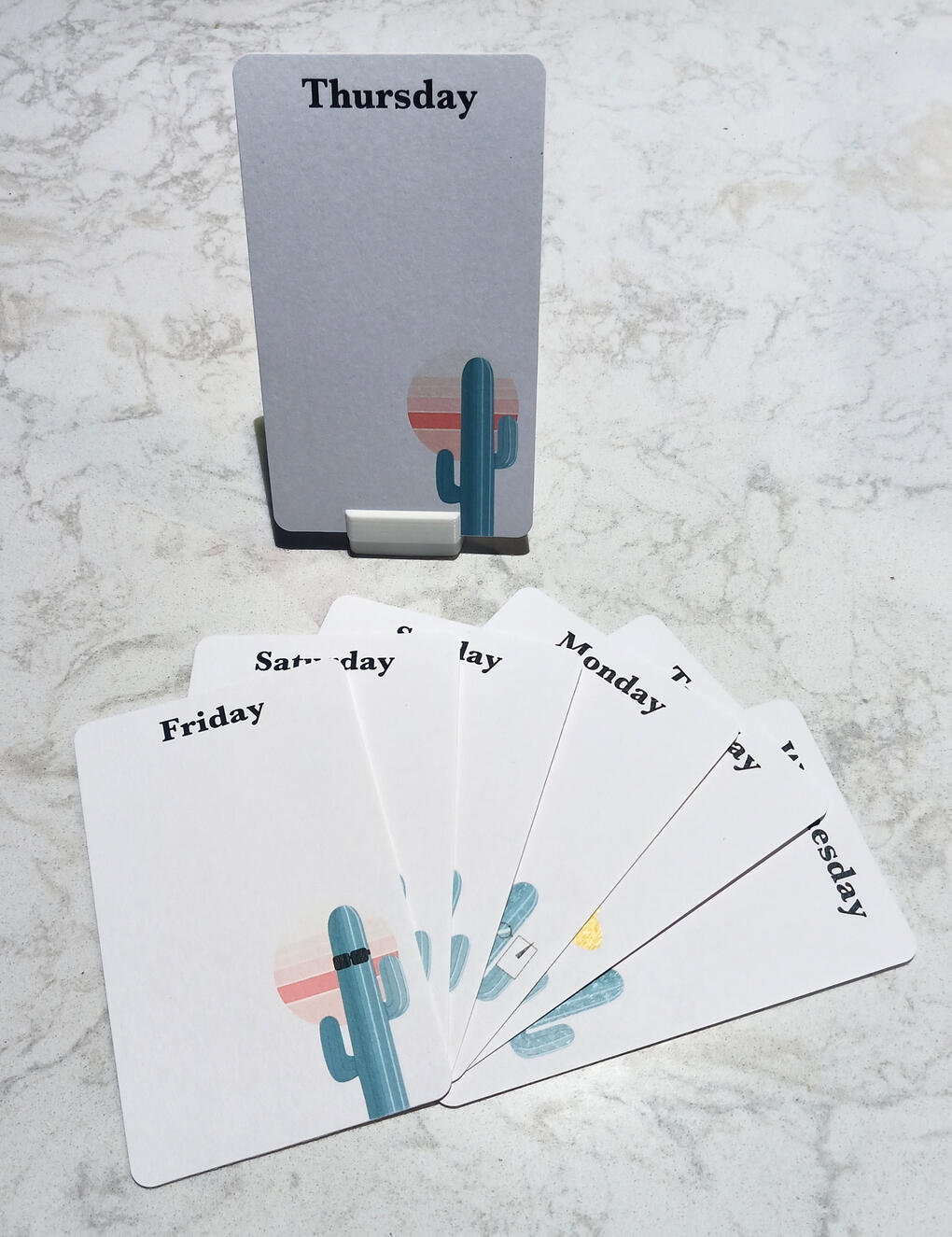
There are websites and physical prototypes, including a money-tracking web app and a mechanical iris intended to close vent tubes. The iris is explicitly presented as work in progress. A replacement deboss seal involved 3D modeling, resin printing and finishing. Elsewhere, a set of task cards pairs printed graphics with a modeled and printed holder. The paint organizer sits comfortably among them.
These examples have different audiences and different tests of success. A seal must leave the intended impression. An organizer must fit its contents. A card holder must make a small piece of paper convenient to use. Looking across them, the common thread is the conversion of a specific need into something that can be inspected, handled or tried.
For a prospective customer, that makes the work easier to discuss. You can point to the object, identify what it is supposed to do and ask which part still needs resolving. A digital rendering may answer a question about appearance. A physical sample may expose a question about fit. Good early design work makes those questions smaller and more precise.
The expensive part came after the idea
Getchel’s failure list is refreshingly particular. Alongside the shirts and paint kit, he mentioned a guide to accomplishing adventures that lacked an audience, illustration assets that failed to gain a place in a major online store, and a job board whose marketing faltered.
“I have too many ideas and I like to test them.”Dave Getchel, 2019
The recurring difficulty was getting from creation to customers. The watercolor project adds a separate complication: attracting buyers does not settle the work of manufacturing and delivery. Read together, the examples suggest two questions a maker should ask independently. Does somebody want this? Can I supply it on terms that make sense?
Editorial reading of Getchel’s experiments. Each question needs its own answer.
The practical response is to test those assumptions separately. Before committing to inventory, a maker can show a sample to plausible buyers. Before promising a delivery price, the maker can pack one finished item and establish what that actual parcel will cost to send. Neither exercise guarantees a business. Both replace a hopeful assumption with something that can be checked.
There is also a useful distinction between personal usefulness and commercial demand. The paint rack can earn its keep on Getchel’s own bench even if nobody else orders one. A product made for sale faces another test. It needs enough outside interest to justify the time, materials and work of reaching those customers.
Creative time has a price tag
The current Dry Lake Design offer puts numbers against access to Getchel’s time. Hourly work costs $55, with a three-hour minimum and materials charged separately. The minimum labor commitment therefore comes to $165. That is a starting commitment, not a promised price for a finished prototype.
$55 × 3 hours. Materials extra. Checked September 11, 2026.
One project at a time; $250 material credit.
Full-time dedication; $1,250 material credit.
The monthly options sell a share of capacity or dedicated attention. For a buyer, the question is how much uncertainty remains in the job. A short consultation can help define a problem. A longer engagement can support successive versions. Choosing between them should begin with the decision the work needs to support, rather than with the number of artifacts a customer hopes to accumulate.
A useful brief might specify the intended user, the obstacle, the dimensions or technical constraints and what a satisfactory first version must demonstrate. It should also distinguish exploratory work from something ready for production. A model that persuades a decision-maker to proceed has done one job. An object ready to be manufactured repeatedly has to do several more.
That places Getchel’s offer in the market for independent design and early prototyping. The alternatives depend on the assignment: a web designer for a website, a fabrication shop for a known part, or a broader design studio for a project requiring several specialties. His visible appeal is the range of tools brought to small, concrete problems.
Seven minutes, with the music turned up
Getchel’s side projects reveal some of his product decisions more clearly than a services list can. Product Hunt dates the launch of 7 Minutes in Hell to 2024. He described making the workout web app for himself, using randomly selected body exercises with 45 seconds of effort and 15 seconds of rest. The site presents a seven-minute session with heavy metal music.
The name came after he encountered a reference to “7 minutes in Heaven” and decided his workout belonged at the other end of the theological spectrum. The joke does practical work: it gives a small exercise timer a memorable identity. On the launch page, Getchel emphasized that he wanted the experience to be simple for his own use.
He also explained a change in the audio. In a public Product Hunt comment about Suno, he said he used the tool to make most or all of the music and assembled it in Audacity. He tried tracks with lyrics but found them distracting. That is a modest, observable design judgment: an added feature competed with the activity, so he preferred an alternative.
The lesson travels beyond fitness apps. A feature should be judged while someone is doing the intended task. A pleasing element in isolation can become interference in use. For a customer commissioning design, asking to try a rough version can reveal more than asking for another description of the finished experience.
A workbench is part of the business philosophy
Getchel’s personal Northstar page describes a workshop, a tiny house he built and a continuing appetite for adventure. The workshop serves a precise purpose: “When the idea strikes, I have little friction between me and something tangible.” His account of the house emphasizes comfort, shelter, cooking, company and the pleasure of reading or watching other people’s creations.
The surroundings fit his stated preference for simplicity. They also help explain why his work moves between a browser and a bench. If the objective is to make a thought testable, the appropriate tool might be code, paper or a printer. The medium follows the problem that has caught his attention.
His interest in controlling creative time predates the current studio. Buy My Time, a short podcast experiment, published four episodes between March 29 and April 1, 2018. Its description framed the project as an attempt to regain control of his time and bring creativity forward. The episodes covered the concept, debt and incremental improvements.
That history gives the current capacity-based service offer a personal context. Time is both what the designer wants to protect and what a client buys. The arrangement makes the definition of a project especially consequential: attention spent on one unresolved detail cannot simultaneously be spent on another.
Start with the thing that keeps falling over
The clearest reason to consider a designer like Getchel is a problem that needs a first tangible answer. His portfolio supplies examples of work crossing digital design, fabrication and everyday use. A customer can use those examples to start a specific conversation about a prototype, a small tool or a digital experience.
The fit becomes less straightforward when a job requires many specialists working simultaneously, production certification or manufacturing at volume. Those needs call for their own capabilities and agreements. The examples shown here support a conversation about developing and testing ideas; they should be evaluated at that scale.
For readers making something themselves, the paint rack remains a useful place to begin. Identify the recurring irritation. Make the smallest object that addresses it. Try it in the setting where the irritation occurs. Then, if the ambition is to sell it, ask somebody beyond your own workbench whether they want one. That last conversation deserves a place in the design process before the boxes of inventory arrive.