A pool makes an excellent promise. Buy it, fill it, and leisure will appear in the backyard. Then comes the testing, the interpreting, the measuring and the trip to buy whatever the water apparently wants this week. Justin Miller has spent years working on the distance between those two experiences. He has built one company around it, sold that company, and come back to the water with another.
His first pool-monitoring venture was pHin, developed by ConnectedYard with co-founder Mark Janes. Hayward acquired the business in 2018. Its monitoring service ended in December 2021. Miller now leads General Galactic Systems, the company behind Crystal Water Monitor. The sequence gives his story an unusual shape: the exit came before the return, and the return concerns much the same chore.
A barbecue with consequences
The conversation that helped start ConnectedYard happened at a backyard barbecue. Miller and Janes were discussing an idea for simplifying pool care. In the third quarter of 2014, they started the company together. A familiar annoyance had become a prospective business. Barbecues have produced worse things than an agreement to do some work.
Miller arrived with a career in technology and customer experience. His earlier workplaces included Apple, eBay and Plaxo; at Comcast, he had led a 250-person innovation center before leaving in 2014. Those names explain the professional setting from which he approached the backyard. A pool offered a task with plenty of information and a customer who had to make sense of it.
ConnectedYard publicly announced pHin in June 2015. The proposition joined a Bluetooth sensor to a mobile app, with premeasured chemical pods delivered to subscribers and access to on-demand pool service. A notification would tell the owner when the water needed attention. The owner could then follow an instruction rather than work through the calculation alone.
The announcement also described support from Tandem Capital and access to a prototyping lab in Burlingame. Behind the pleasant idea of an easier afternoon sat the ordinary work of making a physical product: designing it, fabricating it and getting its parts to cooperate. A swimming pool is a fairly unforgiving place to send a new computer.
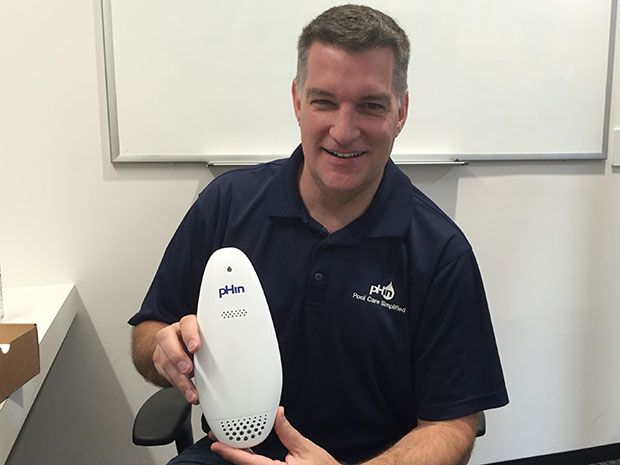
Even turning it on required thought. An external button would complicate waterproofing, so the team used a magnetic switch operated with a magnet in the cap. Another early adjustment concerned alerts: tracking every fluctuation too eagerly could make the system demanding. Miller put the intended result plainly: “The idea is to make pool care easier, not harder.”
A device meets an industry
The customer holding a phone was only one person Miller needed to persuade. Pool care already supported manufacturers, retailers and technicians. In 2015, he was making the case that a connected monitor could help professionals concentrate on other work and reduce unnecessary travel. He was also talking about reaching customers through the stores where they already bought chemicals.
Some professionals were unconvinced. That was a practical response to a product proposing to handle testing and send supplies directly to the home. Anyone whose livelihood included those activities had a reason to ask where the new arrangement left them. Miller’s job included explaining how their businesses could participate.
Over time, pHin’s offer changed. Alongside its own chemical subscriptions, it supported chemicals customers could buy in stores. Lonza became a strategic partner, and a retail version omitted the chemical subscription. A homeowner’s existing purchase could now fit into the system. For the store, a sensor could become a reason for another visit.
This is one of the more revealing turns in Miller’s story. The product had to find a place among established habits and working relationships. The adjustment was visible in what customers could buy, what the app could recommend, and how dealers could stay involved. The commercial design needed attention alongside the industrial design.
Measure the water → interpret the trend → recommend an action → let the owner or technician respond.
By the time Hayward acquired ConnectedYard, the professional network was part of the proposition. Pool Service On Demand had more than 1,000 technicians nationwide, according to the acquisition coverage. Retailers could also use customer data and inventory information. The business had grown around the relationships that a simple floating sensor might initially seem to bypass.
The sale, and the switch-off
Hayward’s acquisition in April 2018 placed pHin inside an established pool-equipment company. Miller and Janes were to continue operating the business under its new owner. Hayward saw the technology as part of its broader work in connected pool automation. For the founders, the deal offered a way to expand adoption through a company already serving the market.
The product also moved toward the plumbing. In October 2018, ConnectedYard announced a partnership with Nordic Hot Tubs for pHin Ready installations in its 2019 North American models. An adapter would put monitoring into the hot tub itself. With customer permission, manufacturers and dealers could see water histories and chemical usage through the partner portal.
That development placed the service relationship inside the product. A dealer could have information before a customer arrived with a question. The owner could receive guidance through the app while the business supplying the hot tub had a view of the same installation. The connected backyard was becoming a shared workspace.
Then the service stopped. Hayward’s customer notice set December 20, 2021, as the end of pHin monitoring and the closure of the business. The notice explained that the monitor would cease actively measuring and the app would no longer operate as before. Owners were advised to recycle the floating device.
For a connected product, the service’s ending reaches all the way into the object. The hardware can still be sitting there while the arrangement that made it useful has disappeared. That gives this chapter of Miller’s career a sharper edge than an acquisition announcement alone would suggest. The owner’s experience continued after the sale, through the service’s eventual closure.
Back to the water’s edge
Crystal Water Monitor launched in 2023. Miller was again working in the category, this time with General Galactic Systems. The company’s leadership includes CTO Scott Eklund and CPO Josh Kennedy. Its team description connects the new business to the people who previously built pHin. The return came with colleagues as well as experience.
The company is based in San Diego, with engineers distributed across North America. Its biographies describe Eklund’s background in games and embedded software and Kennedy’s work in engineering, user experience, cloud infrastructure and mobile apps. Miller’s place in that group combines company leadership with a design background. Pool monitoring calls on all of those kinds of work.
The clearest physical change is easy to explain: Crystal’s monitor stays outside the water, and its sensor goes in. A cable connects them. The mounting guidance allows horizontal, vertical and pole installations, while requiring the sensor’s bottom to remain submerged. The electronics have a different home from the part taking measurements.
That arrangement addresses a lesson Miller described from pHin: moisture could eventually reach electronics in a floating monitor. Crystal also has replaceable batteries and a replaceable sensor. These are decisions about the less glamorous middle of ownership, when a component needs attention and someone has to decide what happens next.
In March 2025, General Galactic announced a revised Crystal sensor. The launch materials paired the hardware with app notifications, dosing guidance tailored to the customer’s chosen chemicals, and historical charts. At that announcement, the price included the first year of monitoring, with an annual renewal afterward. Miller was again selling an ongoing relationship with a device.
“We knew what we were doing.”
Justin Miller, on developing Crystal after pHin
A route full of customers
The professional version extends that relationship across a service route. General Galactic announced its inline Crystal system in November 2024, giving pool professionals access to readings, chemical usage history and other records through an app or computer. It also described collaboration with Gecko around waterlab, a monitoring and dosing-recommendation system integrated under the spa.
The engineering gets quite specific. The inline design retains water around the sensor when plumbing drains. It takes readings when water is flowing, avoiding misleading information from water sitting in hot pipes. The professional app also distinguishes between the technician’s view and the customer’s view. Miller’s account of developing it stresses knowing where to spend the team’s effort.
The consumer system has its own division of labor. It sends samples every ten minutes and turns those samples into trends. The app asks for the pool’s volume and other setup details so it can calculate recommendations. Owners still add the chemicals. The software organizes information into a task someone can carry out.
It also asks for occasional water reports to capture slower-changing values that the electronic sensor does not measure. Test strips can be scanned into the app; store tests and other manual results can be entered too. The arrangement leaves room for several ways of understanding the water, with the person responsible for the pool still involved.
Follow Miller across these ventures and a consistent question emerges: how much work should ownership require? His answers have included delivered pods, retail partnerships, remote access, different hardware and professional tools. The pool continues to require care. Miller keeps revising the part between noticing that something needs doing and knowing what to do about it. The leisure promised by the backyard still needs someone working on its behalf.