Brad Damphousse’s route to GoFundMe began with a vacation he wanted to save for. In 2008, setting up an online savings account proved more bothersome than he expected. A designer accustomed to improving other people’s products had encountered a problem of his own. Surely, he thought, this could be easier. The proposed answer had a cheerful name: Coin Piggy. The arithmetic was less cheerful.
Damphousse and his collaborator, Andy Ballester, considered a service that would let people set money aside through debit-card transactions. Fees would eat into the savings. A piggy bank that takes a bite every time you feed it is a difficult household pet. Coin Piggy never launched. Yet one part of the idea remained interesting: people could invite others to contribute toward a goal.
That small opening would eventually lead to GoFundMe. Before the familiar name came a less familiar stretch of work: explaining the idea, finding customers, revising the business and making the act of giving easier to complete. Damphousse’s founding story rewards attention to the unglamorous bits. The invitation, the registration form, the answer to a customer’s question. Much of the consequential work happened there.
A piggy bank with a leak
The two founders launched CreateAFund in 2008. They tried charging subscriptions to small and medium-sized charities, while offering individuals a free fundraising option. Charities were difficult to sign up. Individuals kept arriving. By 2010, the founders were concentrating on personal causes and had renamed the service GoFundMe.
The contrast between those customers carries the story. A company has a plan for who will pay, and then actual people turn up with their own intentions. The founders had to decide how much authority to give that behavior. Their eventual choice made the individual fundraiser the center of the business.
- 2008 · Coin PiggyA savings concept stopped by transaction fees.
- 2008 · CreateAFundPersonal fundraising emerges alongside charity subscriptions.
- 2010 · GoFundMeThe focus settles on individual causes.
Ballester and Damphousse had met while working at the same San Diego startup. They already knew they could build products together. In the early GoFundMe work, Ballester handled the coding; Damphousse handled design and CSS. Consulting assignments helped them finance the effort. Their partnership supplied both the working relationship and the means to keep going while the product changed.
The division of labor matters. A fundraiser encounters an interface rather than an organizational chart. Someone has to make the machinery function; someone has to decide what the person looking at the screen should see and do next. For these two founders, that collaboration predated the company whose name would become familiar.
A designer learns where people stop
Damphousse had been interested in the web long before crowdfunding entered his career. In a 1998 school design class, he helped create Central Catholic High School’s first website. He went on to Emerson College, studying New Media Design and Marketing and graduating in three years. Design and persuasion were neighboring subjects in his education.
In 2004, he joined a Boston advertising firm. He later described finding its bureaucracy and office politics constraining. He saved money, moved to San Diego and took website design work for startups. The career path gave him repeated opportunities to examine how a digital product presents itself to someone who has never used it before.
His own public design portfolio is revealingly modest in subject matter. The Dribbble entries include a donation form and a fundraising meter. These are the components a user might glance at without considering their author. An amount, a button, a measure of progress: the furniture of an online appeal.
Look closely and each component poses a question. Does the donor understand what happens next? Does the organizer know how far the campaign has progressed? Is the amount easy to enter? The designer’s work sits inside those ordinary moments, where attention is brief and uncertainty can be expensive.
In 2012, Damphousse described a series of GoFundMe experiments. A more explanatory signup experience increased conversions by 16 percent. Letting people preview the page-customization experience before registering produced another 14 percent improvement against that version. Replacing a five-step payment-account connection with a single step increased conversions by 17 percent. A simpler donor payment screen improved conversions by 28 percent against its alternative.
These were separate tests, with different comparisons. Their percentages describe particular experiments, rather than a single grand total. Together, they show what occupied the founder’s attention: the places where people hesitated, got diverted or stopped.
“What’s the one thing that really matters?” he asked. The answer for this product involved both sides of the transaction. The organizer needed to receive support; the donor needed to complete a contribution. Every extra obstacle could interfere with an intention that already existed.
The crowd begins with people you know
GoFundMe’s premise depended on relationships. In 2013, Damphousse explained that campaigns first needed support from personal contacts before they could appeal to a wider audience. A fundraising page could travel, but its first audience was often already acquainted with the person or the cause.
That observation keeps the word “crowd” from becoming too abstract. The first person to contribute might be a friend. The next might know that friend. A page carries an explanation across those connections, giving each visitor something more concrete than a general invitation to be generous.
There is a social awkwardness in asking for money. The product gave the request a place to live: a page someone could read, return to and share. A person could describe a goal once instead of starting the explanation again with every conversation. The interface made the request portable.
Damphousse also placed unusual emphasis on customer service. In a 2013 interview, he said GoFundMe answered user questions within five minutes or less during the day. He spoke about making the experience pleasant for organizers and donors, and about earning enough trust that people would recommend the service.
A fast reply is a small event with a clear before and after. Someone is stuck; then someone has an answer. At a company built around personal appeals, that interaction becomes part of how the service feels. The software and the people answering questions both shape the experience.
“Focus on making your first dollar and the second one will come easier.”Brad Damphousse, 2013
His advice to aspiring founders was similarly practical: establish revenue early. He associated bootstrapping with the freedom to make decisions without seeking board approval. The priority was to build something people would use and a business capable of sustaining the work. The two ambitions had to meet.
Printers, prototypes and the twentieth try
In a 2012 photograph, Damphousse and Ballester sit beneath the GoFundMe logo with 3D printers on their laps. The machines make rather bulky accessories. They also give a glimpse of interests that extended beyond forms and browser windows.
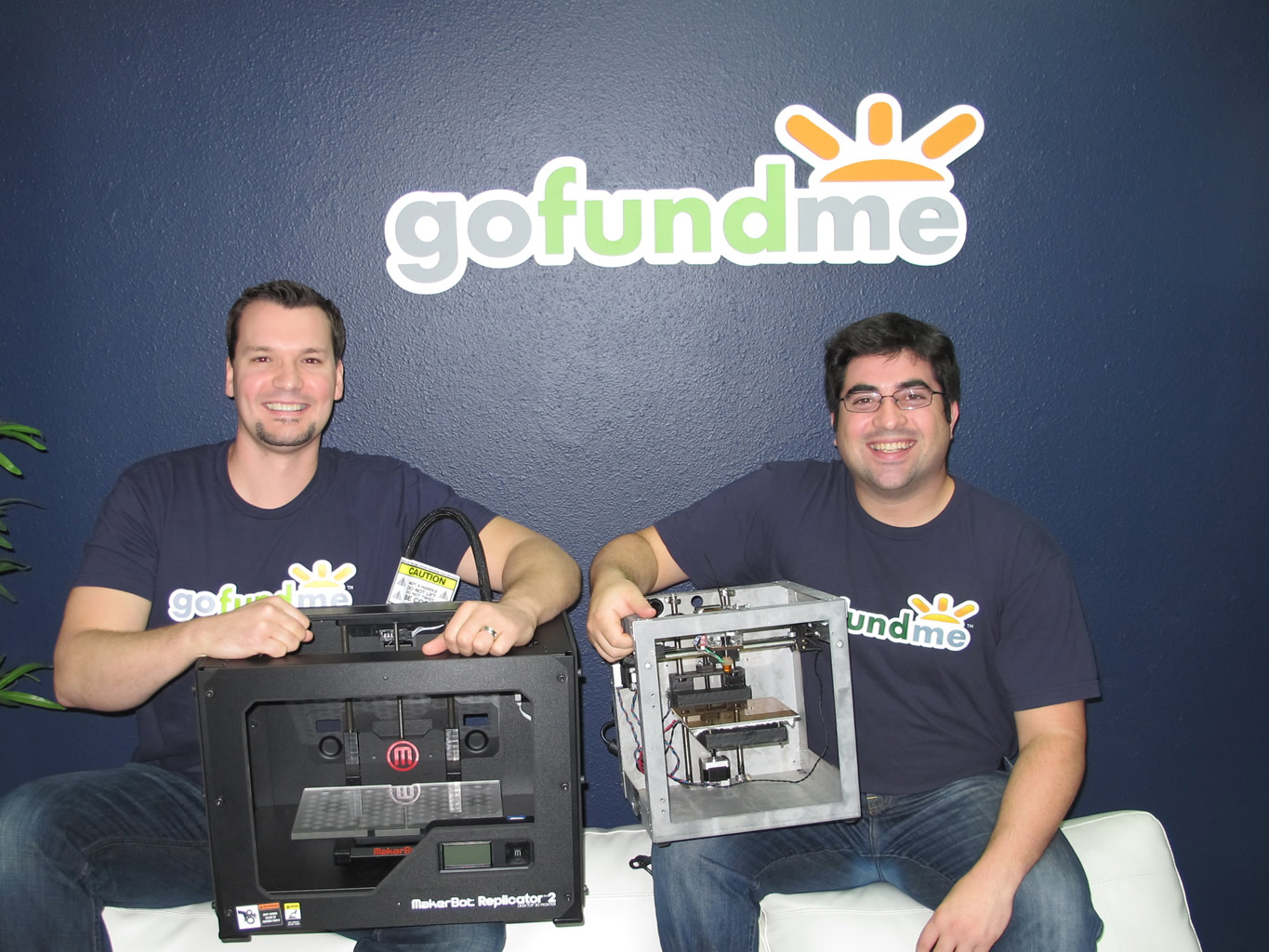
Damphousse had recently acquired a MakerBot Replicator 2 and was relearning SketchUp. He said he was experimenting with household safety products for children and had reached a twentieth functioning iteration of a product he hoped to fund through GoFundMe. He kept the product itself under wraps.
The number is a useful detail. Twenty attempts suggest a relationship with revision that extends beyond the fundraising company. A functioning version could still invite another try. He also expressed interest in helping people who made things at night and on weekends turn their projects into something others could support.
There is a pleasing symmetry in a platform founder becoming a prospective campaign organizer. The person designing the tools also had something he wanted to make. The photograph catches that overlap without requiring a grand explanation: two collaborators, their equipment and an evident willingness to get involved with the machinery.
The company outgrows its founding chapter
By August 2013, GoFundMe reported more than $95 million raised from over 1.5 million donors. Damphousse was named one of five finalists in the Established category of Entrepreneur magazine’s Entrepreneur of 2013 award. Personal fundraising had become a business substantial enough to attract attention well beyond its original customers.
In 2015, the founders agreed to sell a majority stake to an investor group led by Accel and Technology Crossover Ventures. The transaction was reported at a company valuation of approximately $600 million. They stepped back from daily operations and retained board seats at the time.
Rob Solomon became CEO. The company added leadership and established a Menlo Park presence alongside its San Diego origins. Damphousse’s period as the operating chief ended as another team took responsibility for the next stage.
The change also puts the scale of the transaction in perspective. A company valuation describes the business at a particular moment. It cannot be read as a founder’s personal fortune, and it says little about which decisions consumed his working day. The earlier record is more intimate: design changes, customer replies and repeated attempts to find a workable service. Those details make it possible to follow his contribution without letting the sale price swallow the rest of the story. A useful founding history leaves room for the work before the transaction.
His early work continued to appear in other people’s recollections. In 2023, GoFundMe employee Jordan Philyaw thanked both founders for their customer focus, generosity and encouragement of staff to learn and lead. A UC San Diego Rady student also publicly thanked Damphousse and former GoFundMe colleague Greg Smith for discussing startups and growth with a finance class.
Those recollections bring the story back to the scale at which it began: colleagues learning from colleagues, customers showing what they wanted, two people revising a product. The vacation fund escaped its original purpose because its founders kept examining the details. Eventually, they had built a place where other people could explain what mattered to them and invite someone else to take part.