A nonprofit can survive a bad gala. A bad donation system is more dangerous: it can keep making mistakes while everybody is busy doing the actual work. In November 2019, GoFundMe offered charities a tempting cure. Its new GoFundMe Charity suite bundled campaign pages, event registration, donor reports, marketing integrations and a donate button that could live on somebody else's website. There was no subscription and no contract. One pricing option asked donors to leave a voluntary tip for GoFundMe instead of charging the charity a platform fee.
- GoFundMe Charity was a nonprofit fundraising product, built on the CrowdRise business GoFundMe bought in 2017.
- Its pitch: professional tools without a subscription, backed by GoFundMe's social reach and optional donor tips.
- It stopped accepting donations on September 30, 2021. Campaigns did not move automatically; recurring gifts were canceled.
- GoFundMe later bought Classy and introduced GoFundMe Pro, a separate, later nonprofit platform.
The offer sounded like a small charity's improbable shopping list, with the price crossed out in yellow. It also exposed a question every software buyer eventually meets: if the tool becomes part of your income, who pays when the tool changes?
A marathon was the test, not a metaphor
GoFundMe did not invent nonprofit fundraising from scratch. In January 2017 it acquired CrowdRise, a platform built for charity campaigns, peer fundraising and endurance events. CrowdRise brought relationships with the Boston, New York and Chicago marathons, along with charities including the American Cancer Society and Red Cross. Its founders were Edward Norton, Shauna Robertson and brothers Robert and Jeffrey Wolfe. A charity runner who asks friends for gifts needs a different set of tools from someone raising money for a personal emergency: teams, registration, fundraising minimums, event pages and a way to report it all afterward.
CrowdRise had raised $23 million in 2014 from a group that included Union Square Ventures, Spark Capital and Bezos Expeditions. That was predecessor-company financing, five years before GoFundMe Charity launched. It helps explain the depth of the event product GoFundMe acquired; it does not mean GoFundMe Charity itself raised a Series A.
That acquired expertise explains why the 2019 launch was more than a new coat of paint. GoFundMe already knew how to make a personal appeal travel through a social network. CrowdRise knew how a nonprofit handles hundreds of appeals under one roof. GoFundMe Charity tried to put those habits in the same room. At launch, the company said existing CrowdRise customers would move to the new offering without work on their end. The American Cancer Society named its Raise Your Way campaigns; John Hancock pointed to real-time analysis of Boston Marathon runners.
The button was the quiet radical
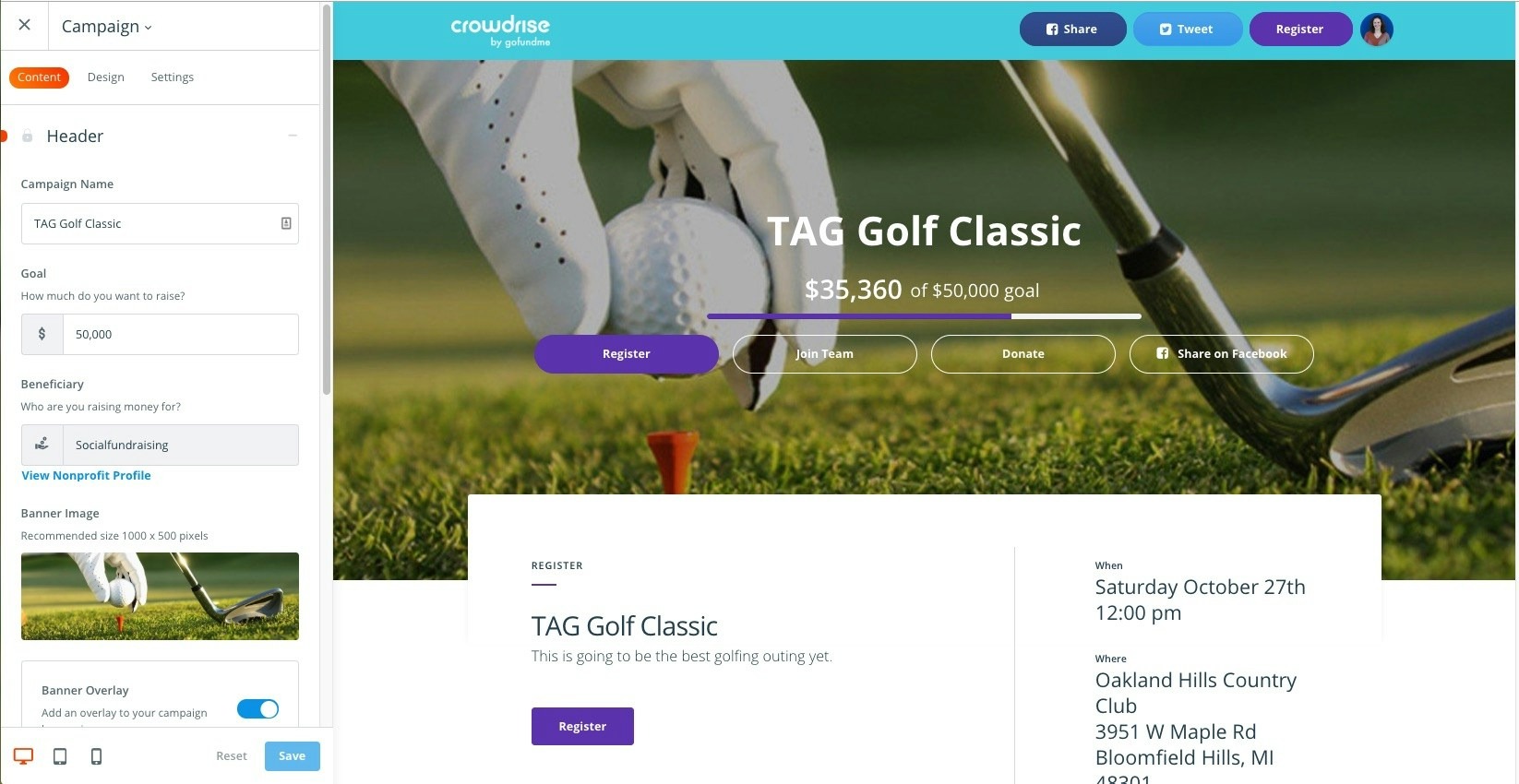
The suite handled the visible work: branded campaigns, ticketing, scheduled reports, data visualizations and connections to Salesforce, Mailchimp and Constant Contact. The companion Donate Button was subtler. A nonprofit could place it on its own site, or a third-party site, without building a separate GoFundMe Charity campaign. Suggested amounts, colors and branding could be adjusted. Underneath came receipts, recurring payments, donor analysis and reconciliation. A WordPress plugin made the placement easier.
This mattered because a donor's generous mood is perishable. If a supporter reads a charity's story on a community site, sending them elsewhere adds another chance to abandon the gift. The button turned the place where attention happened into the place where a donation could start. It also made GoFundMe's payments and donor data machinery available to organizations too small to build that machinery themselves.
“It’s just me and three interns.”
That is the customer the software pitch understood best. The organization has a mission, an audience and almost no spare operations staff. A single service for campaigns, event signups and donor records can buy back time for the work that appears in the mission statement. It can also put a large piece of the organization's memory in another company's hands.
Free is a pricing choice, not an absence of cost
GoFundMe Charity's zero-platform-fee option did not make the payment rails free. Processing charges still applied. The company invited donors to tip GoFundMe at checkout; its other option let donors cover fees. For eligible US nonprofits at the November 2019 public launch, GoFundMe advertised a holiday processing rate of 1.9% plus 30 cents per donation when using the charity tipping model. That was a promotion, not a permanent general price.
The pricing was a competitive argument. Traditional nonprofit tools often sold software subscriptions and add-ons; other fundraising sites charged transaction-based platform fees. JustGiving moved to remove its UK platform fee for charity donations in 2019 too, so GoFundMe was not alone in testing whether donors would support the intermediary. What GoFundMe could add was a familiar consumer brand and an existing stream of people already comfortable giving online. The bet was that distribution and goodwill could carry software that would otherwise require a software invoice.
The customer still had to consider more than the checkout percentage. A large fundraising event needs dependable reporting. A growing charity needs donor records it can use again. A monthly gift is not merely a transaction; it is a relationship with a calendar attached. Those needs become expensive when the place holding them changes its plans.
Then the calendar became the story
In February 2021, GoFundMe announced that the dedicated Charity site would be folded into GoFundMe.com. The company said one platform would make charities easier to discover and connect them with its wider community. That was its stated rationale. It did not publish a detailed postmortem explaining whether customer demand, economics or product overlap drove the decision, and those motives should not be guessed into existence.
Third-party integrations and public API support ended.
Last day to create a new Charity campaign.
Campaigns and donate buttons stopped taking gifts.
Last day to view and export donor data and content.
The dates did not all mean the same thing. Integrations went first, removing links to everyday nonprofit systems months before the donation pages closed. Campaigns did not transfer automatically to GoFundMe.com. Organizers had to recreate active appeals. Recurring gift arrangements were canceled after September 30. A fundraiser could copy a campaign description; it could not simply copy a donor's continuing permission to give.
Nonprofit leaders objected for exactly that reason. Amy Sample Ward of NTEN warned that ending recurring gifts and campaigns would hurt organizations already under pandemic pressure. The objection is sharper than a complaint about a changed interface. A monthly donor may intend to support a cause for years. A software migration can interrupt that intention in one day.
“The most important fundraising feature may be the one that lets you leave.”
The second try had a different foundation
GoFundMe did not leave nonprofit software altogether. It completed its acquisition of Classy in 2022. In 2025 it introduced GoFundMe Pro, bringing Classy's nonprofit tools together with GoFundMe's distribution. That is a later platform, not a renamed version of the 2019 Charity suite. The distinction matters to any reader comparing products today: GoFundMe Charity is a historical product, while GoFundMe Pro is the current nonprofit offering.
The useful part of this story is not a verdict on tip jars. Donor-funded pricing can help a cash-strapped charity start raising money. An embedded button can save a supporter from another detour. Event and CRM tools in one place can save a three-intern operation hours it does not have. But a charity choosing software should ask a less glamorous question before admiring the feature list: can we export the donor data, preserve recurring instructions and rebuild the live campaigns if this arrangement ends?
GoFundMe Charity made a sophisticated fundraising desk available without a subscription. It lasted about twenty-three months. The button was small enough to fit anywhere on the internet. The obligations around it were not.