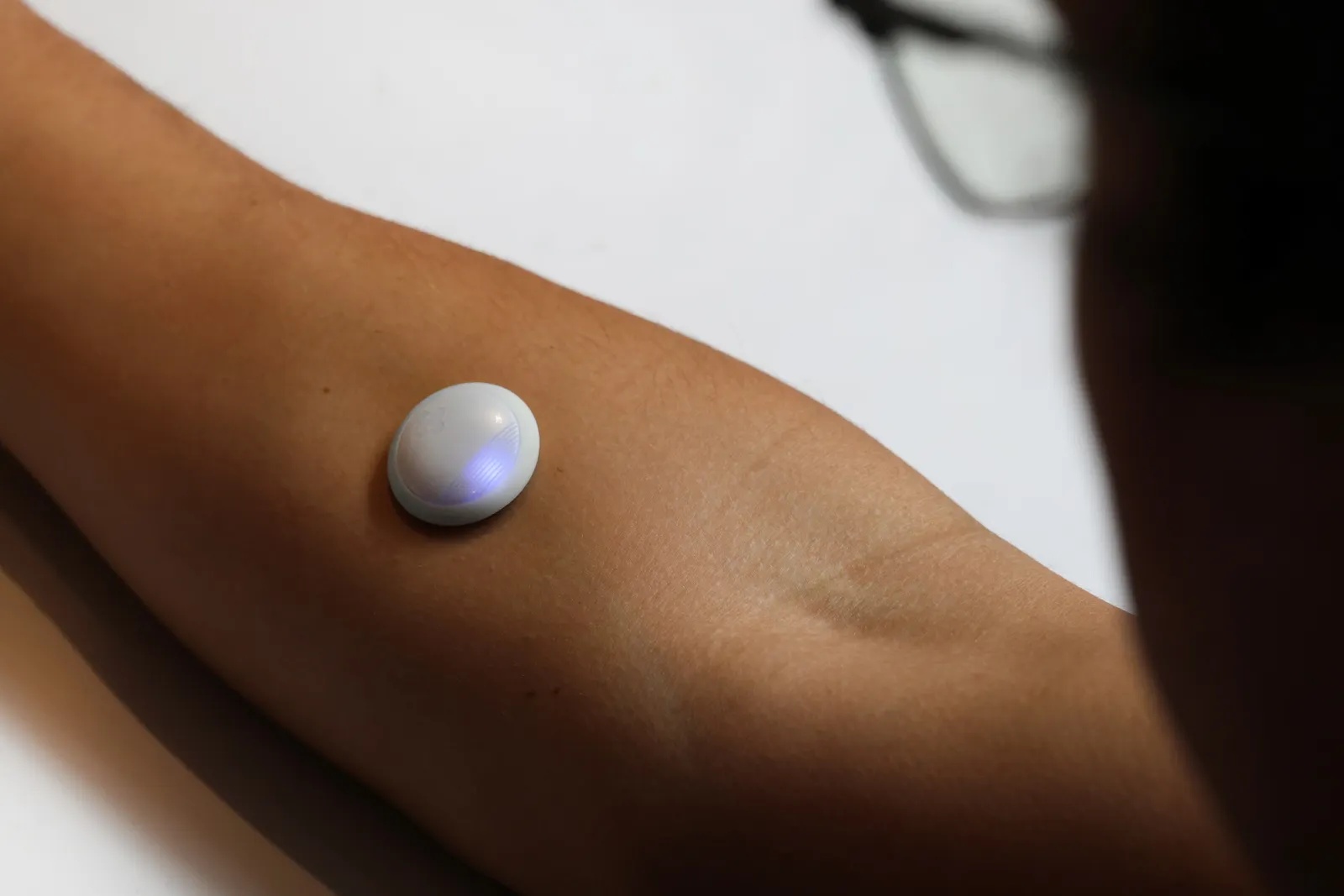
Consider the little light on your forearm. It is blue. You have somewhere to be, your phone is in your pocket, and for once a piece of health technology has given you an answer without requiring a password. The light belongs to Biolinq Shine, a wearable glucose sensor. Blue means glucose is in its target range. The interesting question is how much science, money and time it takes to make that glance possible.
- A glance first. Glucose range information appears on the patch; the app is optional.
- Just beneath the surface. Tiny intradermal sensors replace a conventional needle introducer.
- A wider doorway. September 2026 OTC clearance covers adults 22 and older who do not use insulin.
Biolinq began in 2012 as Electrozyme, founded by Jared Tangney and Joshua Windmiller, who met at UC San Diego. Its early work concerned sweat. Its current product measures glucose in the fluid between cells beneath the skin’s surface. In between lies a useful business story: a company kept its interest in bodily chemistry while changing where it looked for the answer.
The trouble with sweat
The original proposition had an appealing logic. Fitness wearables could count movement; sweat might reveal something about the chemistry behind that movement. Electrozyme explored skin-worn sensors for substances in perspiration. University support helped the founders move beyond the laboratory: UC San Diego credits its entrepreneurship programs with mentorship, incubator access and $100,000 in proof-of-concept funding.
But a fluid that is easy to collect is not automatically the fluid that answers your question. A 2024 review in Nature Biotechnology described the difficult history of sweat-sensing startups, including Electrozyme’s subsequent move to microneedles and interstitial fluid. The review noted that sweat lactate still lacked an established correlation with blood levels. Measuring something successfully and interpreting it usefully are separate achievements.
That distinction explains the pivot better than a tidy tale about one failed prototype. By 2015, Electrozyme had become Biolinq. The durable idea was chemical sensing close to the body. The sample, application and eventual customer changed. For anyone translating research into a product, there is something worth borrowing here: interrogate the relationship between the signal and the decision before becoming attached to the sensor.
A light instead of a homework assignment
Shine sits on the inner forearm. Its semiconductor-based microsensors enter the skin’s outer region, without the hypodermic introducer used to place a conventional glucose-sensing filament. Biolinq calls this needle-free. The distinction matters: the device still senses beneath the surface. It is not a watch reading glucose optically through intact skin.
The FDA describes an array of seven microelectrodes and a device designed to store data for up to five days. An enzyme reaction produces an electrical signal related to glucose. Accelerometer and ambient-light measurements add context around movement and rest. The cleverness is distributed across chemistry, materials, electronics and the decision about what the wearer should see first.
Qualitative glucose ranges on the wearable. More context in the optional app.
The first commercial focus was people with type 2 diabetes who do not depend on insulin. Tangney described the design problem as intimidation, both from insertion and from information. In an October 2025 interview, he said, “Our goal was, let’s really make this process not intimidating.” A light on the patch made that intention visible.
“Our goal was, let’s really make this process not intimidating.”Jared Tangney · Co-founder, President & CTO
Wearers can use the companion app to connect glucose patterns with meals, rest and movement. The ambition is to make everyday choices easier to understand, rather than asking everybody to become an enthusiastic chart reader. That is a design proposition, not proof that every wearer will change a habit or improve a clinical outcome.
There is a tradeoff inside that simplicity. A qualitative display groups readings into ranges, so it cannot serve every purpose of a numerical measurement. Someone seeking an insulin dose needs a different tool. Someone trying to understand recurring patterns may value a less demanding interface. The useful product question is whether the first layer of information matches the task. Biolinq has made a fairly explicit choice about that first layer, while leaving a route to more detail through its app.
The price of getting to simple
The financing gives some sense of the distance traveled. Biolinq announced a $100 million Series B in November 2021, led by RiverVest Venture Partners; $58 million in April 2024, led by Alpha Wave Ventures; and a $100 million Series C in April 2025, again led by Alpha Wave. Those three announcements alone add up to $258 million. They measure capital raised, not the cost of developing Shine.
The 2024 money supported the pivotal clinical stage and FDA submission. The 2025 round backed the regulatory process and preparation for commercialization. In September 2025, Shine received De Novo classification. A year later, Biolinq announced clearance for over-the-counter use. Removing the prescription requirement changed access; it did not turn the device into an insulin-dosing system.
Shine’s OTC indication covers adults aged 22 and older who are not on insulin. Its output is intended to inform patterns and behavior; medical action requires consultation with a qualified healthcare professional. Dexcom’s Stelo and Abbott’s Lingo already occupy the consumer glucose-sensing market. Biolinq’s competitive argument rests on its shallow sensing architecture and immediate, phone-optional display.
A platform waiting beneath the patch

The business centers on a physical, single-use sensor with a companion app. That creates the possibility of repeat sensor purchases, while making manufacturing consistency central to the proposition. CEO Rich Yang brings experience from Dexcom and Medtronic. The company’s leadership also spans diagnostic chemistry, clinical development, quality and production. Its careers page explicitly emphasizes shared values in hiring.
The repeat-purchase model also puts pressure on the mundane parts of the experience. An adhesive must stay comfortable; replacement must feel worthwhile; a signal must remain understandable outside a demonstration. These are practical conditions for adoption, rather than claims that Biolinq has already solved them at commercial scale. Semiconductor manufacturing offers a way to make miniature structures consistently. Turning those structures into a dependable everyday object adds another set of demands.
Beyond glucose, Biolinq is researching other biomarkers. Its technology materials describe a multi-analyte platform; that ambition should remain distinct from what Shine is cleared to do. The immediate test is more ordinary, and more demanding: can the company deliver a sensor people understand, tolerate and keep using? Fourteen years after its founding, Biolinq’s answer begins with a tiny light in plain sight.