Before there was a company, there was a classroom in western Kenya. Sona Shah had finished studying chemical engineering at Georgia Tech and spent part of 2012 teaching math, science and English at Nyagancha Primary School. She has described the experience as formative: a close view of how systems and infrastructure shape what people can do with the resources available to them. Engineering, in that setting, stopped being an abstract exercise in making a thing work. The surrounding conditions became part of the thing.
Shah returned to engineering work, including technical services at Eli Lilly, and volunteered with Engineers Without Borders. Then she went to Columbia for a master’s degree in biomedical engineering. There, in a biomedical design course, she met Teresa Cauvel. The two were asked to identify an unmet clinical need and build toward it. Their first prototype would eventually become a company, but the pivotal move was admitting how little a classroom could tell them.
A prize that bought proximity
In 2015, Shah and Cauvel placed third in the global technology track of Columbia’s Venture Competition. The $10,000 award did not buy a launch campaign. It paid for a two-and-a-half-week trip to Uganda. They visited nine public and private hospitals across four cities, meeting clinicians, nonprofit groups and government representatives. It was customer discovery with unusually high stakes and unusually low tolerance for assumptions.
Inside those hospitals, the pair saw shelves of donated equipment that had fallen out of use. The machines might have been sophisticated. Their environment asked different questions. Could they cope with unstable electricity? Could staff maintain them? Were they practical in a crowded ward? Had anyone designed them around the workflow of the person expected to use them?
“What we had been missing was a deep understanding of conditions on the ground.”Sona Shah, reflecting on the 2015 Uganda trip
The trip gave the founders a sharper brief: build around the constraints, not around an imagined version of the customer. Neopenda was incorporated that year, with Shah leading business development and operations as CEO and Cauvel leading product and technology as CTO. The name paired “neo,” for newborn, with “pendo,” the Swahili word for love. The original class assignment had acquired a philosophy.
The product is also the context
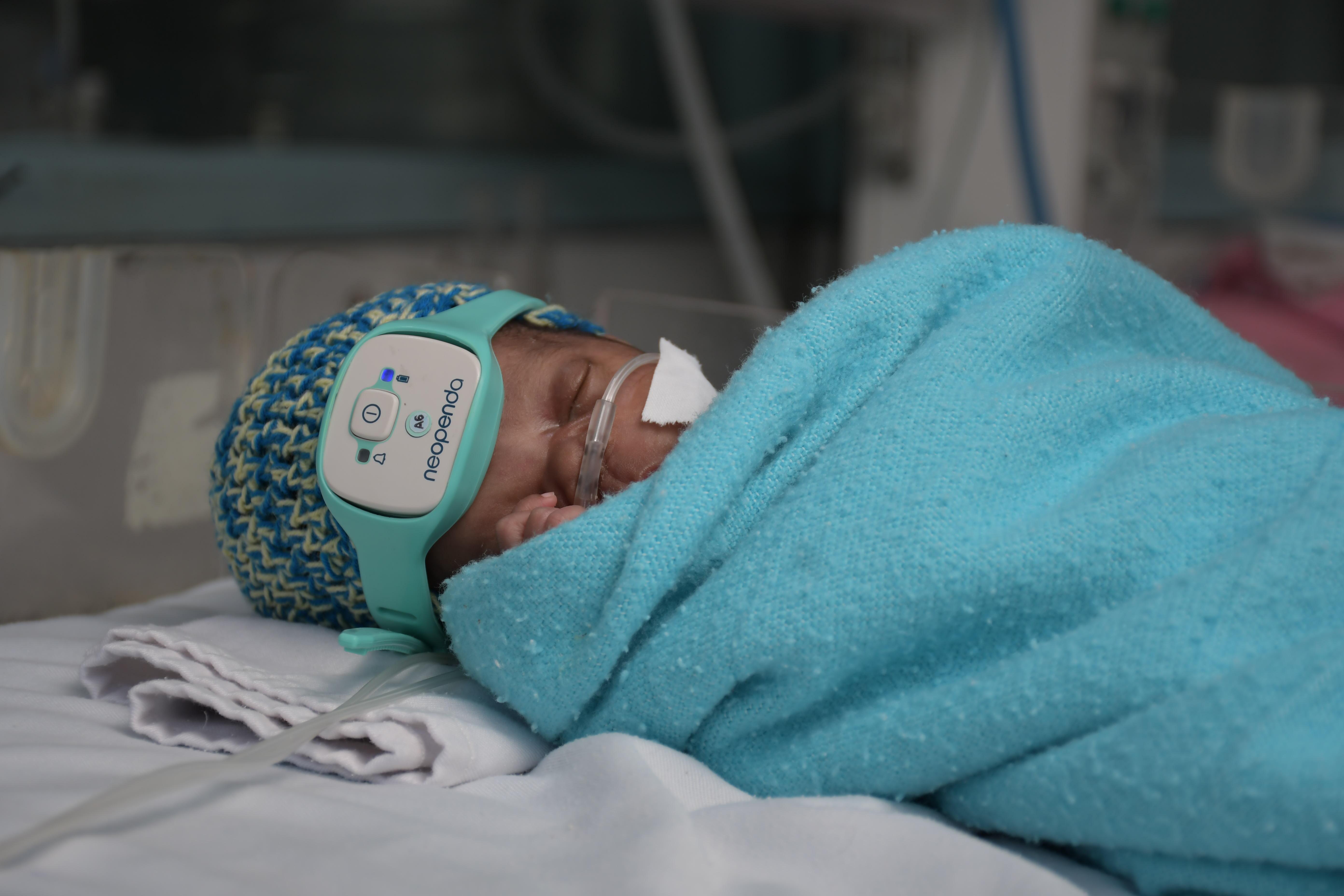
Neopenda’s flagship system, neoGuard, is a wearable monitor that collects four vital signs and sends the readings wirelessly to a shared tablet. Its design choices reflect the field notes: rechargeable hardware, offline operation, a form factor that can move with the wearer, and one screen that helps a clinician follow several devices. The physical object is compact. The design problem around it is sprawling.
Shah’s language about this work is less romantic than most startup origin stories. “Hardware is hard,” she has said. Medical hardware adds quality systems, certification, manufacturing and supply chains. Selling it introduces another knot. The person using the product, the person supervising the department and the person signing the purchase may all be different. Private, faith-based, public and nonprofit-run facilities buy on different clocks. In a 2025 interview, Shah said Neopenda’s shortest sale had taken one day, while a more typical cycle ran two to three months.
This makes Neopenda as much an operating-system company as a device company. Shah describes the sale as an opening rather than an ending. Installation, hands-on training, preventative maintenance and continued support sit inside the offer. Her team has built local sales and customer-success capacity, especially in Kenya, because the most elegant hardware still fails when the relationship disappears after delivery.
That distinction helps explain the “equipment graveyard” image that still anchors Shah’s story. A machine can arrive as a gift and leave behind a burden. Context-aware design accounts for ownership long after the ribbon cutting. Who answers the question? Who has the spare part? Who returns? The support function, easily classified as overhead, becomes a feature customers can feel.
A decade with no shortcut
Neopenda moved its headquarters to Chicago in 2016 and entered the long middle of company building. The founders joined accelerators, including Relevant Health and Techstars Chicago. They combined grants, prizes and investment rather than asking one kind of capital to do every job. Shah’s reasoning is practical: non-dilutive funding can absorb expensive technical and research risk, while investment capital can support commercial growth.
Recognition arrived along the way. Shah and Cauvel appeared on Inc.’s 2017 30 Under 30 Entrepreneurs list. Neopenda was selected for MIT Solve’s 2018 Frontlines of Health cohort and received a UN Women She Innovates prize. The company’s own timeline lists honors from Fast Company, the Wearable Technologies Innovation World Cup and the Rice Business Plan Competition. These were useful doors, not a substitute for regulatory files or a functioning supply chain.
In 2021, neoGuard received CE marking as a Class IIb medical device. Shah later used its re-certification to make a broader point: quality work is repetitive by design. Annual audits and periodic full reviews do not make a dramatic founder montage. They make the commercial promise credible. Shah has also urged other device builders to establish quality and regulatory systems early, and funders to recognize the resources that work consumes.
“Human-centered design is non-negotiable.”Sona Shah on building with users
By 2025, the company reported more than 35,000 hours of monitoring across over 2,000 patients, with customers at more than 45 hospitals in five countries. Those figures are snapshots, not a finish line. Shah’s stated next phase includes wider sales in Kenya, Uganda and Ghana, complementary products called neoSpot and neoCloud, and internal systems that make expansion repeatable.
Trust has a longer sales cycle
The founder lesson underneath those plans is about adoption. Clinical enthusiasm and a purchase order are different achievements. A buyer with a constrained budget must believe the device will remain useful. A clinician must believe the company understands the day. A government must fit a new product into procurement. Every stakeholder carries a different version of risk.
Shah has responded by turning listening into a repeatable commercial behavior. Sales representatives profile facilities, begin with the local problem, demonstrate the system and map the decision-makers. Post-sale staff train users and return. The method is neither a pure enterprise funnel nor a charitable distribution model. It is a hybrid built around the markets Neopenda chose, and the model has had to mature alongside the hardware.
A context-first product brief
One recent field note captures where that can lead. In 2026, Neopenda completed its first three installations in Kenya’s Kericho County and trained 31 staff across facilities in Roret, Sigowet and Sosiot. Shah wrote that nurses at Sosiot wanted their facility to become a center of excellence where neighboring hospitals could visit and learn. The interesting part was not a request from headquarters. It was users volunteering to become teachers.
That is bottom-up demand in its most legible form. A device moves from foreign object to local practice, then from local practice to something worth sharing. It is also an argument for patience. Trust cannot be installed from a box, but a company can organize itself to earn it.
The engineer becomes an institution builder
Shah calls resilience her entrepreneurial superpower. Her definition is active: when she cares deeply about a problem, she will “move mountains” to find a way through it. Yet the more revealing trait may be her willingness to let reality edit the plan. The original classroom idea changed in Uganda. The commercial model changed with customers. The team learned that usability does not guarantee adoption and that a quality system is infrastructure, not paperwork.
In public reflections on Neopenda’s tenth year, Shah writes about building, failing, iterating and rising. She credits co-founder Cauvel, mentors, investors, clinicians and local teams rather than arranging the decade into a solo-founder myth. Her recent posts are often operational: a re-certification audit, a set of installations, a hiring plan, two weeks alongside the Kenya team. The aspiration is large, but her unit of attention stays small enough to manage.
The path from engineer to CEO can look like a move away from the product. Shah’s version looks more like an expansion of its boundaries. The product now includes the financing strategy, regulatory discipline, local relationships, sales process and maintenance promise required to keep the hardware useful. The engineer has become an institution builder because the device alone cannot carry the mission.
There is still no neat roadmap. Shah recently described the company’s hardest complexity as the absence of one: building in places the standard venture model was not designed to serve means writing the playbook page by page and decision by decision. Ten years in, that accumulation of decisions may be Neopenda’s most durable asset. The shelf of idle machines taught her where to begin. The company’s job is to make sure its work does not end there.