The object on the arm is small enough to invite underestimation. It is round, pale and deliberately uneventful. A light changes color. Beneath it sits an array of silicon microsensors, each reaching roughly two-tenths of a millimeter into the skin. Behind it sits thirteen years of work by Jared Tangney and a company that began with a name fit for a science-fiction villain: Electrozyme.
Tangney co-founded that company with Joshua Windmiller in 2012, when both were moving through the laboratories and entrepreneurship programs of the University of California, San Diego. Tangney was studying bioengineering. Windmiller was an electrical engineer working in nanoengineering. The pair met in graduate school and found the useful overlap between their disciplines: chemistry that could be measured at the surface of the body, electronics that could make sense of it, and a product that might someday be worn instead of visited.
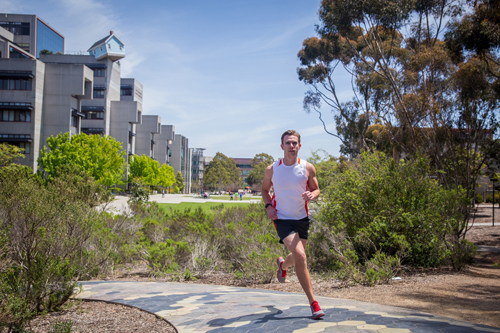
The early version was more athletic and a little more theatrical. A temporary-tattoo sensor sampled chemicals in sweat; a watch received the signal. One photograph from the period shows Tangney running through the UC San Diego campus wearing the equipment. The pose has the clean optimism of a prototype demonstration: sunshine, sneakers, a device not yet burdened by a supply chain. Even then, however, the founding ambition was wider than a fitness gadget. The laboratory work had begun with a biosensor intended to help identify and mitigate battlefield injuries. The company was looking for a practical door into a much larger room.
The charming part comes first
Every long startup story keeps one short anecdote for dinner parties. Electrozyme's belongs to its mailing list. The first three subscribers were Windmiller, Tangney and Mark Cuban. The investor had noticed the idea early and supplied seed backing as well as advice about the sports market. It is a fine anecdote, not least because its arithmetic is impeccable. It also risks making the years that followed sound easier than they were.
The less glamorous machinery was already forming around them. UC San Diego's von Liebig Entrepreneurism Center and Gordon Engineering Leadership Center provided mentorship and business training. A Department of Energy fellowship supplied $100,000 in proof-of-concept funding. The startup entered the EvoNexus incubator. In 2014, Electrozyme won a CONNECT Most Innovative New Product award, plus product-development recognition from IDTechEx. Tangney completed his Ph.D. that year. In 2015, the company changed its name to Biolinq, a sensible act of mercy for receptionists everywhere.
“Our engineering backgrounds have given us the ability to develop new and innovative technologies, and our entrepreneurial training has prepared us to make those technologies a commercial success.”Jared Tangney, 2014
The sentence sounds like a young founder's thesis statement. Its two halves would prove radically unequal. Engineering can produce a convincing prototype on an academic timetable. Commercial success in regulated hardware requires a calendar with more seasons. Materials must behave repeatedly. Sensors must be manufactured at scale. Clinical evidence has to survive scrutiny. A physical object must satisfy its users, its factory and its regulator, three constituencies famous for never sharing a lunch order.
A founder changes chairs
Tangney served as Biolinq's chief executive through its formative years. By 2023, the company needed the particular choreography of a business approaching clinical and commercial scale. Rich Yang, an executive with long experience in glucose sensing, became CEO. Tangney moved into the role he holds today: president and chief technology officer.
In founder folklore, leaving the chief executive's office is sometimes written as defeat. Here it reads more like division of labor. Tangney remained with the technology he had helped carry from the university, while the leadership bench widened around regulatory affairs, clinical work, manufacturing and commercialization. Stewardship does not always mean keeping the grandest chair. Sometimes it means knowing which problem is still yours.
Tangney's public patent record makes that problem visible in wonderfully severe prose. It includes methods for electrically isolating microneedles, sensor assemblies for continuous analyte monitoring, the integration of silicon microneedles with circuitry, and even the industrial design of an intradermal biosensor. Read together, the filings describe less a lightning bolt than a long campaign against tiny sources of unreliability.
Depth is the design decision
The bars use 5 mm as the comparison baseline. Tangney describes the array as at least twenty times shallower than a conventional continuous glucose sensor.
The interface is a color
By the time Biolinq's first product took shape, its most interesting feature was not solely what the sensor could detect. It was how little ceremony the company wanted around the answer. Biolinq Shine includes an indicator that changes color to communicate whether a reading sits below, within or above a target range. A phone can provide additional information, but the first message is already on the arm.
“Our goal was, let's really make this process not intimidating,” Tangney said in 2025. The choice is easy to mistake for decoration. It is actually a decision about hierarchy. A platform may produce a torrent of data; a person may need one legible signal before breakfast. Good instruments reveal. Good products edit.
The underlying sensor uses semiconductor manufacturing methods to make strong, minuscule silicon structures. It measures in interstitial fluid within the skin rather than deeper subcutaneous tissue. The array format is central to Tangney's longer ambition because separate sensing sites can, in principle, be developed for different analytes. The first commercial focus is glucose. Public discussions of the platform have also named lactate, cortisol and phenylalanine as areas of development. “The vision from day one has always been to do much, much more,” he has said.
Tangney and Windmiller found Electrozyme from UC San Diego research.
The wearable sensor wins local and industry product recognition; Tangney completes his doctorate.
Electrozyme becomes Biolinq, a name broad enough for the platform it hopes to build.
Tangney becomes president and CTO as Rich Yang takes the chief executive role.
Biolinq announces a $100 million financing for regulatory work and commercial readiness.
The FDA grants De Novo classification to Biolinq Shine.
Tangney presents the journey from university lab to FDA classification at ATTD in Barcelona.
Permission to become ordinary
The FDA decision arrived on September 23, 2025. De Novo classification created a new device category for the Shine Autonomous Time-in-Range Microsensor and allowed Biolinq to market it subject to the agency's controls. In the company's chronology, this was the clean milestone: the moment a long development story acquired a date and a document number.
It was also the start of a more prosaic chapter. Tangney described the next work as scaling manufacturing and preparing to bring the product to market. Earlier that year, Biolinq had announced a $100 million Series C led by Alpha Wave Ventures, intended to support the regulatory process and commercial readiness. Capital of that size does not end the engineering. It moves the engineering into factories, quality systems, packaging and forecasts.
In March 2026, Tangney stood at the ATTD conference in Barcelona to give a talk with a title that neatly compressed his professional life: “The Biolinq Journey: From University Lab to FDA Clearance.” The route from San Diego to that stage was not a straight ascent. The product changed form. The company changed name. Tangney changed jobs without changing companies. The founder learned to translate between researchers, investors, regulators, manufacturers and people who would rather not study a dashboard every time a device has something to say.
A mature wearable does not prove its intelligence by demanding attention. It earns its place by knowing when a color will do.
This is the quiet coherence in Tangney's work. He is a bioengineer whose defining task has been translation: from tissue chemistry to electrical signal, from academic result to manufacturable array, from dense information to a glance. The company around him has raised substantial capital and collected a consequential regulatory decision. Yet its product argument remains almost modest. Put the sensor where useful chemistry is accessible. Make it shallow. Let an array leave room for the future. Tell the wearer what matters now.
Deep technology is fond of grand horizons. It is financed by them. But it reaches daily life through details that have been made boring on purpose. A reliable surface. A repeatable process. A light whose meaning is obvious. After thirteen years, Jared Tangney's project is approaching its sternest test: whether an improbable piece of engineering can become an ordinary object, noticed just enough and no more.