Most machines meet the world through light and sound. Cameras watch. Microphones listen. Radar sends a pulse into the distance and waits for an answer. Yet a vast stream of information drifts straight past them: the volatile chemistry of the air. Osh Agabi has spent his career trying to give that missing stream a readable form.
His company, Koniku, calls its devices smell processors. The phrase sounds almost domestic, like a kitchen appliance with unusual confidence. The engineering is stranger and more exacting. Koniku combines engineered biological cells, including cells fitted with odorant receptors, with electronics that capture and interpret their response. Biology recognizes a compound. Silicon helps turn the reaction into data.
That pairing places Agabi in a category that resists tidy labels. He is a physicist by training, a computational neuroscientist by practice, a bioengineer by necessity, and a founder by choice. His route to California ran through Lagos, Umeå, Zurich, St. Gallen, and London. Each stop added another language for the same persistent question: how can living systems become useful parts of a machine?
“Biology has the most extensive open source hardware and software.”Osh Agabi, TEDGlobal 2017
First, find the unmeasured thing
Agabi was born and raised in Lagos. He entered the University of Lagos in 1997 and studied physics, finishing in 2001. His undergraduate work already leaned toward the border between body and device: he explored whether piezoelectric material could harvest energy from human movement to power mobile electronics. The material was not alive, but the instinct was present. Look at an ordinary physical process, find the energy or information hiding inside it, and build an interface.
Graduate study took him to Umeå University in Sweden. There, a Russian professor offered advice with the efficiency of a good theorem. If Agabi wanted to make an impact, he should go into a field where little had been done and where much remained to be quantified. Agabi took a neuroscience course. The subject caught immediately.
Neurons were measurable but not mastered. They computed without looking much like the computers engineers knew how to build. They worked in wet, chemical environments. They spoke in electrical spikes and molecular signals. For a physicist interested in first principles, the field offered both rigor and productive discomfort.
The Agabi operating system
- Choose a signal that technology still struggles to read.
- Learn the disciplines the signal refuses to respect.
- Build the interface before promising the platform.
A career assembled across borders
From Sweden, Agabi moved into research in Switzerland. His work crossed physical electronics, robotics, and computational neuroscience. At Neuronics AG, he worked around intelligent mobile manipulators - robots built to operate in industrial environments. Elsewhere in his research, the central task was learning how to address neurons, record their behavior, and structure biological circuits on electrode arrays.
He later joined Imperial College London, working in computational neuroscience and bioengineering. The laboratory problems were highly specific: optical systems, neural signals, interfaces, and the mechanics of getting biological tissue to communicate with engineered hardware. The ambition around them was broad. Agabi wanted more than a model of intelligence running on silicon. He wanted to use the biological machinery itself.
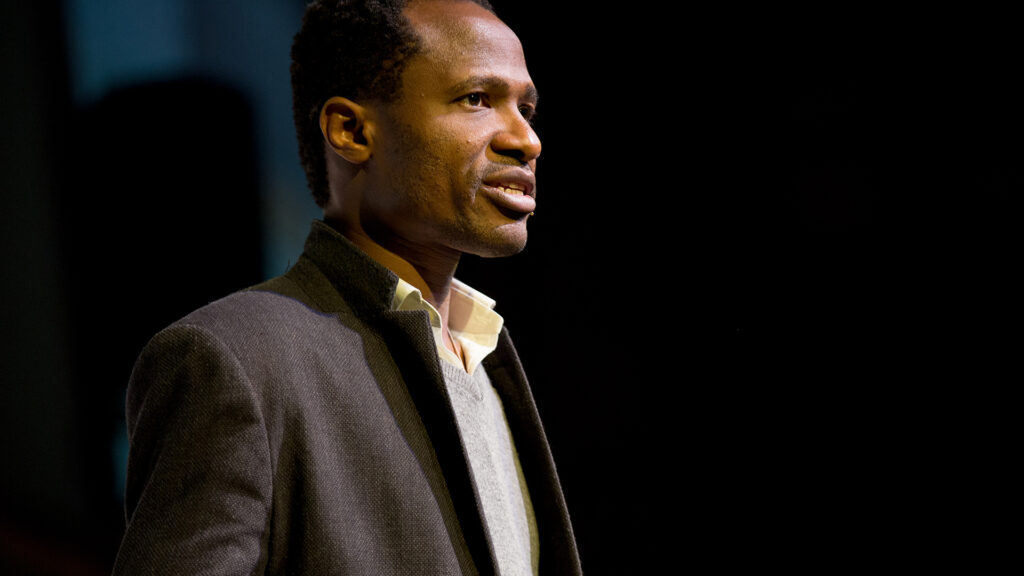
Koniku emerged from that work. Agabi formed the company during his Imperial years, and it became a Delaware corporation in 2015 after joining the IndieBio program. The name means “immortal” in Yoruba. It is a playful choice for a company whose hardware includes living components, and a serious declaration of scale from a founder willing to describe biological neurons as an engineering material.
Biology is part of the stack
Nature is often invited into technology as a metaphor. Neural networks borrow a name from the brain while running on conventional chips. Swarm systems borrow behavior from insects. Agabi's approach is more literal. In a Koniku smell processor, biology participates in sensing. Engineered receptors respond when targeted molecules reach them, and the system records that response for analysis.
This division of labor matters. A machine does not need to reproduce an entire nose. It needs a reliable chain from compound to receptor, receptor to signal, signal to classification, and classification to action. The cleverness sits in the whole chain. Cells must remain viable. Hardware must be rugged. Signals must remain consistent. Software must distinguish one pattern from another. A laboratory result that works once is a curiosity; a device has to work when a customer turns it on.
Agabi has been unusually candid about that difference. Early in Koniku's life, he described the near-term challenge as delivering devices and earning revenue without treating hardware like software. A physical product cannot be casually patched after shipment. It has to perform in the field. That sentence contains the sober half of deep tech, the half that does not fit neatly on a conference stage.
“We want to prove we can connect to neurons and structure biological systems, and have the ability to package that.”Osh Agabi
From stage demonstration to the field
Agabi presented Koniku's approach at TEDGlobal in Arusha in 2017. That same year, Koniku and Airbus began cooperating on detection systems for aviation. Airbus later described the joint work as contactless, automated detection and location of chemical and explosive threats aboard aircraft and in airports. The partnership joined Airbus's experience in sensor integration and security operations with Koniku's work on volatile compounds.
The application made intuitive sense. Airports already rely on layers of sensing, screening, and human judgment. Odor offers another dimension, one that could operate without the ritual of opening every object. The hard part is not imagining the use. It is building a sensing system that survives the clutter of real air: perfume, fuel, cleaning products, food, weather, luggage, and thousands of people moving at once.
By 2025, Koniku's public emphasis had moved further toward security infrastructure. Agabi announced the company as a founding member of the Oracle Defense Ecosystem, with its technology connected to Oracle Cloud Infrastructure pathways. Weeks later, he demonstrated the smell technology at an Accenture Federal Services event in Washington, D.C., focused on travel and the operational pressure created by coming World Cups, Olympic Games, and international summits.
Physics degree in Lagos, after early work on energy harvesting.
Graduate physics work in Sweden points him toward neuroscience.
Koniku joins IndieBio and establishes its California company structure.
TEDGlobal presentation and the beginning of cooperation with Airbus.
Oracle defense ecosystem membership and a federal-security demonstration.
The platform beyond the processor
Agabi's stated ambition extends beyond selling a box. From Koniku's early days, he described a user base that could program the devices and build applications on top of them. The pattern is familiar from software platforms but demanding in biological hardware. A platform needs repeatability. Developers need stable inputs, understandable outputs, and confidence that one device behaves like the next.
The prize is a new category of data. Light became pixels. Sound became waveforms. Location became coordinates that millions of applications can call without knowing how a satellite works. Smell has no comparable universal layer. Airborne chemistry remains rich in meaning and awkward to compute. If Koniku can make even a narrow part of it dependable, the value lies not only in the sensor but in the vocabulary others can build around it.
Sensors are contracts with reality. A thermometer promises that a number corresponds to heat. A camera promises that an array of pixels corresponds to light. A smell processor must promise that a pattern corresponds to a compound even when the room, weather, and background odors change. Every useful application depends on that contract holding. It is why Agabi talks as often about packaging and deployment as he does about neurons.
It also explains the patience in Koniku's progression. Sensing comes before control; control comes before broader forms of cognition. Start with a bounded job, prove the biological interface can survive outside a laboratory, and expand only when the evidence permits it. The road map is grand, but the next test is always physical. A receptor either responds, a device either captures it, and a system either makes the result useful to someone standing in the field.
This is where Agabi's interdisciplinary life becomes more than biography. Physics taught him to measure. Neuroscience taught him that biological signals are noisy but structured. Robotics taught him that sensing belongs inside a system that must act. Company building taught him that a platform is earned through deployment, not declared in a slide deck.
A child of many cultures, fluent in borders
Agabi has called himself a child of many cultures. Lagos gave him his beginning and a company name. Sweden opened the door to neuroscience. Switzerland supplied years of research and robotics. London became the place where the company idea hardened. California became its operating base. His LinkedIn profile lists languages ranging from Yoruba and Avianwu to English, German, and Swedish.
There is a useful symmetry between that life and the machine he is building. Koniku also lives between systems. Wet and dry. Cell and circuit. Laboratory and checkpoint. Scientific paper and purchase order. Agabi's public style is direct, sometimes impatient with the boundaries that keep those worlds separate. He has argued that useful invention matters more than an academic culture of publishing for its own sake. The position attracts disagreement, which seems unlikely to trouble him.
Two decades after a professor advised him to quantify the neglected, Agabi is still working on the same frontier. The air remains crowded with signals. Machines remain mostly oblivious to them. Between those facts sits Koniku's peculiar proposition: if computers need another sense, perhaps the shortest route is not to imitate life from afar, but to invite a small, carefully engineered piece of it inside.