Long before Oshiorenoya Agabi tried to give a machine a nose, he went looking for things other people had thrown away. Growing up in Lagos, he searched discarded material for objects he could tinker with. It is a modest beginning for a career in biological computing, and a useful one. An object that has outlived its first purpose can still offer a second education. You take it apart. You ask what each piece does. Occasionally, the rubbish has better answers than the instructions.
Agabi was the second of seven children. His mother ran a general store; his father worked at the port. They put education first. He would later describe his mother as the “best entrepreneur I know.” The family business belonged to the world of customers and goods, rather than microscopes and microchips. Yet the compliment gives his scientific career a welcome human scale. The founder of Koniku learned to admire an entrepreneur before he acquired that title himself.
His company now develops systems that combine engineered biological cells with electronics to process smell. The nose is a good place to begin this story. It does something so familiar that we seldom stop to admire the machinery. Agabi has spent years asking how a machine might borrow some of that machinery, and what happens when a biological response becomes useful digital information.
The physics student changes his material
Agabi’s formal route began with physics at the University of Lagos and continued with a master’s degree at Umeå University in Sweden. During his master’s studies, a Russian professor offered advice that stayed with him: find a field with room for fresh work and measurement. Agabi took a neuroscience course. It gave his interest in computation a living subject.
Switzerland added another part of the education. At Neuronics, he worked on learning algorithms for pick-and-place robots operating alongside people in factories. The task included teaching robot grippers to categorize objects. A gripper must do more than close. It needs information about what it is holding, and a way to translate that information into an action. The connection between sensing and doing would keep appearing in his career.
His work at ETH Zurich included applying liquid state machines, a computational approach, to biological neurons on a chip. Subsequent research brought him to Imperial College London’s Department of Bioengineering. There, he worked with instruments for observing neural activity. The engineering was tangible: microscopes, optical systems and the difficult business of getting a readable signal from a living system.
A 2017 paper he co-authored describes robotic automation of targeted electrical recordings from cells using two-photon microscopy. Its problem was wonderfully stubborn. As a tiny recording pipette approached, the tissue could move and carry the target cell away from its expected position. The team’s system used visual feedback to adjust the approach. Biology had declined to sit still for the photograph; the engineering had to accommodate it.
That work gives the later founder a more specific outline. Agabi’s relationship with biology includes the practical effort of measuring it, addressing it and adapting equipment around it. For him, a neuron can be part of a computational experiment as well as a subject of scientific observation. The idea becomes much less abstract when you have spent time building the apparatus.
A business plan meets the stopwatch
By May 2015, Agabi was a final-year doctoral student at Imperial and leading an international Koniku team. His supervisor was Simon Schultz; Vincenzo De Paola also supported his work. The transition toward a company involved colleagues from outside the laboratory. Christina Salys and Chris McAndrew came from UCLA Anderson, while Laura Brightmann and Mark Brown came from Cambridge.
At the MIT Global Startup Workshop in Guatemala, finalists had five minutes to explain their plans and three minutes to answer questions. Koniku’s team won both the business plan and elevator pitch competitions. Agabi’s reaction was “I’m blown away.” It is an appealing interruption to the usual retrospective founder confidence. At the time, the success surprised him.
The awards helped the team advance toward MASSChallenge. They also marked a change in audience. A research collaborator may want to understand an experiment in detail. A competition judge needs to understand the opportunity before the clock runs out. A prospective customer will eventually ask a still less romantic question: where does this fit into the work I already do?
Agabi’s ambitions stretched well beyond a single sensor. He wanted biological computation to support systems capable of cognition, and he wanted other people to build applications around the technology. Smell offered a concrete opening. It gave a broad proposition about living computation something particular to detect.
“We want to deliver an amazing product.”
Osh Agabi, 2016
Borrowing the nose, keeping the electronics
The core proposition of Koniku’s sensing work is straightforward to describe, even if making it reliable requires rather more effort. Engineer cells to express odorant receptors. Put the biological sensing system together with electronics. When a targeted molecular compound meets the receptor, the response can become a signal for a detection system.
The biological element gives the device its way of recognizing a chemical input. The electronic element helps make that recognition usable by a machine. Koniku calls its devices smell processors or smell cyborgs. The vocabulary is memorable. The practical question underneath it is how to turn something present in the air into information someone can act on.
- 01Airborne compoundA target reaches the sensor.
- 02Engineered receptorBiology recognizes the input.
- 03Cellular responseThe interaction produces a response.
- 04Electronic signalThe system makes it usable.
There is also a question of what such an object ought to look like. Koniku asked the design firm Whipsaw for an appearance that felt mysterious and alien. The brief sounds mischievous until you consider the object: an unfamiliar combination of living material and circuitry, intended to sample its surroundings. A conventional box might have been reassuring. Agabi’s company was willing to let the unfamiliarity show.
Whipsaw designed a compact sensor intended to test air from different directions. Its account pictured installations around airports and at aircraft entrances. That brings the invention into the built environment. A sensor has a body, a position and a relationship with the people passing it. Industrial design helps determine whether a laboratory idea can occupy public space without becoming an obstacle.
An airport is a demanding classroom
Koniku and Airbus entered a cooperation agreement in 2017. The division of expertise made sense: Koniku brought biological detection technology; Airbus brought experience with sensor integration and aviation security operations. Their work included automated, contactless detection of chemical and explosive threats in airports and aboard aircraft.
For Agabi, this put the nose in a setting with exacting requirements. An airport is full of movement, competing demands and established procedures. A new device has to earn its place among them. The attraction of detecting a target compound is clear. Making that detection fit the operation is a separate engineering task, with consequences for staff and passengers alike.
In 2022, the companies announced an expansion of their collaboration. The plan included software and hardware integration work by MTM Robotics, an Airbus subsidiary in Mukilteo, Washington. The announcement described multiple tests and performance validations involving law enforcement agencies and airport security operations.
That sequence is more revealing than a single launch date. A collaboration begins, tests follow, and integration becomes an explicit part of the next phase. The device has to work as part of a larger system. For a founder with experience in factory robots and laboratory instruments, those surrounding conditions are familiar territory, even when the application changes.
It also explains why Agabi’s story resists a clean invention scene. There is no convenient moment when the machine acquires a nose and everybody goes home. The receptor, the reader, the software, the enclosure and the operational setting all make demands. A company exists partly to keep those demands in the same conversation.
The company keeps finding new rooms
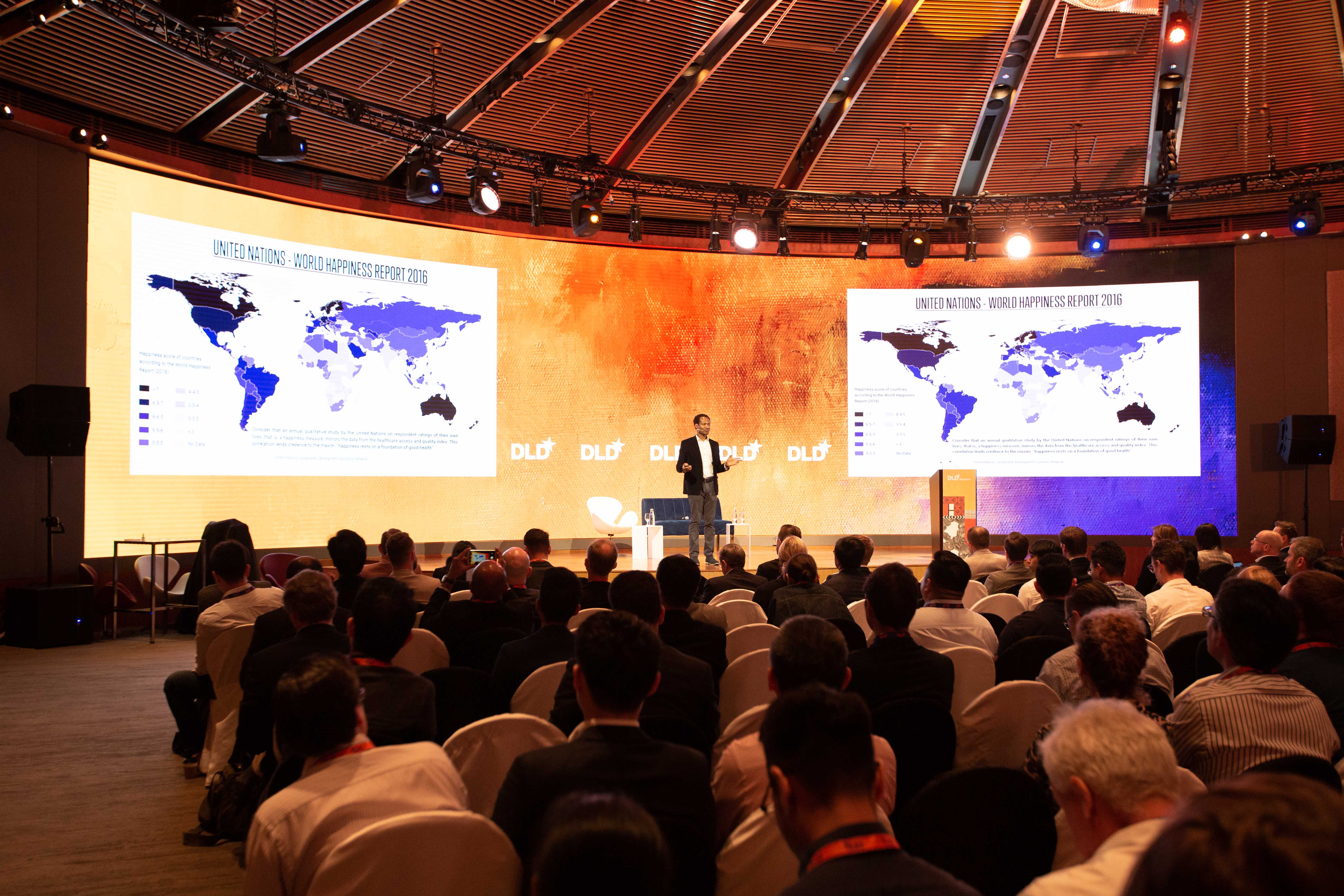
Agabi has taken that conversation to audiences well beyond the laboratory. At DLD Munich in 2019, he discussed the prospect of combining synthetic neurobiology and silicon for future intelligence. Later that year, he spoke at DLD Singapore about programming living cells to perform sensing. The presentations carried both a near-term application and a longer computational ambition.
His current public biography at GESDA places him on its Anticipation Committee. It is a fitting setting for someone whose work invites questions about the relationship between biological systems and engineered ones. His career has moved among several disciplines, and the company asks them to cooperate inside a product.
There were further public milestones in 2025. In June, Oracle named Koniku among the inaugural members of its defense ecosystem, an initiative intended to connect technology companies with cloud resources and national security delivery channels. In July, Agabi shared a demonstration of smell technology at an Accenture-hosted event in Washington, DC, where public and private leaders discussed secure travel and upcoming large events.
The names of the partners have changed since his student competition days. The underlying task remains recognizable: explain what the technology can do, place it beside other capabilities, and find a use that warrants the engineering. A sensor has little reason to be impressed by the size of the room in which it is demonstrated. It still needs the right input.
Agabi’s ambition is to make biological sensing and computation into tools others can build with. That ambition carries him a long way from the discarded objects of his childhood. Yet there is continuity in the habit of mind. A living cell has properties an engineer might use. An unfamiliar response might become a signal. An object might have another purpose waiting inside it.
The nose gives those ideas a particularly earthy destination. For all the talk of future intelligence, it brings the machine back to its surroundings: what is here, what is in the air, what can be recognized? Agabi’s long education has led him to an engineering question that a dog encounters on an ordinary walk. The dog, of course, has never needed to prepare a business plan.