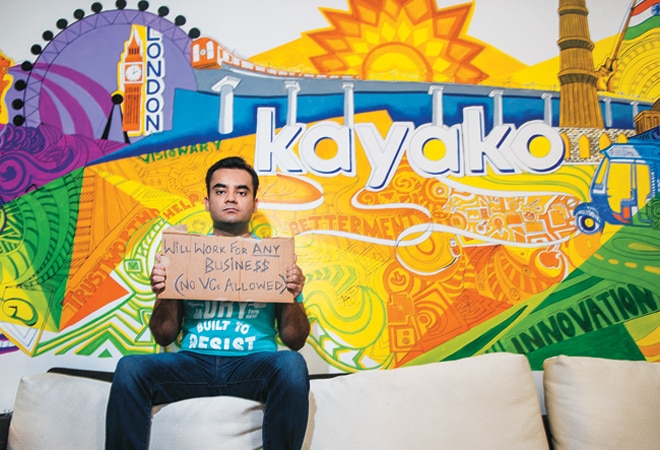
Varun Shoor sits on a sofa at Kayako’s Gurgaon office holding a cardboard sign: “Will work for any business (no VCs allowed).” Behind him, a mural squeezes London landmarks, a blazing sun and the company’s name into a riot of colour. The photograph, taken in 2014, has the comic timing of a job application submitted by someone who already owns the workplace.
It also catches a particular moment in his education. Shoor had started Kayako in Jalandhar in 2001, aged 17. He had written the software, found customers and learned to keep a company alive on its sales. By the time he posed with the sign, the harder questions were arriving. How do you hire people who know things you don’t? How do you recognise a market larger than your own business? And when should independence make room for help?
A factory computer finds another occupation
Shoor grew up around a different kind of production. His father manufactured hand tools, including hammers. His grandfather had arrived from Pakistan with little and built a business; his father developed it further. Entrepreneurship was an activity close enough to watch, with an actual factory attached. Software offered the son a way to make something without following the family into manufacturing.
A spare computer from that factory helped him learn programming at 13. He experimented with FoxPro and Visual FoxPro. The attraction lay in making things work: a set of instructions could become an object someone else might use. Later, design would become one of his central interests, including the possibility of making business software feel as approachable as consumer products.
His curiosity could be expensive for smaller household possessions. He recalled that his sister’s electronic toy dogs rarely survived his attention beyond their second day. At boarding school, LOGO introduced him to drawing shapes through commands. Back in Jalandhar, he used a cybercafé that dialled Delhi to reach the internet, paying by the minute. Exploration came with a meter running.
He tried a web-design business called Cyfox Graphics. It consumed money without becoming the enterprise he wanted. When he returned to his father with another proposal, enthusiasm was no longer sufficient collateral. A previous experiment had already demonstrated that computers could spend money quite efficiently.
A company name with three months left
In the Web Hosting Talk community, Shoor encountered customer-support software selling for $2,000. He thought he could build something comparable and initially intended to release his work as an open-source project. He spent about six months writing it. Then the prospect of selling the finished product became more interesting.
The missing ingredients were mundane: a domain, hosting and a way to accept payments. Someone in a chat room offered him Kayako.com, which was approaching expiry. A friend supplied hosting. A payment processor required $50 to get started, so Shoor found a hosting-company operator willing to pay that amount for the software and help establish the account. The first sale supplied a piece of the machinery needed to make further sales.
His launch tactics were less innocent. He later described using multiple forum identities to manufacture a conversation recommending Kayako. Those accounts created an appearance of independent enthusiasm. The episode belongs in his history without acquiring a halo: invented endorsements are invented endorsements, even when the inventor has written useful software.
Real customers followed. Their payments introduced a new difficulty at home. Shoor could show earnings on a screen, but his parents wanted to see money arrive. He ordered a laptop using his proceeds; it failed to appear on schedule. A bank transfer was delayed too. For a while, both proofs of his new occupation were missing.
Eventually the transfer landed, and a customs letter explained the laptop’s whereabouts. The business had acquired evidence a factory owner could recognise. Shoor’s father agreed that he could pursue it rather than college. The permission mattered as much as the money: the family was accepting that this unfamiliar activity could become his work.
- 2001Starts Kayako at 17
- 2005Opens the first office
- 2010Moves to per-seat pricing
- 2018Exits through the ESW acquisition
The help desk needs help
Kayako’s first market was web hosting. Its customers needed to answer their own customers, and the product’s visible branding brought it to the attention of other buyers. Shoor later recalled that hosting companies accounted for the entire customer base during the first three years. Distribution was built into the places where people encountered the software.
He added live chat in 2004. By 2005, he recalled a revenue run rate of about $1.5 million with three employees. An office followed that year because the operation had become too much to handle from home. Customer messages were taking days to answer. The founder of a help-desk company had developed a help-desk problem of his own.
Opening the door to an office did not automatically make him a manager. He later admitted he had lacked training, people-management and conflict-resolution skills. Employees left. Accountability was poor. His account of those years is striking because it allows the business to be commercially promising while the employer is still learning how to behave.
The distinction makes the story more useful. A working product can bring orders before its maker has developed the organisation to fulfil them. Revenue offers proof that somebody wants the thing. It offers fewer guarantees about how colleagues will be treated, how decisions will be made or whether the next person hired can do good work.
The hall that made his company smaller
At a trade show in Hanover, Shoor walked into a large hall devoted to customer relationship management. Companies he barely knew were doing tens of millions of dollars in revenue. He had underestimated the size of his market. Other businesses were showing him how much territory existed beyond the portion Kayako occupied.
His response exposed a practical imbalance. In 2010, he had 60 employees but only four engineers. He had built revenue without building enough capacity to advance the product. In 2011, he opened an office in the Delhi area to improve engineering recruitment. By his 2014 account, that engineering team had grown to 35.
60 employees
Pricing changed too. In November 2010, Kayako moved from flat charges to per-seat pricing. Shoor said the increase made it possible to expand research, development and engineering. Price was becoming part of the product’s future: what customers paid determined how much of the next version the company could afford to create.
Kayako served customers who wanted software hosted for them and customers who preferred to run it on their own premises. By 2014, Shoor described the split as roughly equal. These were different buying preferences inside the same business. Building for them required more than the original ability to write a convincing first version.
“I learned from experience.”Varun Shoor, on his early years managing Kayako
Independence, with room for doubt
The cardboard sign makes a neat emblem, but Shoor’s views on funding were more flexible than the joke suggests. He discussed plans to raise capital in his 2014 interview and again in 2016. The company’s actual trajectory remained bootstrapped. In December 2016, Kayako was operating profitably across three countries without outside funding.
There is a useful tension here. Shoor valued the room to make mistakes without investors demanding immediate results, while recognising that greater resources could have accelerated growth. Independence gave him discretion. Competitors still set a pace. Running the business on its own receipts did not make every decision correct or every lost opportunity recoverable.
His product ambitions were also changing. In announcing a redesigned Kayako, he described a platform built around personal customer service, with conversations across channels, customer timelines and collaboration. The underlying concern was context. A person asking for help should not have to become a disconnected ticket every time they changed the way they contacted a company.
ESW Capital acquired Kayako in 2018. Shoor exited the company he had started seventeen years earlier. For a founder who had once needed a stranger’s domain and a customer’s $50, the ending brought a different set of choices. He could experiment again, carrying both the proceeds and the mistakes of the first venture.
The founder who notices the cutlery
Avinash Raghava, a longtime friend, remembers an initially introverted entrepreneur who was reluctant to get on stage. He also remembers a lunch at which Shoor explained the cutlery in technical detail. Office lighting and the lunchroom layout received similar attention. The curiosity that had endangered electronic dogs had acquired a more hospitable outlet.
These details give his interest in design a human scale. The person thinking about software usability also wanted to understand a place setting and how an office worked for the people inside it. Raghava recalls being welcomed warmly at Kayako and later hosted at Shoor’s Dalhousie home. An organisation, in this telling, included the rooms and meals as well as the product.
Raghava’s 2025 recollection describes someone more comfortable speaking publicly and sharing experience with the founder community. It is a quieter form of development than opening a new office. Being able to explain a mistake to another person requires giving up some control over how successful you appear.
What he teaches after the sale
Shoor took that experience into SaaSBoomi’s GrowthX programme, working with founders on their businesses. In 2023, he described four months with PipeCandy, followed by work with Wingman. Both companies, he wrote, doubled revenue after participating in the programme and were subsequently acquired. He also described helping them raise prices.
He found value in a community where founders could speak candidly about difficulties. His assessment of cheaper pricing had become more demanding: a low price alone could fail to communicate the value of good software. The teenager who attracted buyers with an inexpensive product had grown interested in helping other builders charge with greater confidence.
Alongside Arvind Parthiban, he co-hosted marketing conversations for SaaSBoomi, including a December 2023 episode with Almabase founder Kalyan Verma about reaching US customers and building partnerships. Marketing had become a subject to examine in public, with other people at the table. That is quite a distance from programming alone in Jalandhar.
In 2021, Shoor had described wanting to code solo again and experiment with small software businesses, initially aiming for $100,000 in annual recurring revenue. The scale was modest by the standards of the company he had sold. The attraction was familiar: build something he enjoyed, see whether people wanted it, and let their response determine what happened next. After learning all the jobs a company could demand, he still had an appetite for the first one.