A team can agree on a decision, write it down, and still lose it. The document survives. The knowledge disappears into a folder that somebody named sensibly, six months ago. Björn Michelsen helped build a company around this small, expensive absurdity. Before he was Nuclino’s co-founder and CEO, he was a member of a team trying to keep its own work straight.
That beginning gives his career a particular shape. The problem was close enough to be irritating every day. The people designing the remedy would have to use it themselves. A missing decision or an elusive product requirement could not be waved away as somebody else’s unfortunate workflow. It would come back to visit, usually when there was something more interesting to do.
Michelsen’s public work now spans collaboration software, writing about how teams organize knowledge, and a form builder with a taste for pixel art. Across those projects, a useful question emerges: how much of the working day should people surrender to the tools that supposedly help them? His products offer different answers, depending on whether the task calls for getting out of the way or showing a little personality.
Three people, one recurring nuisance
His Munich years brought together two strands of preparation. He studied information systems at the Technical University of Munich from 2013 to 2015 and technology management at the Center for Digital Technology and Management from 2014 to 2015. The overlapping dates are apt for a career that moves between how software works and how people experience it.
The CDTM’s spring 2014 class included Michelsen and Jonathan Kienzle, his future Nuclino co-founder. It was an interdisciplinary setting: the class roster places information systems alongside computer science, business administration, engineering, and other fields. Looking at that mix, one can see why making a tool usable beyond a single technical specialty would matter. A shared workspace has to make sense to the person who did not build it.
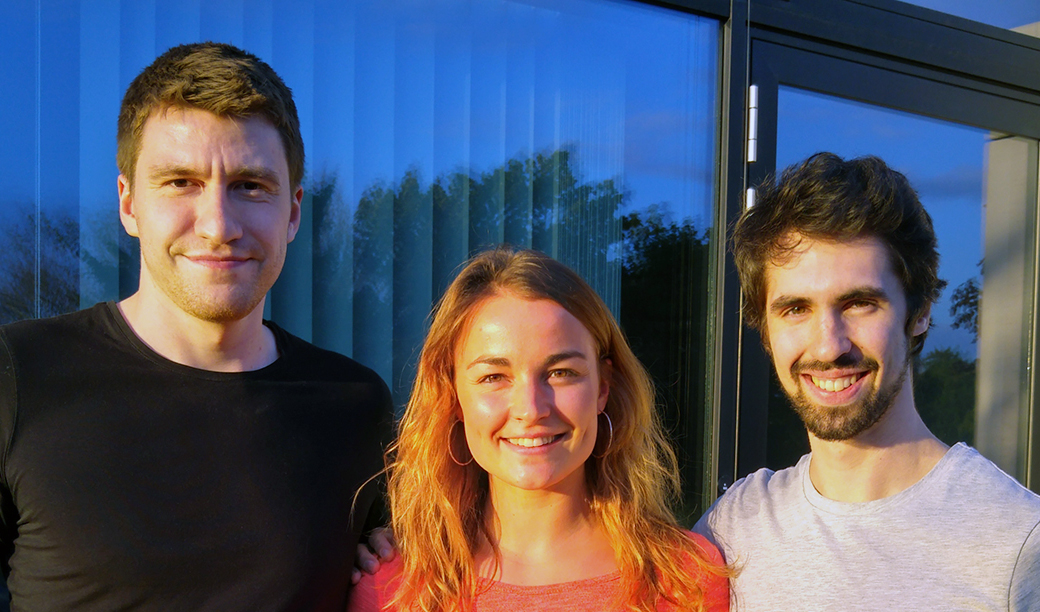
Nuclino’s early founding team also included Veronika Fischer. They had met at CDTM and worked together on projects before founding the company. In their June 2016 account of the venture, the three introduced themselves by their complementary specialties: Björn the designer, Johnny the technical specialist, and Veronika the business specialist. The Google Drive folder chaos they described was a shared experience.
There is something useful about a founding story with so little theatre. A folder is an unpromising villain. Yet it can consume an impressive amount of everyone’s time without ever making a sound. The ambition was to make the team’s knowledge easier to capture, share, and retrieve. That is a modest sentence with a large amount of everyday work concealed inside it.
The designer had to listen first
By June 2016, the founders said they had conducted more than 150 interviews with their intended users. They had also opened a public beta at the end of January. Those interviews give the early story a useful counterweight: the team’s frustration was a starting point, followed by conversations with people outside it. A personal annoyance had to prove that it was shared.
Interviews with the intended audience before the team described its approach publicly.
A November 2016 funding announcement made Michelsen’s responsibility explicit: product and design. Kienzle handled backend and frontend development; Fischer handled marketing and finance. That autumn, five business angels invested a six-figure sum, with Florian Huber as lead investor. The allocation of work is revealing. Design was one of the venture’s named founding disciplines, with Michelsen responsible for turning the problem into a product people could use.
Good interface work is often experienced as the absence of an event. Nobody pauses to congratulate a menu for being where they expected it. Nobody applauds a document opening promptly. The task continues, and the software receives the flattering reward of being briefly forgotten. For a designer working on collaboration, that creates an awkward commercial challenge: the work has to be visible enough to choose and unobtrusive enough to keep using.
Nuclino’s comparison with Confluence expresses that choice in practical terms. It presents Nuclino as a fit for teams that value easy adoption, speed, and fewer separate tools. It also acknowledges situations in which Confluence may suit a team better, including closer ties to other Atlassian products and more granular formatting control. The comparison allows preference and context to enter a discussion that software marketing often treats as a coronation.
What happens after the meeting ends
Michelsen’s writing spends considerable time on the moment after people have talked. His guide to meeting minutes treats the written record as a way to retain decisions and outcomes. It distinguishes the agenda, prepared before a meeting, from the notes that preserve what happened. The distinction sounds elementary until a team discovers that its beautifully organized agenda contains no record of what it actually decided.
The same attention appears in his guide to sprint retrospectives. He explains the meeting as a chance to review how the team worked and identify improvements. His suggested questions include what went well, what went wrong, and what the team should start or stop doing. The product and the advice meet at a familiar difficulty: a useful conversation needs somewhere to go afterward.
His writing on employee handbooks brings another audience into view: the person arriving late to everybody else’s shared understanding. He argues for conversational language and uses public handbooks from Valve, Basecamp, and Disqus as examples. A handbook can convey how a company works and what it values, rather than merely stand guard at the entrance wearing a legal tie.
In his discussion of standard operating procedures, the recurring problem is continuity. Someone leaves, someone joins, someone goes on vacation. A documented process helps the work carry on. Such writing makes Michelsen’s subject larger than document storage. The interesting unit is the handoff: can another person understand enough to act without having to reconstruct the entire history?
“Your team’s collective brain”
Nuclino’s description of the workspace
That phrase is useful because it makes remembering a shared responsibility. A business can employ capable people and still repeatedly ask them to retrieve the same explanation. The familiar request to send a link again is polite, harmless in isolation, and surprisingly persistent. Michelsen’s career has given this sort of friction a place on the product agenda.
A workspace learns a few new tricks
In April 2023, Nuclino introduced Sidekick, an AI assistant for drafting, editing, summarizing, and generating ideas. It works within the editor: users can invoke it to create material or select existing text for assistance. This places help near the writing task itself, which is a sensible place to encounter a writing tool.
Canvas followed in March 2024, bringing collaborative whiteboarding and diagramming into Nuclino items. Teams can arrange ideas, build flowcharts, and assemble moodboards. The addition gives a visual counterpart to the document. Some explanations want a paragraph; others want boxes and arrows. Asking either medium to do every job is a reliable way to make a simple idea look difficult.
In July 2024, Ask Sidekick extended the assistant into questions about a team’s documented knowledge. Answers draw on accessible content and include links back to the underlying material. The feature moves the retrieval problem forward: a user can ask in ordinary language, while retaining a route back to the document that holds the answer.
- 2014Michelsen joins CDTM’s spring class
- 2015Begins his co-founder and CEO role at Nuclino
- 2023Sidekick joins the editor
- 2024Canvas and Ask Sidekick arrive
- 2026More ways to work through connected AI assistants
By September 2026, Nuclino had expanded its MCP capabilities so connected AI assistants could create and update workspaces, move items, and work with comments and internal links. The same release added comment reactions and formatting improvements. That pairing is an appealing detail: automation and the humble acknowledgment of a colleague’s comment can belong in the same batch of work.
Then the form got a personality
FormGrid introduces a different register. Michelsen’s biography there identifies him as a product designer, developer, and founder, and says he co-founded the service to help people make visually distinctive, engaging forms. Where a shared knowledge workspace benefits from an orderly presentation, a public form may need to look like the person or organization asking the questions.
The FormGrid team’s account, signed by Björn, Jonathan, and Ana, complains about a sanitized web and recalls GeoCities, old Tumblr pages, ASCII art, loud colors, and custom cursors. Its headline is direct: “The web lost its personality. We want to bring it back.” There is affection here for an internet that occasionally dressed badly but at least chose its own clothes.
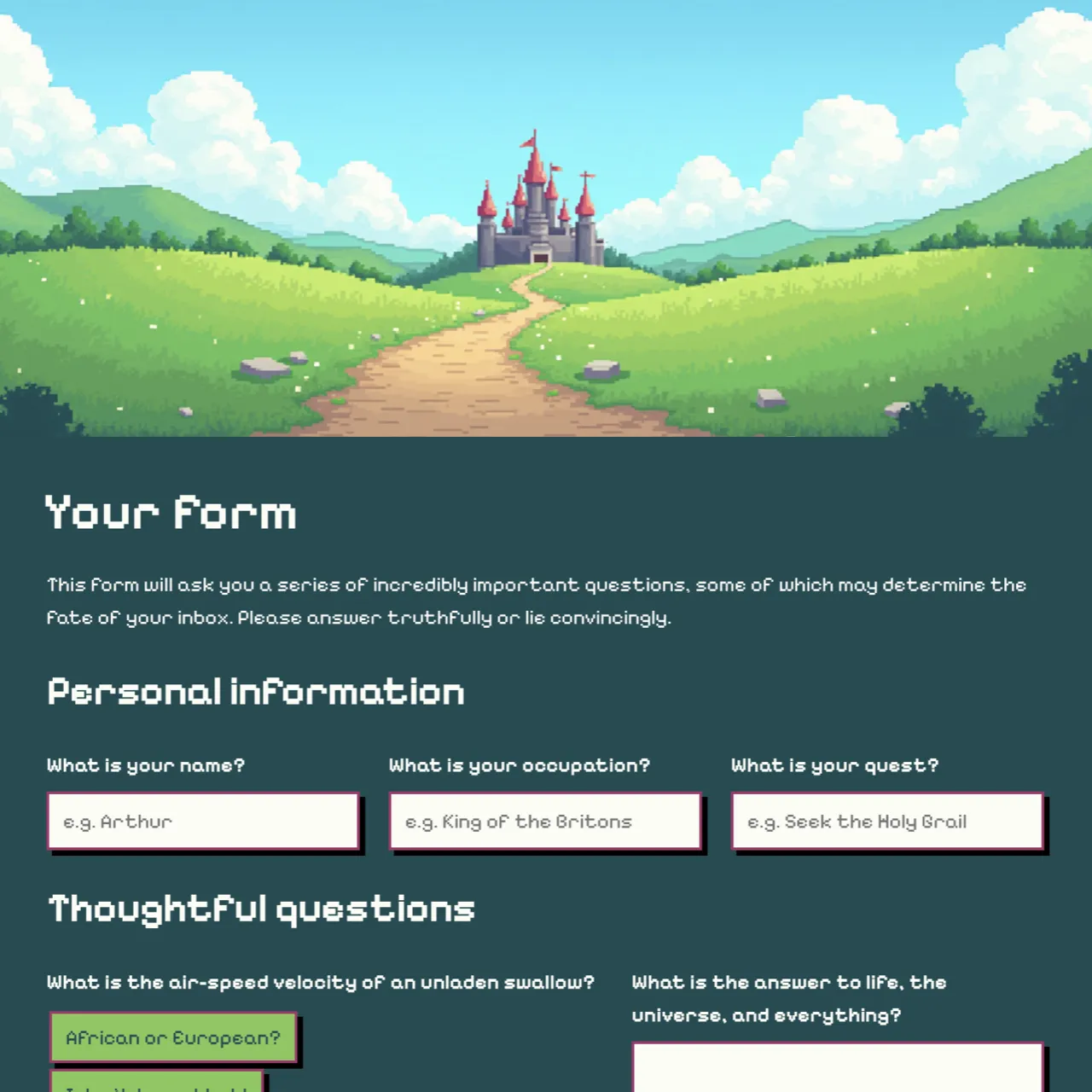
The product makes that premise concrete with pixel art, pop art, seventies-inspired, and other visual examples. It offers a flexible grid for arranging elements and an editor that works like a document. Users can describe a form for AI generation or customize it themselves. The design question has shifted from finding an internal decision to inviting an external response.
These two projects make an interesting pair. A work tool should help people get on with a task. A form can also communicate something about who is asking. In one case, reducing visual distraction serves the reader; in the other, a deliberate visual choice can be part of the message. The comparison suggests a design practice concerned with purpose, rather than one prescribed appearance for everything.
The small fix is part of the story
There is a less polished glimpse of Michelsen in an August 2023 note from the reviewer behind Note Apps. At the beginning of a review of another application, the writer thanked Björn for fixing two Nuclino issues found the previous week. It is a brief acknowledgment, tucked into somebody else’s story, and perhaps more useful for that reason.
It places him near the ordinary exchange between a person using software and a person improving it. His title is CEO; the anecdote concerns two fixes. Both belong in a portrait of the same career. The products can acquire new abilities, the interface can change, and the work still comes down to somebody noticing a problem and somebody responding.
Michelsen’s story began with a team having trouble keeping hold of its own knowledge. It now includes tools for writing, drawing, asking questions, and making forms look less anonymous. The thread is easy to recognize. A person has something to do, and the software stands between intention and action. His work keeps returning to that small stretch of distance.