April Dunford was given a list of customers and a rather gloomy assignment: find out whether they would mind if a product disappeared. Sales had disappointed. The team was considering shutting it down. Calling buyers was supposed to help tidy up the ending.
- A free show about giving B2B buyers a clear reason to choose.
- Start with what customers actually compare you with.
- Turn the resulting strategy into a pitch, then try it in real conversations.
The product that almost disappeared
In Dunford’s telling, most people she reached barely used the software. A few, however, were delighted. They had put the database on devices used by workers in the field. The company had imagined desktop productivity software; these customers needed a portable database. Their use suggested a different market. The team reconsidered the cancellation and tried selling into it.
The important discovery was a comparison. Judged as one kind of product, the software looked unremarkable. Judged as another, its capabilities mattered. Dunford returns to that early Watcom experience in the show’s first full episode. It supplies the question behind the business: what frame makes a product’s value easiest to see?
Positioning with April Dunford launched in 2023, with a trailer in May and its first full episode in June. It is an educational media brand attached to Dunford’s work as a consultant and author. Entrepreneurs, product marketers and business leaders can listen without commissioning a workshop. A difficult strategic conversation becomes something they can hear on the way to work.
Dunford brings an operator’s background to the microphone. She studied engineering at Waterloo, then spent 25 years leading marketing, product and sales teams. Her career included seven B2B startups and roles at larger companies after acquisitions. That history helps explain the show’s preoccupation with the handoff: an idea has to survive contact with colleagues, customers and a sales process.

The rival hiding in a spreadsheet
Many companies begin with a list of firms that resemble them. Dunford starts with what buyers would do instead. Those are different lists. A customer may be comparing your software with a spreadsheet, a manual routine, another vendor or leaving things alone. Winning requires understanding that actual choice.
Her February 2026 episode on competition presses the distinction. Sales teams hear which alternatives reach a buyer’s shortlist. Product teams, founders and marketers can bring different assumptions. A positioning exercise has to reconcile those views with the market the company encounters today.
- 01AlternativesWhat would buyers use instead?
- 02CapabilitiesWhat can you do that those choices cannot?
- 03ValueWhy does that difference matter?
- 04CustomersWho cares most about that value?
- 05CategoryWhat context makes it understandable?
A sequence of decisions, not a fill-in-the-blank slogan.
That order gives the show a distinctive place among marketing podcasts. Its subject is the machinery beneath the message: alternatives, capabilities, value, customers and category. Naming a category too early can saddle a product with expectations it cannot satisfy. Choosing one after understanding value gives the buyer a useful shortcut.
The interview episodes widen that lens without losing the subject. Emma Stratton discusses messaging; Georgiana Laudi discusses customer-led growth. These are adjacent disciplines, and the distinction matters. Choosing the comparison is one task. Writing the words and building the customer journey are others. The show gives a team language for deciding which problem it actually needs to solve.
Free to hear. Costly to agree.
The podcast sits beside a paid business in books, consulting, training and speaking. Dunford’s flagship engagement is a three-day positioning and sales-pitch workshop. Its deliverable connects the executive team’s strategic decisions to a story salespeople can use.
The consulting page displays headline pricing of $80K-$100K, while also retaining $50,000 startup and $80,000 enterprise cards. The currency is unstated. Those figures are useful context, rather than a universal quote. A prospective client needs current pricing for its scope. The other meaningful cost is the team’s time: leadership must make decisions together.
Her client evidence includes Help Scout, Skillsoft, Funnel and Redgate. The show also features guests from other businesses; appearing on a podcast does not establish a consulting relationship. Help Scout co-founder Nick Francis’s episode explicitly discusses working with Dunford, adapting a sales narrative and revisiting the pitch as the business moved upmarket.
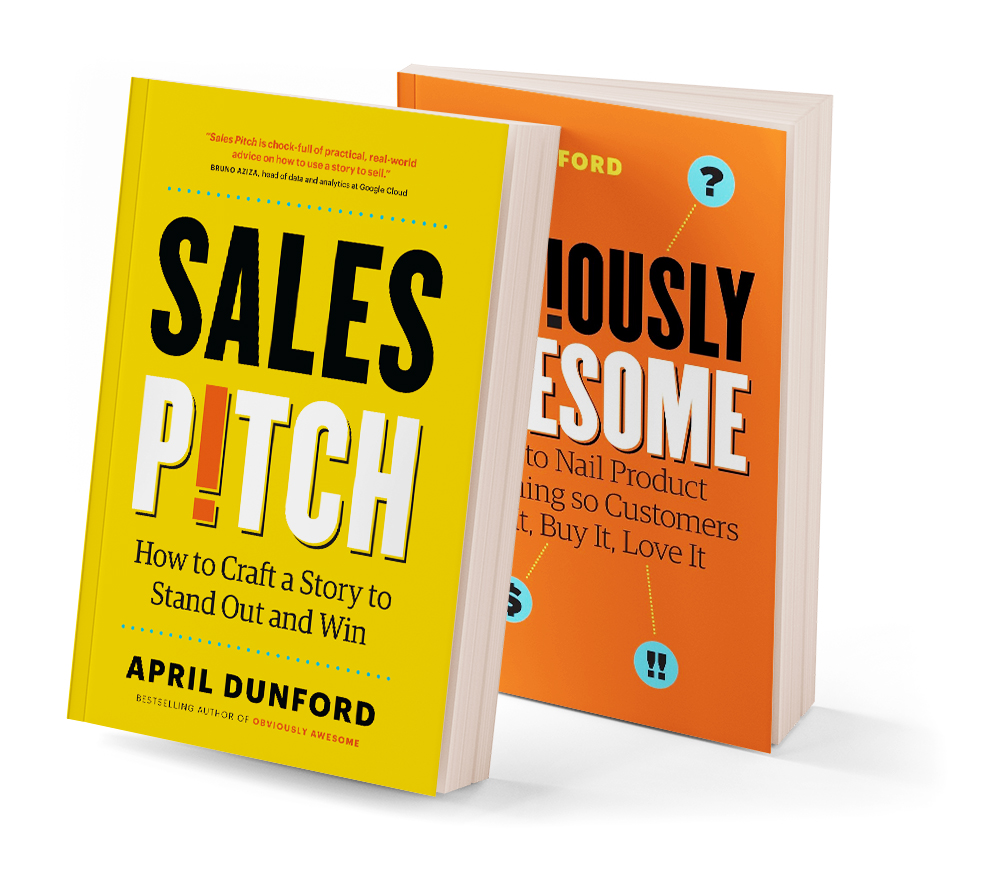
The books make the process available in another form. Obviously Awesome lays out positioning; Sales Pitch, released in 2023, carries it into a structured sales conversation. The books page reports more than 100,000 copies of Obviously Awesome sold and offers a combined workbook with newsletter signup.
A sales pitch is the field test
A reader can copy one habit immediately: after naming a capability, ask what it allows a customer to accomplish. Then ask again. Dunford’s repeated “so what?” pushes a team beyond a feature’s convenient description toward its consequence for a buyer.
In a Business of Software talk, she describes LevelJump, whose software was built inside Salesforce. Avoiding another login was a modest benefit. Connecting training to sales performance was a more consequential one. Moving that outcome to the beginning changed the pitch. The software’s architecture had supplied a story the team was burying.
The next move is to test that story. In the April 2, 2026 episode, Dunford recommends live conversations with best-fit prospects before homepage experiments. A page test can mix positioning with design and copy. A conversation lets a team hear whether the comparison makes sense, then turn agreed positioning into a messaging document.
The method gets a do-over
Her own teaching has changed under that same pressure. In January 2026, Dunford announced an expanded Obviously Awesome. Client feedback had exposed places where teams got stuck, especially translating capabilities into differentiated value. She separated preparation and follow-through from the central process and restarted the podcast with episodes on the revised material.
“I decided I wanted an Obviously Awesome do-over.”
April Dunford / January 2026
The discipline needs evidence. Dunford’s consulting FAQ excludes pre-launch and very early-release products; her teaching advises those teams to keep positioning loose. They have a thesis to test. Established teams still need agreement across functions and a product that delivers the promised value. A clearer explanation cannot manufacture that evidence.
Start with the customer who already gets it. Find out what they compared you with, what they valued and why. That is a manageable assignment. It also leaves room for the possibility that the thing you built has a better use than the one you first imagined.
Episode library · Books & workbook · Newsletter