For a man selling marketing advice, Dave Gerhardt made a curious marketing decision. He asked his customers to leave a place they already visited and sign up somewhere else. Some declined. In a February 2024 account of moving Exit Five from Facebook to Circle, he put the damage at 1,000 customers and $100,000 in revenue. A business built on attracting people had deliberately made itself harder to reach.
That is a useful place to begin with Exit Five, a membership and media company for business-to-business marketers. Its product is partly information: podcasts, newsletters, workshops. But its more interesting product is a room. Who gets into that room, what they can ask, and whether someone useful answers are the questions that explain the business.
- Paid peers, free media, and real-world meetings for B2B marketers.
- A platform migration cost customers before the business recovered.
- The useful habit to copy: let customer questions shape the product.
The audience wanted to meet itself
Gerhardt had already worked in marketing leadership at Drift and Privy. In November 2019, he started The A List, a paid side project on Patreon. The initial attraction was access to his experience. The revealing change came when subscribers wanted access to one another. He added a private Facebook group. A creator business had acquired a second source of value: its customers.
A community can help one person choose an agency while another works out how to ask for a raise. Gerhardt could attract the first members; he could not personally possess every answer they would eventually need.
The business became DGMG, short for Dave Gerhardt Marketing Group, before adopting the Exit Five name in 2022. The rebrand loosened the connection between the product and one man. Even the name is pleasantly unceremonious: Gerhardt has said it comes from the highway exit on the way to his wife’s parents’ house.
A free room with an expensive ceiling
The early arrangement split the business across Patreon payments, Facebook conversations, and email. Circle’s account of the migration describes scattered records and limited control over member data. The discussions were working. The machinery around them was becoming a problem. Familiarity made Facebook convenient, while that same familiarity tied professional conversations to a general social feed.
Gerhardt wanted a branded membership experience with searchable discussions, content, and a mobile app. The switch required members to act again. That extra step exposed how fragile an apparently settled subscription could be. In his public account, the free Facebook setup gave way to a Circle setup costing $20,000; he did not specify the billing period.
He reported recovering the lost customers and revenue over roughly ten months. His explanation included another telling detail: some people cancelled because they wanted Facebook, while others said they had avoided joining because it was there. The migration changed which customers the product suited. It also made a larger business possible, at a price paid before the benefits arrived.
The migration, as Gerhardt described it in February 2024. Historical, self-reported figures.
“People didn’t just want to read my posts”Dave Gerhardt · on the early community
Buy a second opinion
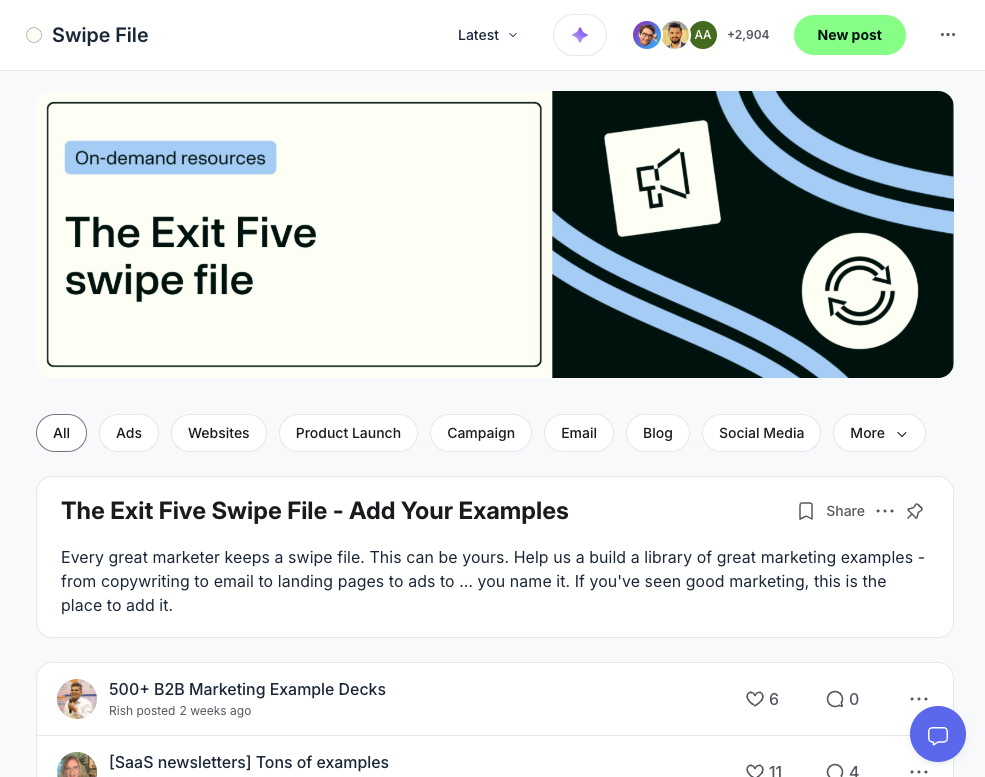
Today, the main community offers topic spaces, industry groups, peer introductions, training, and a library of working examples. Content marketers, demand-generation specialists, marketing operations staff, and department leaders can bring specific problems. Public testimonials include marketers at Navattic, SOCi, and Opal. The homepage advertises more than 7,000 B2B marketers, placing the business well beyond a small founder fan club.
The practical use is straightforward. Before buying software, ask people who have used it. Before presenting a campaign, ask peers to challenge it. A good question includes the audience, budget, constraints, and what has already been tried. Otherwise, even a room full of experienced marketers can only return the familiar answer: it depends.
The pricing page lists Pro at $49 a month or $444 billed annually, with a separate plan for teams of three or more. The annual price works out to $37 a month. That buys access and programming; it does not buy a finished campaign. Members still have to contribute context and decide which advice travels safely into their own business.
Some rooms need smaller doors
Exit Five’s CMO Council makes the room argument explicit. Its dedicated page describes a vetted group for in-house marketing leaders at B2B companies with at least $50 million in annual revenue. Applicants have a 30-minute call, members sign nondisclosure agreements, and the company excludes competing businesses. Monthly advisory groups match five or six peers by circumstances such as revenue and company stage.
Alternatives such as Pavilion and CMO Huddles also offer professional peer networks; Exit Five places its executive group inside a wider B2B marketing media business. Its advantage depends on how well it matches the people, rather than merely how many it admits.
Nor is every interaction behind a paywall. The free newsletter and podcast let readers and listeners inspect the company’s approach. The Expert Network recruits practitioners for its coverage. Exit Five says one live session can later become a podcast episode or newsletter feature.
The conference leaves the conference room
The business earns from memberships, sponsorships, and events. Its 2026 Drive conference sold in-house marketer tickets at $1,299 for members and $1,499 for nonmembers. Sponsors included Knak, Webflow, Customer.io, and AirOps. These are companies selling to the people Exit Five gathers.
In its September 2026 recap, the team described growing Drive from 200 to 400 people in Stowe, Vermont. Staff had worried that expansion would spoil the small-group atmosphere. Instead, they reported attendees still meeting new people on the last night. Hikes, bikes, meals, and fire pits supplied places to talk. A conference about professional relationships had sensibly left room for unprofessional amounts of s’mores.

Copy the listening before the launch
There are lessons here for anyone building a specialist business. Start with a problem people already bring you. Notice when customers want one another, rather than more of you. Organise conversations so the next person can find the answer. Hire people who make introductions and keep discussions useful. Gerhardt’s public description of Exit Five as bootstrapped puts customer revenue at the centre of that expansion.
The sequence is harder to copy without an existing audience, paying demand, and enough cash to absorb a migration. A passive subscriber may prefer the free podcast. Someone seeking sales prospects will collide with the main community’s rules against self-promotion. The decisive question for a prospective member is wonderfully ordinary: what are you stuck on this week, and who might know how to help?
Start with the free material, then bring a real question.