The first thing George Coudounaris and Kevin Chen did with their first video was delete it. Watching themselves back was too embarrassing, Coudounaris later recalled. They made The B2B Playbook an audio podcast instead. For two people who would teach businesses to become familiar faces in their markets, it was an awkward beginning.
- Free podcast and newsletter; paid courses, consulting and campaign management.
- The 5 BEs put customer research before content, and content before distribution.
- The founders promise to run agency engagements themselves.
- Useful for lean B2B teams with time to build demand, rather than a 30-day lead deadline.
The recording that went in the bin
There was a practical reason to keep going. Chen had watched his father build an IT business and felt small companies were underserved. Both founders had worked in law. Coudounaris had been a corporate lawyer at Clifford Chance. Their new field presented a different difficulty: plenty of advice, little agreement about what to do first.
In his account of entering B2B marketing, Coudounaris describes chasing the promised single tactic that would work. His eventual filter was more mundane: could a small team execute it, and did it produce revenue? The resulting framework became the organising idea behind The B2B Playbook.
The first podcast episode appeared on August 2, 2021. Chen’s early biography describes recording in wardrobes. After the first season, they returned to video. Coudounaris says prospects later told him they had discovered the business that way; people recognised the founders at events. The camera had become useful enough to tolerate.
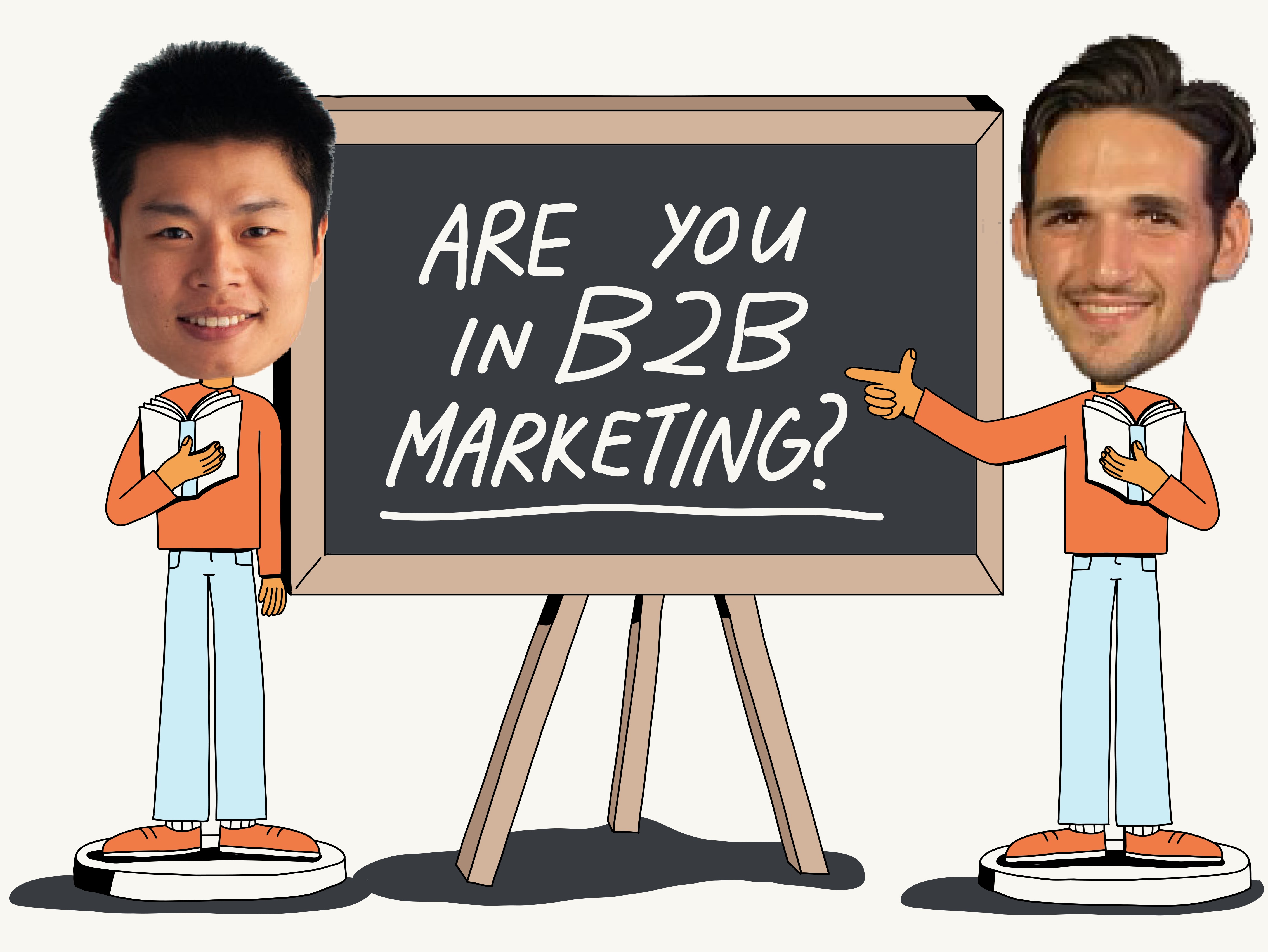
Five verbs, in the right order
The 5 BEs sound almost suspiciously friendly: Be Ready, Be Helpful, Be Seen, Be Better, Be the Best. Their value lies in the sequence. Be Ready asks who the customer is, what problem prompts a purchase and what makes a supplier worth switching to. Be Helpful turns that understanding into material buyers can use. Be Seen puts it in front of them.
Then come improvement and expansion. Measure commercial outcomes, learn from customer conversations and build on what works. In this arrangement, advertising has a specific job: distribute something relevant to people whose needs you understand. Buying reach before doing that homework simply gives an uncertain message a larger audience.
- 01Be ReadyKnow the buyer and the buying trigger.
- 02Be HelpfulAnswer questions worth answering.
- 03Be SeenDistribute to the people who matter.
- 04Be BetterFeed commercial results back into the work.
- 05Be the BestExpand the parts that earn their place.
The audience is recognisable: a marketing manager responsible for strategy, copy, campaigns and explaining the numbers. The course says most participants work at companies with 10-500 employees. Testimonials come from small teams at ClearCalcs, Commutifi and Weel. A method that gives them priorities can be more useful than another list of channels.
“this is our strategy, this is the process”
Ati Aziz, ClearCalcs / company-published testimonial
The framework is free. The help has a price.
The business lets customers choose how much assistance to buy. The podcast, blog and Weekly Playbook newsletter are free. The company reports more than 200 episodes and 2,300 newsletter subscribers. Paid training compresses the method into a programme; consulting guides a team; agency services take on execution.
At the October 2026 review, the six-week demand generation course lists $997 USD for complete self-serve access and $1,997 for a first cohort seat with live support. The $497 entry option covers the first two weeks only. It is easy to mistake the lowest advertised number for the whole course.
Consulting lists a $2,750 setup fee and $1,150 monthly advisory. Agency retainers start at $2,250 a month, before advertising. Recommended LinkedIn media spend is another $3,000-$5,000 monthly. Combining those published figures puts that starting route at $5,250-$7,250 per month, before any additional scope. “Small team” does not necessarily mean small bill.
The positioning is equally concrete. George and Kevin promise to run engagements directly. Buyers can inspect their thinking through the free material before hiring them. Against hiring internally, buying another course or choosing another agency, the attraction is continuity between the people explaining the method and the people applying it.
A lead is not a deal
Leadwave’s published case supplies a useful test. Its previous agency had delivered leads without closed deals, according to The B2B Playbook. The response was to clarify the ideal customer, align messaging with buying problems, build targeted campaigns and introduce conversion tracking and regular review. The case reports three times return on investment including fees, and first six-figure deals.
Those are company-published outcomes, rather than a forecast for the next client. The revealing part is the intervention: the work began with customer definition and messaging. More traffic would have left the original uncertainty intact.

The company’s newer revenue material pushes further into sales and customer success. Closed Circuit Selling, written by Coudounaris and Adem Manderovic, argues for sharing market intelligence across departments. Its lead-scoring article makes the issue tangible: someone can enjoy your content while remaining locked into a supplier contract for two years. Interest tells you something. Renewal timing tells you something else.
Copy the homework
A reader can start with a shared record of buyer conversations. Note the current supplier, the frustration, the renewal date and what could prompt a switch. Use recurring questions to choose the next piece of content. Give sales a way to return what it learns to marketing. None of that requires buying a course first.
It does require cooperation and patience. The agency describes itself as a poor fit for companies demanding leads within 30 days or unwilling to align sales and marketing. Coudounaris has also described declining an early founder’s ad brief when the audience barely used LinkedIn and the message still needed testing. He recommended more manual outreach.
That is a useful place to leave the playbook: with a person picking up the phone, learning something specific and writing it down. The next campaign has a better chance when somebody has done that first.