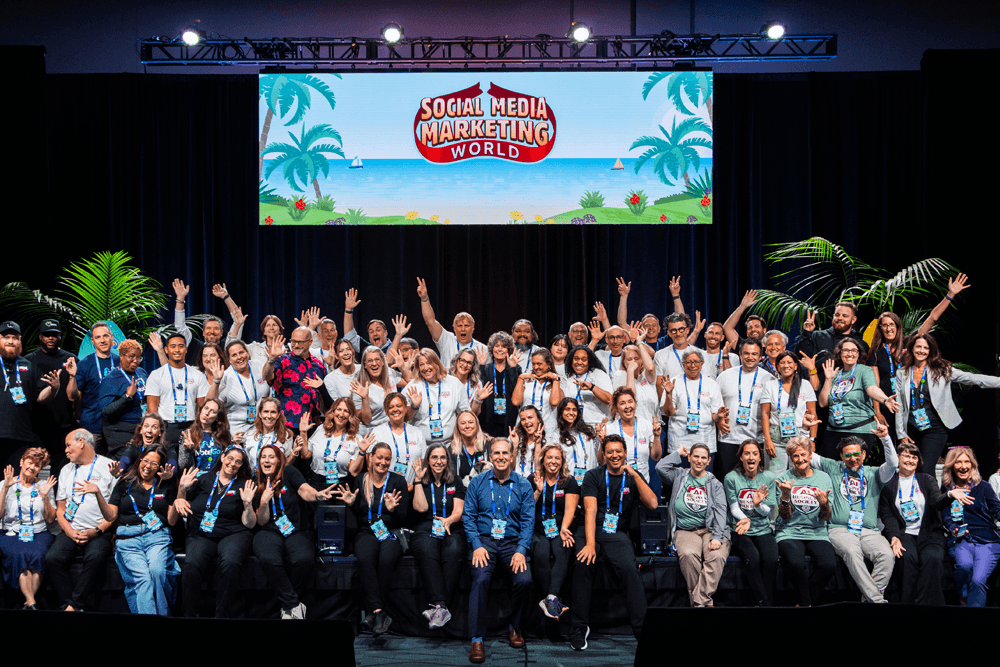
In the summer of 2012, Michael Stelzner had a peculiar marketing problem. People knew Social Media Examiner, the publication he had founded three years earlier. They did not necessarily know him. A conference was coming. Before asking readers to spend money and travel, he needed a way to become a familiar voice.
- Free weekly interviews, built for small-business marketers.
- Written lessons accompany the audio.
- Paid conferences and communities sit behind the free teaching.
He hired podcasting coach Cliff Ravenscraft and launched Social Media Marketing Podcast on August 10. Early interviews introduced potential attendees to the people who would speak at Social Media Marketing World. The existing publication supplied an audience. The inaugural conference, in 2013, drew 1,100 people. The microphone had a commercial purpose from the beginning.
That origin matters because it explains the company profile behind the show. Social Media Marketing Podcast is a production of Social Media Examiner, rather than a separately described startup. Its product is free education. Its place in the business is to create a relationship with people who may later want more education, more access, or a room full of peers.
Forty-five minutes, one useful problem
The show is advertised as a weekly, roughly 45-minute interview with marketing practitioners. Its promise is specific: discover tactics you can use in your own work. Apple Podcasts now lists Michael Stelzner and co-host Jerry Potter in the show description. The subject is broad enough to follow changing platforms, but narrow enough to serve someone with a marketing job to finish.
That person might own a small business, run an agency, or handle social media for a company without a sprawling marketing department. The problem is partly information overload. Instagram changes something. YouTube rewards something else. A client wants an explanation by Friday. An interview offers a manageable unit of learning, and the accompanying written article makes the lesson easier to revisit.
Take the October 8, 2026 conversation with YouTube strategist Adam Ivy. It examines his BINGE scripting method: hook the viewer, build intrigue, move the story forward, generate engagement, and end with momentum. Instead of treating views as the whole objective, the discussion asks how attention becomes trust and, eventually, a customer.
The useful move for a listener is modest. Pick one video, inspect where viewers leave, and test a different opening or transition. Treat the guest’s framework as a hypothesis. A local service business and an entertainment channel have different reasons to publish, even when both use the same video platform.
The audience that could afford the next step
A free listener and a paying customer are different categories. Stelzner learned that distinction as the show grew. In his six-year retrospective, he described an early mix of marketers, bloggers, and podcasters. Marketing content performed better, and marketers were more interested in the conference. Many hobbyists could not afford to attend. He narrowed the editorial focus toward smaller-business marketers.
The podcast fits into an education business whose paid offerings include conference tickets and memberships. The current lineup includes AI Business Society, while the separate AI Explored podcast teaches practical AI adoption. These are related Social Media Examiner products; listening to the marketing show does not require buying them.
The economics of paid learning became especially visible in a 2024 account of Social Media Marketing Society, an earlier membership offering. Its initial price had been $30 a month. Some members canceled within one to three months, before experiencing enough value. One-off training sales during COVID-19 also failed to work well as a route into membership.
The response was to emphasize community alongside training and replace monthly subscriptions with quarterly and annual options. Enrollment became available year-round. Those changes reveal a recurring problem for educational businesses: signing someone up can happen faster than helping them form a useful habit. The billing schedule and the learning experience have to make sense together.
“I was looking for a creative way to get in front of my audience.”Michael Stelzner, recalling the 2012 launch
A bigger market proved expensive
There is a less comfortable story in the parent company’s history. Stelzner built My Kids’ Adventures, a parenting publication with a companion podcast, because the consumer market looked larger. In his 2017 account, he called it a $300,000 mistake. After a year, the anticipated monetization did not materialize. He closed the project and absorbed its staff into Social Media Examiner.
The lesson is easy to borrow and surprisingly easy to ignore. Before expanding into another topic, ask who pays, what they buy, and why the free material helps them reach that purchase. A large audience can be an expensive distraction when its interests have little connection to the product you can actually sell.
The show’s own production supplied another cost lesson. Stelzner reported spending three to four hours per episode when he handled recruitment, recording, and editing. By 2018, delegating work had reduced his own involvement to about 90 minutes. That is founder time, not the entire team’s production time. Someone still has to do the work.
Borrow the filter, then do the work
There are plenty of substitutes for this kind of education: independent marketing podcasts, YouTube tutorials, platform documentation, and course libraries. The show’s appeal lies in its editorial selection and connection to a wider teaching business. You can meet an expert through an interview, read the lesson, and encounter deeper training elsewhere in the same organization.
That arrangement gives Social Media Examiner an incentive to keep its free teaching useful. It also gives the reader a reason to remain selective. An expert interview cannot diagnose every business, and a conference invitation does not establish that a tactic will work for your audience. The listener still owns the experiment. Free listening lets you sample the teaching before buying.
For a marketer, a workable routine is to choose episodes by the problem currently on the desk. Write down one change, decide what result would count as improvement, and test it before queuing another lesson. If your immediate need is enterprise governance or highly specialized technical implementation, a broad small-business interview may be too general.
For a publisher, the more interesting thing to copy is the filter. Choose a customer whose problems you can keep solving, build a repeatable teaching format, and connect the paid product to the same needs. Social Media Marketing World is scheduled for April 1-3, 2027, in Anaheim. The weekly conversation continues between those larger gatherings. Familiarity gets another appointment on the calendar.