There is a species of sentence that quietly runs half the organizations in America: “Someone should update that.” The “that” might be a website with last year’s event on its home page, a newsletter drafted but never sent, a Facebook account that wakes up twice a quarter, or a Google ad purchased with hope and inspected with dread. The someone is usually a capable employee with another job.
Dogwood Media Solutions has built a company around becoming that someone. From Pike Road, just outside Montgomery, its 11 strategists, developers, and creatives operate as an outsourced marketing department for businesses, nonprofits, churches, schools, professional firms, and public organizations. The menu is broad: websites, hosting, SEO, social media, advertising, design, email, public relations, photography, and video. The point is not breadth for its own sake. It is to make the neglected parts belong to one accountable team.
This is a less glamorous proposition than “transforming brands,” and a more useful one. A client gets people who can write the post, design the image, repair the form, run the ad, read the report, and decide what happens next. The customer buys continuity - the expensive, unphotogenic ingredient that marketing departments routinely run out of.
“Dogwood helps us accomplish our mission… Dogwood made it happen.”Chad Boak, Vaughn Forest Church
It began behind a church camera
Brian Harris started Harris Media Solutions in 2010 after noticing that churches needed help with social media and websites. This was not trend forecasting. It was proximity: Harris served in church communications, saw the unfinished jobs, and understood the people who were supposed to finish them. His contacts widened to businesses, nonprofits, and educational institutions.
In January 2019, Harris and Thomas Jones opened Dogwood Media Solutions in a 250-square-foot room above Pike Road Family Eye Care. By May they had hired two people and added an intern. The room failed first. They moved into 400 square feet in June, later worked from downtown Montgomery, and in November 2022 occupied a 2,500-square-foot Pike Road office with an editing suite, four offices, and a garage door opening to a patio. Agency growth can be abstract. Running out of places to put chairs is not.
Forty families, one Sunday
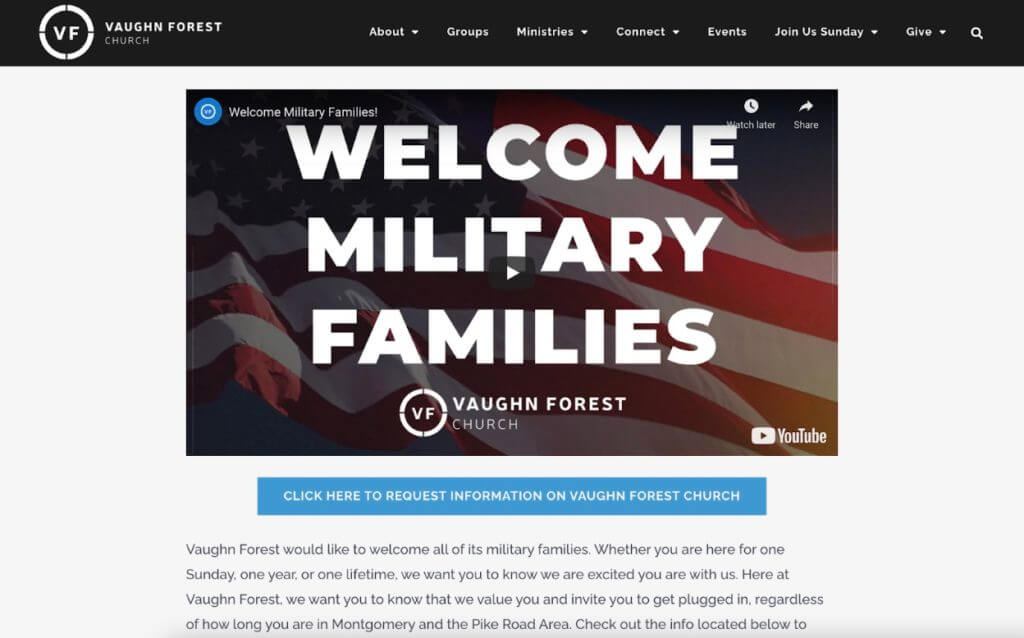
The case that explains Dogwood best is not a redesign. Vaughn Forest Church wanted to reach military families moving near Maxwell Air Force Base. Dogwood built a landing page that answered practical first-visit questions - what worship looked like, what people wore, what was available for children - and added video testimony from military members. Then it geotargeted Facebook ads around the base and neighborhoods where those families lived.
In one week, the ads produced more than 18,000 impressions. The church attributed 40 new visiting military families the following Sunday to the effort. An impression is a slippery marketing number; a family walking through a door is not. The clever move was not Facebook. It was recognizing that the anxiety of a newly relocated family could be reduced before the visit, then putting that answer in front of a very specific geography at the right moment.
The greenery seller with no internet footprint
Alabama Smilax had operated for more than 55 years, selling greenery to wedding and event professionals, but it had no digital presence. Dogwood built a Shopify site with a simple point-of-sale system, made photography central, opened Facebook and Instagram accounts, posted two or three times a week, and added targeted Google and Meta advertising. The audience was national, but narrow: florists, wedding professionals, and people demonstrating an interest in flowers.
From the July 2021 launch through December 2022, the site recorded more than 19,000 clicks and 815,000 impressions, with a 2.34 percent click-through rate. Facebook went from zero to just under 6,000 followers; Instagram passed 700. Dogwood says the client's revenue reached a high, though it does not publish dollars. The copyable idea is the order of operations. A business with nowhere useful to send demand should not begin by buying more demand. Build the shelf, stock it with strong pictures, make checkout work, then turn on distribution.
Eighteen months from zero
A website can become a digital attic
Dogwood's 2026 rebuild for the Town of Pike Road began with a familiar municipal problem. The eight-year-old DIY site had accumulated pages from multiple departments until important resources were buried and the back end became difficult for staff to maintain. The first failure was not visual polish. It was retrieval. Residents could not reliably find things, and employees could not comfortably keep them current.
That distinction matters because it changes the brief. Dogwood selected Drupal for structured, content-heavy municipal work after researching whether the complexity justified it. Its everyday website practice still includes WordPress, generally delivered in six to twelve weeks depending on scope, and Shopify when commerce demands it. The agency is not selling one sacred tool. It is selling judgment about when the inexpensive, familiar tool has become the costly one.
That judgment also appears in its SEO work. For TransformedPD, an education business, Dogwood resisted chasing giant search volumes. It built topic clusters around two high-intent phrases and published one optimized article a month. “Biblical integration” reached Google's first page by September 2022; “Christ-centered instruction” followed in December. Both had previously sat outside the top 100. New users represented 68 percent of organic traffic over seven months. Small volume worked because relevance was unusually high and the client supplied substantive expertise.
Dogwood says many advertising clients begin here in media spend, plus a management fee based on scope. It separately argues that billboards are more sensible when the monthly budget is closer to $5,000 and the goal is brand or location awareness.
What it costs - and what breaks
Dogwood does not publish project or retainer prices. It does publish a useful floor: many ad clients start with at least $500 per month in spend for each platform, in addition to management. Digital campaigns may show activity within days, but Dogwood says stable, measurable performance more often appears by the second month. For billboards, its own guidance raises the budget to roughly $5,000 a month and warns that limited budgets usually get a faster punch from digital ads.
The conditions behind the case studies are equally important. The Vaughn Forest result depended on a time-sensitive influx of families, a sharply defined location, a welcoming offer, and a landing page that dissolved uncertainty. Repeating “Facebook ads” without those ingredients would be cargo cult marketing. Alabama Smilax had photogenic inventory, national shipping, and a market that already browses visually. TransformedPD supplied valuable source material and accepted guidance; the search phrases were small but commercially meaningful.
Dogwood has also written candidly about what fails. During Google's August 2025 spam update, it observed early traffic or impression declines of 10 to 35 percent on several client sites. Thin tips pages, weak engagement, and suspect backlinks were more vulnerable; maintained cornerstone content recovered faster. The change of mind is embedded in the lesson: more content is not automatically more marketing. The agency says it is doubling down on editorial depth, technical hygiene, and human judgment rather than mass-produced AI copy.
The part worth copying
- Define a human action - a visit, sale, call, donation, or completed form - before choosing a channel.
- Build one page that answers the anxieties immediately before that action.
- Narrow the audience by intent, place, or need until the budget can matter.
- Connect the channels: useful page, consistent social, search visibility, email follow-up, and measured ads.
- Watch what fails first. Fix navigation, message, offer, or maintenance before buying more reach.
The middle of the market is the point
Dogwood sits between the freelancer and the distant full-service network. It is large enough to put specialists on development, design, strategy, and content, yet local enough to promise that visitors to its Pike Road office can meet the people building their site. It even sells white-label production to other agencies, pledging not to pursue their clients. That is a quiet admission that the market has plenty of relationships and not always enough execution.
The model will not suit every buyer. A company with a strong internal marketing leader may want a narrow specialist. A startup seeking global consumer scale may need a different bench. A client unwilling to provide expertise, approvals, access, or time will make even a full team slow. And no $500 media budget can rescue an unclear offer aimed at everyone.
But for an organization whose marketing exists as a constellation of side jobs, Dogwood's proposition is precise. The deliverable is not merely a site or a calendar. It is the removal of “someone should” from the weekly meeting - and the replacement of good intentions with a named person, a due date, and something the customer can actually click.