In October 2010, Kate Austin put $1,000 into a Glens Falls National Bank account and constructed a very short runway. If the money vanished, she would stop. Waiting tables was the backup plan. Her assets were seven clients, an old laptop, an artist's eye, a newspaper background, and the kind of local network one acquires by showing up at gallery openings, joining boards, and remembering people's names.
The first thing to break was not demand. It was the arithmetic. Austin was busy and still poor. Her SCORE mentors looked at the numbers and pointed to everything the young business had neglected: taxes, insurance, retirement, professional fees, office costs, gasoline, promotion, and the minor matter of paying its founder a livable wage. The work was real. The price had been make-believe.
That early correction explains Advokate better than its service menu does. The company makes websites, logos, brochures, social campaigns, videos, photographs, press releases, illustrations, email newsletters and, with cheerful specificity, jingles. But the actual product is judgment about sequence. What should a client pay for now? What can wait? What can the client competently do alone?
“A lot of folks come to us with a million ideas and could use help with a plan.”Advokate's current client guide
The cheapest thing on the menu may be the most important
Advokate's first meeting costs $25. For an hour, the studio asks about the business, its goals, its existing identity, its budget and its timeline. The customer is supposed to leave with a clearer plan even if no larger contract follows. In agency economics, this is almost comically modest. As a piece of positioning, it is exact.
The studio's natural customers are organizations living between two unsatisfying options. A do-it-yourself template is cheap but lonely. A large agency brings specialists, process and a bill designed for a larger balance sheet. Advokate occupies the space between them. A founder can buy advice and keep doing the work. A nonprofit can commission a site or a brand. A growing organization can pull in a larger group of designers, writers, photographers, video specialists and marketers.
Show the way
A low-cost session identifies priorities, tools and work the client can handle.
Make the piece
A defined logo, website, campaign or press package solves the immediate problem.
Bring the team
Specialists assemble around broader branding, content and ongoing marketing work.
This is Advokate's difference from both a freelance marketplace and a conventional agency. It preserves a known human at the center while changing the circumference. The business can be, in Austin's phrase, a “one-woman-band” for a shoestring assignment, then add specialists when the problem grows. Pricing follows the shape of the job: flat fee where predictability matters, hourly work where the boundary moves, or a retainer where continuity is the point.
A hometown is not a target market. It is infrastructure.
Advokate is national in the literal sense that remote work lets it serve clients beyond the Adirondacks. Yet its deepest advantage is local. Austin was an arts writer for The Chronicle, served arts organizations, helped found arts initiatives, and became part of downtown Glens Falls civic life. In 2011 she started a Downtown Glens Falls Facebook page because, as she later wrote, one ought to exist. She tried to hand it off. Eventually the Glens Falls Collaborative formed, took it, and later hired Advokate to work on the page, a website, events, email, print and promotion.
That story is difficult to reproduce with search advertising. It is a relationship assembled before anyone wrote a brief. The firm's client history includes the City of Glens Falls, the Town of Lake George, the Glens Falls Collaborative, NorthCountryARTS, the Charles R. Wood Theater and local small businesses. These organizations do not merely need attractive files. They need someone who knows which newspaper calendar matters, how downtown events collide, and which introductions might unlock the next step.
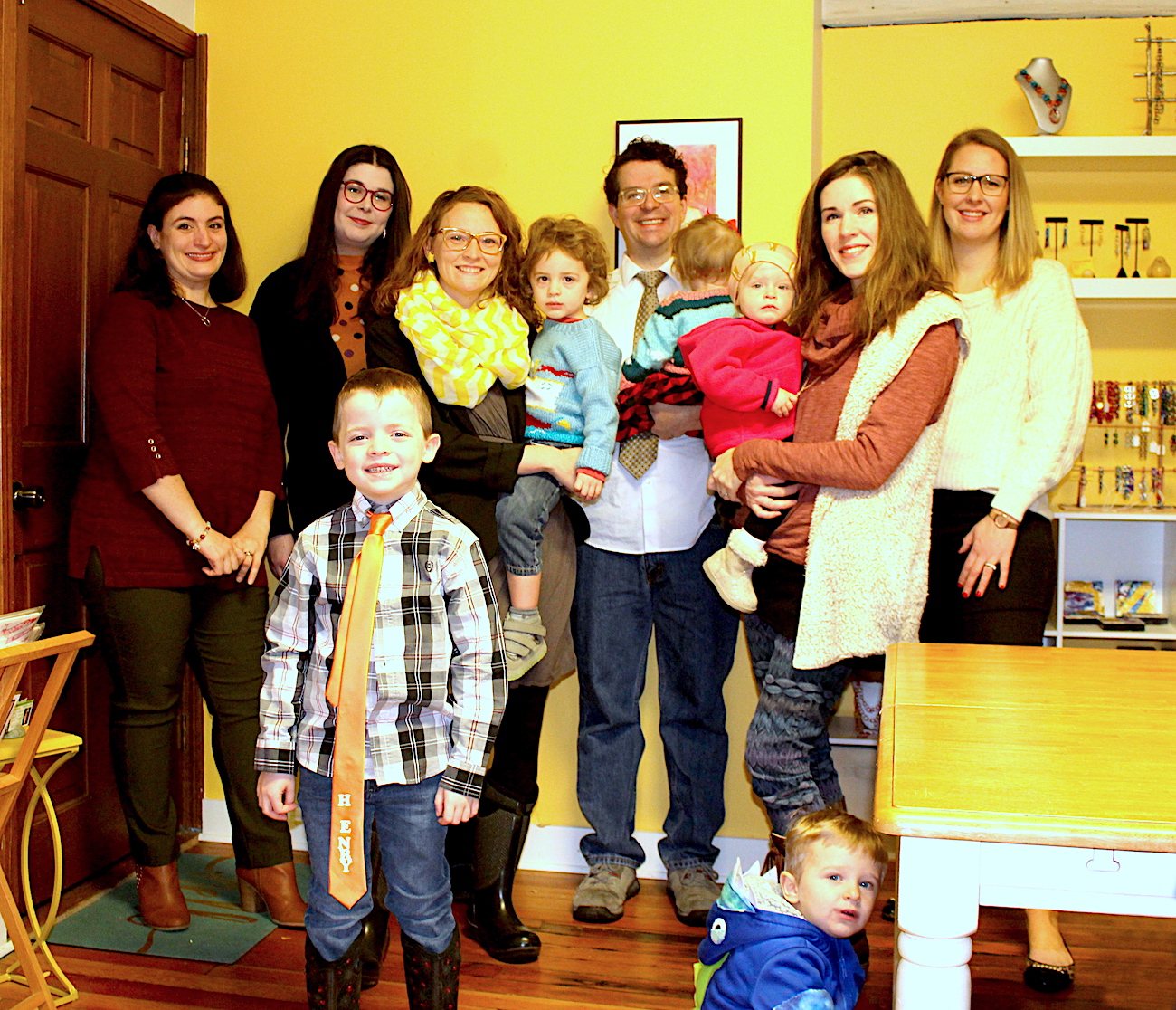
The culture follows the same logic. The company describes itself as family-run and woman-owned. It champions independent businesses and nonprofits, environmental protection and the LGBTQ+ community. Its 2018 team portrait looked less like an org chart than a holiday gathering, children included. That informality should not be confused with vagueness. The web process Austin published years ago is a crisp seven-stage sequence: meeting, proposal, signing, gathering, building, revisions, launch. Two rounds of revisions were typically included. Analytics and search submission arrived at launch. Clients received access to update their own WordPress sites.
Fifteen years in five useful turns
A microenterprise course, SCORE meetings, seven clients and $1,000 turn a home-office practice into a registered business.
The Adirondack Regional Chamber of Commerce names Advokate Independent Business of the Year.
Austin leaves a part-time job, opens a studio-gallery and reports more than 150 organizations served by year five.
After two remote years, the company chooses a smaller, elevator-accessible Glen Street office built for meetings and growth.
The firm celebrates with the community that supplied its first network and much of its enduring purpose.
The pandemic supplied the sharpest later correction. Austin told a local newspaper that the break in business as usual showed her she could not control everything, and that loosening her grip helped Advokate grow. In 2022 the firm returned from two years of remote work, but not to an oversized monument. It moved to an accessible suite at 333 Glen Street with two private offices and shared conference space. The office became smaller while the operating model became more expandable.
That is how Advokate fits its market. It is not selling novel software, venture-backed speed or infinite capacity. It sells enough structure to turn a fog of ambitions into the next sensible move. Its customers are the people who need a professional result but cannot afford to make every task professionalized. Sometimes the answer is a new ecommerce site. Sometimes it is consistent Canva templates for the volunteers at a puppy rescue. Sometimes it is advice to keep doing the work yourself.
The moat is not the logo file. It is knowing which problem deserves to be solved first.
The part worth copying
The copyable idea is not to charge $25. That number works because it belongs to Advokate's costs, market and larger service funnel. Copy the choreography instead: make diagnosis a real product, give it a small but nonzero price, leave the buyer with something useful, and divide the plan into client work and specialist work. A proposal then becomes the consequence of clarity rather than the price of obtaining it.
A small-agency operating card
- Ask for the goal, budget and deadline before prescribing channels.
- Order tasks by impact, not by how impressive they sound.
- Hand capable clients the keys, templates and instructions.
- Keep a trusted specialist bench for work beyond the core team.
- Price the invisible costs before calling the work affordable.
The model has limits. It depends on trust, repeat relationships and clients willing to participate. It is less persuasive for a buyer who wants worldwide media buying, constant enterprise support, or a giant production department under one roof. Its local advantage weakens when a project depends on unfamiliar regulations, languages or markets. And a flexible team still needs disciplined project management, especially when the founder's relationships are part of what customers believe they are buying.
But for a museum, maker, restaurant, municipality, arts group or founder who arrives feeling, as Advokate's FAQ puts it, “gelatinous,” the offer is unusually humane. Bring the million ideas. Spend one modest hour sorting them. Keep the pieces you can carry. Pay for the pieces you cannot. The original $1,000 bet was about whether Kate Austin could stay in business. The more interesting result is a company designed to help its clients make the same calculation with better numbers.