A speaker called the Barnacle comes with a useful warning about its ambitions: it intends to attach itself to something. In Stevie Patsis’s corner of the audio business, the interesting question begins after you have chosen the music. Where will the speaker go? What will hold it there? How much of the rest of your equipment has to come along?
These are modest questions for a founder to build around. They are also questions that become rather pressing beside water. Patsis, the San Diego entrepreneur behind Speaqua Sound Co., has made outdoor listening his company’s territory. The familiar promise of portable audio becomes more specific when the destination includes a paddleboard, a bicycle or a beach bag. Somewhere between the playlist and the outing, an object has to earn its passage.
Patsis’s story joins two worlds with very different vocabularies: surfing and electronics manufacturing. One supplies the setting. The other supplies the means of making something that can work there. The pleasure of the finished object can conceal how many decisions lie between them. A small speaker is easy to carry. A small hardware business comes with considerably more baggage.
Patsis attended the University of San Diego from 2010 to 2013, with lacrosse and the university surf team among his activities. The early Speaqua team included USD students. There is something fitting about that combination: a company concerned with getting outside assembled with help from a campus community. The work required more than a shared enthusiasm, but the people around Patsis gave the new business a place to begin.
A good idea meets a factory
Speaqua was founded in 2014. Patsis had been working in his father’s manufacturing and supply-chain business when he began developing a speaker for traveling surfers. The early run had a static-electricity problem affecting 10,000 speakers. He used prototypes for promotion in Hawaii, drawing on surfing connections. His description of dealing with overseas factories was succinct: “Communication is a huge barrier.”
“Communication is a huge barrier.”
Stevie Patsis, on early overseas manufacturing
There is a considerable distance between knowing what an object should do and getting a factory to make it consistently. A product brief can fit on a page. Every part of it still has to survive translation into materials, components and assembly. For a consumer, a speaker either works or it does not. The number of people who understood the intention offers very little consolation when it falls silent.
Speaqua’s own company description places manufacturing close to the center of the business. It describes the brand as a subsidiary of Supply Concepts, with electronics manufacturing relationships in Asia and Latin America. That background gives the origin story its particular shape: an outdoor product emerging from an existing network of industrial relationships. The sea supplied the destination; the supply chain supplied a route toward it.
The useful part is underneath
A product photograph naturally directs attention toward the speaker grille. Speaqua’s mounting system invites a look around the back. The company describes four ways to attach its compatible speakers: a universal thread, a removable suction cup, a GoPro adapter and a carabiner clip. The details concern surfaces, existing equipment and the ordinary business of getting an object out of your hands.
A suction cup makes a smooth surface useful. A clip makes a bag useful. A compatible mount makes equipment someone already owns useful. Each choice changes where the speaker can accompany its owner. Portability becomes a relationship between the object and its surroundings. You can admire a device on a shelf; taking it somewhere asks a different set of questions.
Speaqua’s four-part mounting approach. Compatibility varies by model.
Patsis’s design work also appears in a more formal register. A speaker design filed in June 2020 was granted in August 2022 as US D960124. It names Steven Patsis as inventor and Speaqua as assignee. The drawings show the object through a sequence of views. A patent drawing is an austere way to encounter something meant to play music, but it directs attention to the physical decisions that remain when the soundtrack is removed.
Permission to leave the phone behind
Waterproofing is only part of Speaqua’s proposition. Selected Barnacle models also store music locally. The company advertises capacity for up to 2,000 songs, allowing listening without keeping a phone connected. That pairing of features matters to the idea of an outdoor speaker: protecting one object becomes less liberating if another still needs careful supervision.
The procedure is pleasingly tangible. Speaqua’s instructions tell owners of compatible models to connect the powered-on speaker to a computer and transfer MP3 files into its folder. The music becomes part of what is being carried. A collection of files may seem unfashionably hands-on beside an endless stream, yet it answers a practical requirement: let the speaker operate independently of the other device.
There is a small bargain here. Preparing music takes effort before the outing. In return, the speaker can have less need for attention during it. That is a design choice people can assess for themselves. Some will prefer the convenience of their phone. Others will welcome a reason to leave it somewhere dry. The feature has a clear job, which is a more useful distinction than a long list of capabilities without a destination.
Six years inside a small collaboration
In 2017, Patsis met VSSL at Outdoor Retailer. Discussions began about a proprietary end cap. The project eventually became an insulated flask with an integrated Bluetooth speaker. VSSL’s development history traces the speaker concept to 2019, prototypes to late 2021, another prototype round and a Kickstarter launch to 2022, and commercial launch to 2023.
Patsis meets VSSL at Outdoor Retailer.
Flask and speaker development takes shape.
The first prototypes arrive late in the year.
The product reaches commercial launch.
Six calendar years separate the meeting and the launch. A finished collaboration can look effortless in a photograph: two familiar kinds of object brought together. The chronology gives that photograph a different weight. There were discussions, development and successive versions before there was a product to buy. Even an idea small enough to fit in an end cap has a working life before it enters anyone’s backpack.
For Patsis, this is a documented example of the company’s audio work joining somebody else’s outdoor equipment. It also broadens the meaning of a partnership. The work can reach into the construction and use of the object itself. One company’s speaker has to make sense within another company’s product, with both sharing the same limited space. Hardware is an excellent editor of expansive intentions.
The surfboard takes a detour to the golf cart
Patsis’s published design record includes a golf ball marker and holder, granted in April 2022, and a golf speaker assembly, granted in November 2023. Together with the speaker design, they form a concrete trail of product work beyond a single setting. The ocean remains central to Speaqua’s identity, while the equipment finds uses on land.
Golf makes the placement question visible again. A portable object needs a place to sit or attach while its owner does something else. Speaqua sells a golf version of its Barnacle Pro, alongside a range that also addresses pickleball. These are specific contexts for the brand’s outdoor listening idea. The surrounding activity supplies the practical brief.
A design grant does not tell the whole story of a business or measure how many people use a product. What it supplies is narrower and useful: a named inventor, a particular object and a date. In a founder profile, those details bring the work back down to things one can examine. Patsis’s company has a lifestyle vocabulary. There are physical designs underneath it.
A speaker enters somebody else’s world
Speaqua’s Artist Division brings the brand into collaborations with musicians, artists and athletes. Its Machine Gun Kelly range included custom versions of the Barnacle Vibe 2.0, Barnacle Pro and Cruiser H2.0. The outdoor audio object becomes a vehicle for an artist’s visual identity as well as a way to listen.
The company also offers customized products to other brands. Its partnership page describes work with Los Sundays and Aloha Collection. The latter’s brand director discusses collaboration on colors, rollout and content. This is a different set of decisions from waterproofing or mounting, though the object still has to be worth using after its first appearance. A logo occupies space; a useful product occupies a place in someone’s routine.
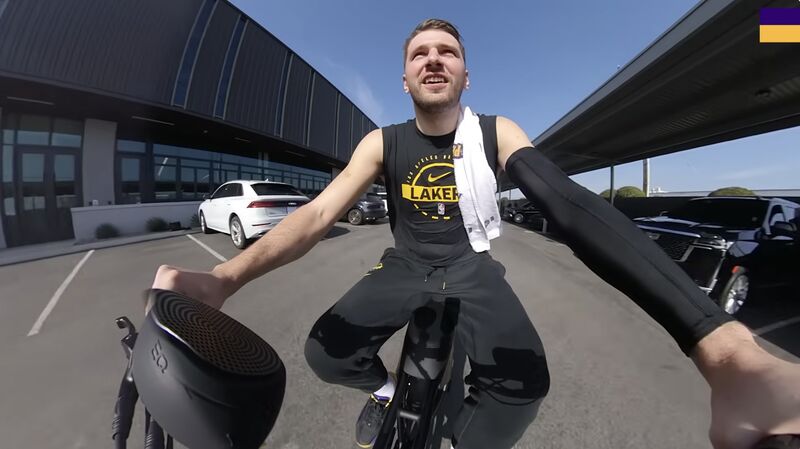
On December 17, 2025, Patsis shared an image of Luka Dončić with a bicycle and speaker, celebrating Speaqua and Pedal Electric bikes associated with the Lakers’ Christmas gifts. It is a distinctly different setting from the brand’s aquatic beginnings. The familiar design problem travels well: there is an activity, there is music, and there needs to be somewhere for the speaker.
An ambition small enough to carry
Speaqua describes its purpose in terms of people bringing music into their lives, with or without a phone. It also wants customers to feel a connection to the brand. Those two aims sit beside each other throughout Patsis’s work: make equipment that serves an outing, and give people a reason to identify with it.
The appeal of this founder’s story lies in its scale of attention. It keeps returning to the place where the product will actually be used. A smooth surface. A mount. A bag. A flask. A bicycle. The settings change, and each brings another practical question. For Patsis and Speaqua, there is still something to work on after the song has been chosen.
Keep the music going
Patsis’s public profile, the products and the stories behind them.
- Steve Patsis on LinkedIn
- Speaqua website
- Speaqua on Instagram
- Speaqua on Facebook
- Watch Speaqua on YouTube
- The 2015 USD interview
- VSSL’s design history
- Speaker design D960124
- Patsis’s design grants
- Speaqua’s company background
- Speaqua’s mounting and music features
- Music transfer instructions
- The Artist Division collaboration
- Brand partnerships
- The December 2025 post