The most revealing thing about a swimming pool is that it can look perfectly innocent while plotting against you. The water is blue. The sun is out. Somewhere beneath that holiday-card surface, pH is drifting, sanitizer is fading and tomorrow's algae is quietly clearing its calendar. Pool ownership turns leisure into a chemistry practical. pHin's founders, Justin Miller and Mark Janes, looked at this ritual and asked the most productive kind of lazy question: surely the pool could check itself?
The short version
- A floating sensor watched pH, sanitizer effectiveness and temperature around the clock.
- The app converted readings into exact, brand-specific dosing instructions.
- The 2020 kit cost $349; monitoring after the first year was $99 annually.
- ConnectedYard raised $9.2 million and sold to Hayward in 2018.
- Hayward closed pHin in 2021, exposing the fragility of cloud-dependent hardware.
The instruction mattered more than the number
ConnectedYard, founded in 2014, did not invent pool testing. Strips, reagent kits and the helpful person behind the counter at the pool store had been doing that for decades. Its insight was subtler: most owners did not want data. They wanted a decision. The distinction between “your pH is low” and “add 25 fluid ounces of this bottle” is the distinction between diagnosis and relief.
The pHin system bundled a white floating monitor, a Bluetooth connection, a Wi-Fi bridge and a phone app. It measured pH, sanitizer effectiveness and temperature more than 1,000 times a week. Once a month, the owner photographed a test strip against a calibration card so the system could account for cyanuric acid, alkalinity and hardness - measurements the floating sensor did not continuously supply. It worked with chlorine, bromine and saltwater pools, hot tubs and swim spas.
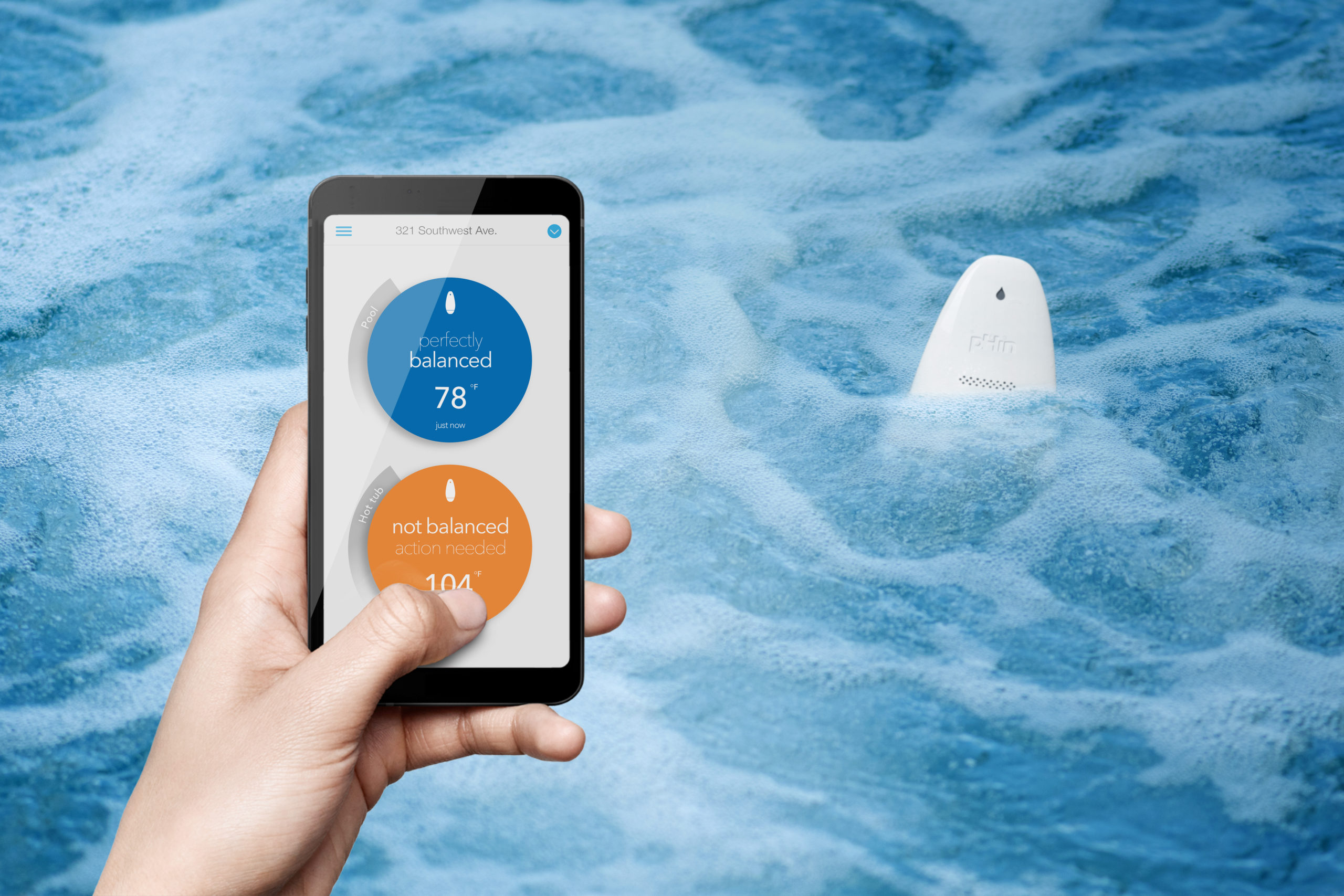
Reviewers found the proposition surprisingly real. A PoolPro tester compared pHin against three independent pool-store tests each week and reported that the results were nearly always identical. Setup could take minutes. The app could show how rain moved the temperature, catch a sanitizer decline before the water turned green and tell a technician what to bring before arriving.
“There’s gotta be a better way to take care of our pool.”The founding complaint, recalled by pHin executive Jim Conti
A pool store, folded into the phone
The first version of the business was a tidy Silicon Valley stack: sell the device, charge a subscription and ship pre-measured, color-coded chemical pods. A 2015 pre-sale customer paid $199 and then waited 20 months for his unit. Hardware, it turns out, obeys a different calendar from software.
What changed pHin was contact with the pool industry. A device that bypassed the local dealer might delight a direct-to-consumer investor deck, but pool owners already had habits, preferred brands and trusted stores. Dealers had relationships pHin needed. So the company moved toward compatibility instead of conquest. By 2020, users could scan products from a database of more than 60 brands, receive instructions for that exact chemical, put it in a local retailer's cart and share water history with a store or technician.
That was the company's sharpest strategic move. pHin did not merely automate the store's test counter; it sent the customer back with a better shopping list. A retailer portal let professionals see what a pool needed. A partnership with Lonza connected recognized products to precise doses. A Nordic Hot Tubs project planned to put an inline version into 2019 models and expose the data to dealers and manufacturers.
The pool was local. The product was not.
Playground Global and Tandem Capital backed ConnectedYard with a $2.2 million seed round in 2015 and a $7 million Series A in 2016. Hayward Industries acquired the company in April 2018 for an undisclosed price. The logic looked clean: place a nimble sensing-and-software team inside an established pool-equipment company, connect pHin to Hayward's automation portfolio and expand beyond North America.
Two years later, Hayward released a refreshed monitor with improved analytics, a cleaner app and broader chemical support. Then, on December 20, 2021, it ended the service and closed the pHin business. Annual subscriptions stopped renewing. The app stopped actively monitoring. Customers were told to recycle the floating device.
The official backend and app were essential to measurement history, alerts and dosing advice. Without them, intact hardware could no longer deliver the experience customers had bought.
It is tempting to say the hardware failed. More precisely, ownership failed. The object in the pool belonged to the customer; the intelligence that made it useful did not. pHin required a 2.4 GHz Wi-Fi signal near the water, a working bridge and a live vendor service. It also expected reasonably clear, algae-free water during setup. Those were visible conditions. The invisible condition was corporate willingness to keep the cloud running.
There was a partial afterlife. In early 2022, iopool published a way to connect some pHin monitors directly to its app over Bluetooth. The original Wi-Fi bridge would not work, remote access was lost and iopool could not repair the old hardware. Still, the rescue made a useful point: a local radio and an open door can preserve some value after the original service ends.
Three things worth stealing
pHin occupies an interesting corner of the smart-home market. Its alternatives ranged from five-dollar test strips and full liquid kits to weekly human service. Connected rivals such as WaterGuru, Sutro, Blue Connect and iopool attacked the same inconvenience with different sensors, cartridges and subscriptions. pHin's contribution was not that it eliminated pool work. It reduced the moment of doubt between measurement and action.
None of this means the model works everywhere. It depends on a problem frequent enough to justify recurring payment, a network connection close to the pool and measurements accurate enough to earn trust. It works poorly when the water is already green, when the chemical is unsupported or when the annual fee costs more than the owner's annoyance. Above all, it fails when the recurring service is treated as an accessory even though it is the product's nervous system.
The funny thing is that pHin's original question remains persuasive. There should be a better way to care for a pool. Justin Miller later returned to the category with Crystal Water Monitor, while other companies kept refining automated water care. The demand survived because the inconvenience survived. So did the lesson bobbing at the surface: the best smart device is not the one that tells us the most. It is the one that tells us what to do - and keeps enough intelligence nearby that we still can.