The least theatrical object in a workplace may be the one that matters most on payday: the clock on the wall. Someone arrives, identifies themselves and starts a shift. A small transaction becomes a record that payroll must trust. Newmark Security has built an increasingly consequential business around that unremarkable moment.
Through Grosvenor Technology, the British group supplies the devices, software connections and services that capture workforce data and move it into larger business systems. Its name still suggests cameras, guards and locked doors. Its direction increasingly points toward the machinery behind attendance: who turned up, when they arrived and whether the record reaches the right software intact.
The change has acquired a remarkably small price tag. On 29 July 2026, Newmark announced a conditional agreement to sell Safetell, its physical security subsidiary, to managing director Nicholas Shannon for £1. Separate liability settlements were expected to reach roughly £2 million at completion. A nominal selling price, in other words, can accompany a substantial exit bill.
The wall clock has acquired a second job
Grosvenor’s GT4, GT8 and GT10 are recognisably timeclocks, though the product category has moved beyond a slot for a paper card. Depending on the model and configuration, users identify themselves through credentials or biometrics and interact with a screen. The GT8 offers finger biometric and facial-recognition options for larger workforces; the GT10 provides a more expansive kiosk format.
These products address an awkward gap in enterprise computing. An employer may have sophisticated workforce software while the original attendance record still needs to be collected at a factory, hospital or shop. Grosvenor’s customers and partners operate across retail, healthcare, education, commercial premises and industrial settings. Their common requirement is dependable information from people who do not spend every working minute at a desk.
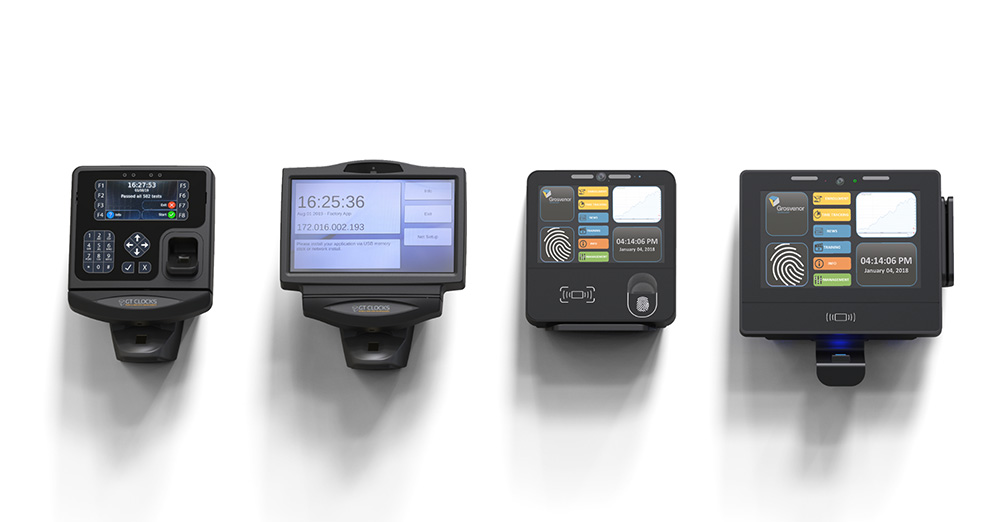
Newmark says its technology supports approximately two million employees and processes more than 40 million workforce transactions each month. Those are usage figures reported by the company, rather than a count of organisations buying directly from it. They help explain the niche: a relatively small supplier can sit inside a much larger employer’s daily routine.
The recurring sale comes after installation
Hardware gives Newmark something to install. GTConnect gives it something to keep doing. The subscription platform lets operators inspect device status, distribute configuration changes and run diagnostics remotely. It also manages identity information across networked clocks and connects their data with workforce software. The service addresses the maintenance and coordination problems that appear once an installation becomes a fleet.
For a customer, the appeal is practical. A support team can examine a device without automatically sending an engineer to the building. Employee information can be distributed centrally. Firmware and application updates can be organised across groups of clocks. The commercial logic follows the operational logic: customers have an ongoing problem, so Newmark has a reason to send an ongoing invoice.
This is an evolution of an established business. Newmark’s 2024 annual report described efforts to attach services to every device and introduce an entry-level package combining equipment, software and services. It also reported cross-selling into existing accounts. The approach offers a fairly concrete lesson for other manufacturers: start with what becomes inconvenient after delivery, then build a service customers have a reason to retain.
Oracle and Workday are routes into the building
GT Time makes the integration pitch explicit. Its Oracle version connects Grosvenor timeclocks to Oracle Cloud HCM Time and Labor. Its Workday version connects them to Workday Time Tracking. Both have marketplace routes. Newmark can therefore pursue employers already committed to large software platforms, offering the attendance connection those deployments need.
The configured experience can extend beyond clocking in. Grosvenor describes support for activities including labour transfers, leave requests and employee attestations. These are useful distinctions for a buyer: the terminal may serve as a point of interaction with a workforce system, rather than merely collect an arrival time. The exact workflow depends on the chosen integration and implementation.
Readers sit inside this chain too. Grosvenor integrates ELATEC reader technology across its timeclock range and received the supplier’s Momentum Award for adoption of that technology. A credential reader sounds like a small component until a business has to accommodate the identification methods its workforce already uses. Here, compatibility is part of what the product sells.
A smaller group, with a costly decision to make
Safetell belonged to an older chapter of Newmark’s expansion. The group acquired it in February 2000 for £1.5 million cash, financed by a bank loan repayable over seven years. Its traditional products protected staff at transaction counters, including building-society employees facing armed robbery. Physical protection and electronic security once looked like a natural combination.
The recent figures made that combination harder to defend. In FY2025, Safetell revenue fell 15% to £4.9 million while Grosvenor’s revenue increased 10% to £18.1 million. Within Grosvenor, HCM supplied most of the sales. Group revenue reached £23 million, with £0.7 million profit after tax. One set of accounts contained businesses moving at different speeds.
January 2026’s interim report offered a mixed picture: Safetell services were growing, but the board had begun a strategic review. By May, project orders slipping into the next financial year had worsened its losses. The first visible weakness was project timing and the division’s financial performance. The public record does not establish a defective product as the cause.
“HCM represents the future of the Group”
Marie-Claire Dwek · May 2026 trading update
The July agreement retained a £300,000 deferred loan, with repayments scheduled to begin in 2030 subject to Safetell’s cash flows. It also required regulatory clearance and other conditions before completion. The announcement described an agreed route out, rather than a completed disposal. That distinction matters when deciding which businesses and liabilities still belong inside Newmark.
The growth is real. So is the stockroom.
Newmark’s unaudited May update put FY2026 HCM revenue at £19.5 million, up 27%, with North America contributing £14.1 million. Group revenue was expected to be at least £26 million. Those figures describe a trading update for the year ended 30 April, rather than audited final results.
*FY26 unaudited trading update. FY25 audited. Years ended 30 April; bars share a zero baseline.
The cloud does not abolish the stockroom. Newmark reported net debt excluding leases of £4.8 million at April 2026, citing inventory investment, sales timing and additional Safetell funding. Its business still needs components available when customers order. Hardware-backed subscriptions demand both software capability and the cash discipline of a product supplier.
For customers, the relevant cost comparison consequently reaches beyond the terminal. Installation, integration, recurring services and support all belong in the purchasing decision. A cheaper clock that creates extra administration may be a poor bargain; an elaborate managed installation can be excessive for a small operation. The useful comparison is the cost of collecting dependable records over the deployment’s life.
The competition also knows what time it is
Newmark does not own this idea. Dormakaba sells dedicated time-recording terminals. UKG’s InTouch DX connects a timeclock with its own workforce platform. NoahFace offers a different hardware proposition by turning iPads and smartphones into clocks, including an integration for UKG Pro Workforce Management. Buyers have choices about the device and the surrounding software relationship.
Grosvenor’s position rests on combining purpose-built equipment, managed cloud services and connections into other vendors’ HCM systems. That is a useful proposition for a distributed workforce already running compatible software. An organisation satisfied with mobile attendance capture has a different requirement. A buyer whose existing platform lacks the required integration faces additional work before the proposed convenience becomes real.
Nor does biometric functionality settle an employer’s data-management decisions. GTConnect includes tools for applying consent and retention policies, but the organisation still needs to decide how it will use those tools. The product’s value depends on a workable operating arrangement around it: appropriate identity methods, support responsibility and a reliable path from attendance capture to the receiving system.
The next experiment begins with the installed fleet

Dwek’s task is to make the changing mix of businesses add up. Grosvenor managing director Colin Leatherbarrow brings an engineering background and has promoted lean working methods and a focus on quality and compliance. These are the company’s descriptions of its management approach, but they fit the job: a workforce device earns its place by being dependable on an ordinary Tuesday.
The newer experiments grow out of that installed fleet. GT Labs offers an invite-only preview of an AI assistant for exploring GTConnect information through natural-language questions. It operates outside the platform’s normal production release and support commitments. That makes it an experiment to watch, rather than a benefit a buyer should assume is already part of the standard service.
The more immediate proposition is easier to judge. Can an employer capture attendance accurately, get the record into its existing system and maintain its devices without unnecessary effort? Newmark’s next chapter depends on answering those questions often enough that the customer renews. The clock on the wall remains the starting point. Keeping it useful is the business.
Follow the clock
Explore the products, hear from management and keep up with the business.