At WorkForce Software's first analyst day, Kevin Choksi opened with a request that required a little nerve: “Let’s elevate the discussion on workforce management.” The subject was time, attendance and scheduling. It was the sort of software that gets invited to a meeting because something has gone wrong. Choksi wanted a larger conversation about what employers could learn from the working day, and what they could do with that knowledge.
There is a particular entrepreneurial challenge in selling something customers would prefer never to think about. A clock records an arrival. A schedule assigns a shift. The trouble begins when those tidy acts encounter an actual organization, with its agreements, exceptions, different jobs and different countries. Choksi spent sixteen years as chief executive of a company built around that trouble. Its proposition depended on taking the details seriously.
He co-founded WorkForce Software in 1999 with Kathy Cannon and Mike Knister. The company eventually became part of ADP, which acquired it in October 2024. Between those dates lies a less hurried business story: a Michigan software company, a change in how its product reached customers, expansion overseas, outside investment and a founder moving into a different job. The interesting turn came well before the acquisition announcement.
A business hiding inside the exceptions
Choksi's education brought together two useful perspectives on an enterprise software business. He earned a BSE in computer engineering and an MBA at the University of Michigan. Engineering asks whether a system can handle a problem. Business asks whether somebody will pay it to keep handling that problem. Workforce management offers ample opportunity to become acquainted with both questions.
His career before WorkForce included application development management at Urban Science and product management at FASTECH. Those positions put software development and product decisions on the same résumé. By the time he became a founder, the relationship between a program and the organization using it was already familiar professional territory. WorkForce would make that relationship its business.
The company's EmpCenter suite dealt with time and attendance, scheduling, leave administration and labor information. Those categories sound orderly on a presentation slide. Inside an employer, they cross departmental boundaries. Operations needs people available. Payroll needs usable records. Managers need to understand the cost of the decisions they are making. A product has to survive contact with all of them.
Choksi's stated approach was to accommodate changing requirements through configuration. In practical terms, that means giving a system adjustable rules rather than requiring a separate programming project for each variation. His emphasis helps explain the company's interest in complex employers. The difficult cases were part of the proposition. An exception, inconvenient to a calendar, could be a reason to buy software.
Record time→02
Apply rules→03
Plan workA simplified view of the operational problem WorkForce set out to address.
“Let’s elevate the discussion on workforce management.”Kevin Choksi · first analyst day, 2012
The product stayed. The delivery changed.
The shift to cloud delivery gives Choksi's story its hinge. In late 2010, WorkForce introduced a software-as-a-service version of EmpCenter. By the company's first analyst day in 2012, the SaaS option accounted for 80 percent of new customers' selections. The licensed on-premise and hosted alternatives remained, but the balance of new demand had moved.
That is a revealing sequence. WorkForce was already more than a decade old when it introduced this version. The company had accumulated experience in the subject before changing the way customers could obtain its software. A founder's original product can acquire a new commercial life without requiring a new founding story. In this case, the clock kept running while the delivery model changed around it.
The figures deserve careful reading. An 80 percent share of new customer choices describes adoption of a delivery option. It does not describe the entire installed customer base, revenue or profit. Even with that boundary, it captures a consequential decision by buyers. The cloud offering had become the usual choice among new clients, giving the company a concrete reason to organize for more of it.
Choksi also wrote about labor analytics, arguing that workforce systems could support business decisions as well as automate administration. His subject was what organizations could discover in their own labor information. That interest fits the invitation he made at the analyst day: move the discussion beyond the transaction of recording time and toward the decisions that follow.
Michigan, with a longer reach
WorkForce expanded internationally during Choksi's tenure. In May 2013 it announced the acquisition of Sydney-based RosterLive, whose workforce software served more than 200 customers. The transaction added a business aimed at smaller and medium-sized employers in Australia. It also gave WorkForce a larger presence in Australia and New Zealand, alongside its enterprise offering.
The same announcement described new UK offices, an alliance in China and data centers in the Netherlands and Sydney. These were specific pieces of an international operation: sales and support, a partner relationship, and infrastructure. A company selling software for different working arrangements was putting more of its own organization in different places. Geography was becoming an operating responsibility.
In April 2014, Insight Venture Partners assumed a majority equity position. Choksi and the existing executive team continued to lead WorkForce, while Insight's Ryan Hinkle and Ross Devor joined its board. The company presented the investment as a way to support international expansion. It had already reported revenue growth of 66 percent for 2013.
That number belongs to a particular year and a particular business. It is useful here because it locates the investment in a period of expansion, rather than making the financing stand in for progress by itself. By August 2015, WorkForce had also signed a global reseller agreement with SAP. EmpCenter components would reach customers under the SAP Time and Attendance Management name.
For Choksi, distribution now included an enterprise software partner as well as WorkForce's own organization. Building the product and finding ways for it to travel were becoming increasingly connected tasks. The SAP agreement brought time, scheduling and leave capabilities alongside SAP's HR and payroll products. It was an arrangement rooted in where customers already did business.
An award with other people in the picture
In 2014, Choksi became an EY Entrepreneur Of The Year finalist in the Michigan and Northwest Ohio region. His response brought his fellow founders into the account and described two purposes for the company: helping employers manage their teams and giving talented employees a place to develop their careers. The public recognition of an individual became an occasion to talk about the organization.
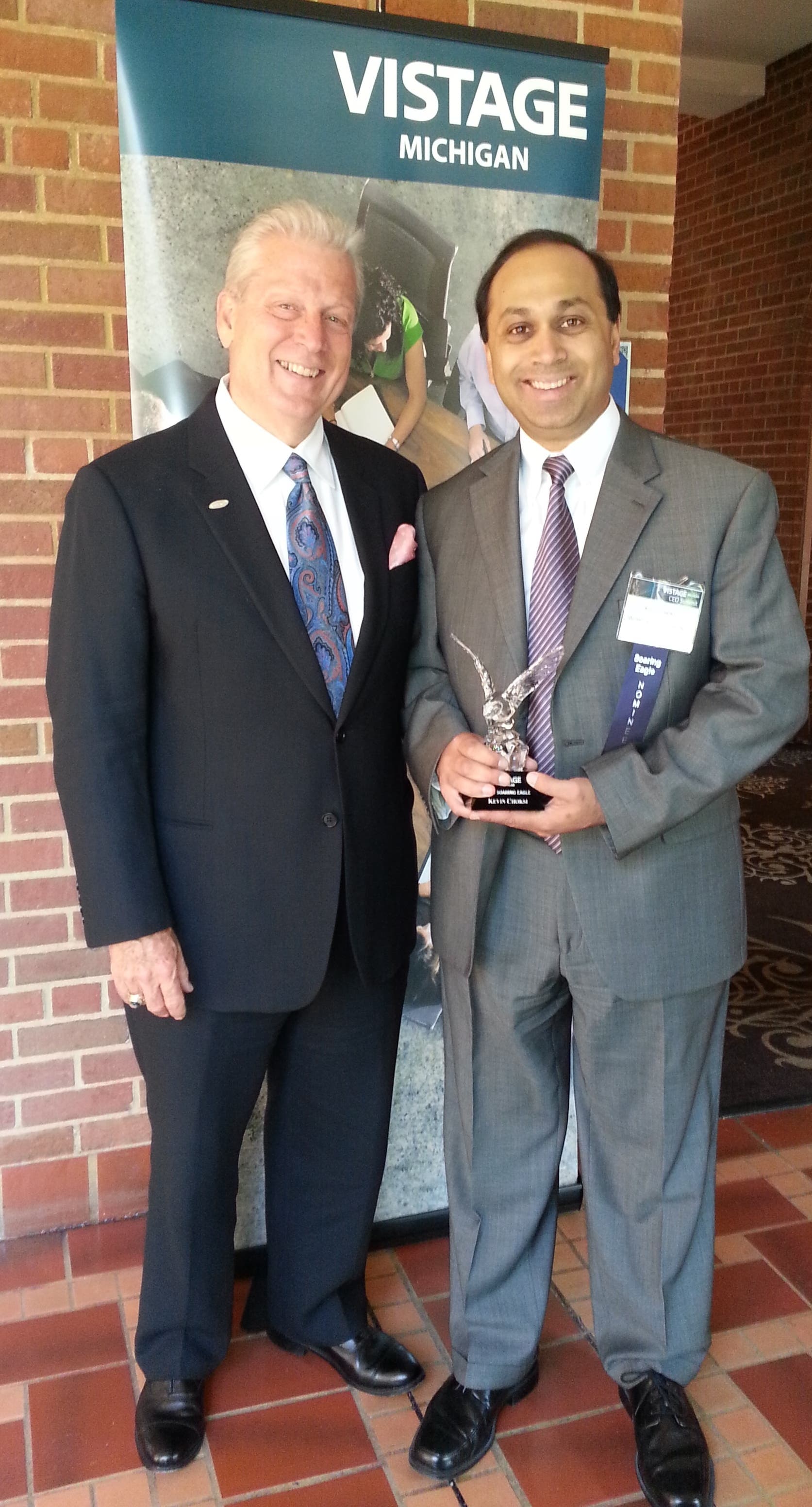
That September, Vistage Michigan recognized him with its Soaring Eagle Award, alongside National Food Group's Sean Zecman. The award acknowledged business results and contributions to fellow members. It provides a useful glimpse of Choksi among other executives exchanging experience, rather than occupying the solitary founder's perch that business profiles so readily build.
A professional recommendation from former colleague Sai Huan describes their problem-solving and brainstorming together. That is a modest but telling detail beside the financing announcements. A software chief executive's working life also consists of conversations about problems, with people who may remember those conversations long after they have changed employers. Choksi's professional record includes both the transactions and those relationships.
Sixteen years, then a different chair
In October 2015, Mike Morini became WorkForce's chief executive. Choksi moved to chief strategy officer after sixteen years leading the company. His announced focus included closer work with product development and client services. The handoff changed his responsibilities while keeping him involved in the company's direction.
The timing matters. Choksi's CEO tenure ended nine years before ADP bought the business. His contribution belongs to the founding, product development, cloud transition and expansion that occurred under his leadership. The subsequent organization had other leaders. A company that continues for twenty-five years has room in its history for more than one person's decisions.
His work also extended into investments, advisory assignments and boards. In March 2022, Ann Arbor-based DryvIQ announced his appointment as a director. The company worked on enterprise data management, including identifying and managing unstructured information. It was another business concerned with the complications inside large organizations, this time in their content rather than their working schedules.
DryvIQ's announcement presented Choksi's experience as spanning SaaS investments, boards and advice. The move gives the later part of his career a clear connection to the earlier one without requiring every new assignment to repeat it. Experience building one software company can become useful in the decisions of another. The job changes; familiarity with the operating questions travels.
When ADP acquired WorkForce in 2024, Jeff Moses was the company's CEO. ADP described the acquisition around capabilities for large global enterprises and their varied pay rules and schedules. Those details echo the problem that occupied Choksi years earlier. A working day looks simple on a clock face. Building software for everything around that face took a company, several founders and considerably more time.