Selling a software company can make a satisfying final chapter. Matt Airhart kept turning the pages. In 2014, MSDSonline acquired KMI, the Ontario business he had helped found. A decade later, he became chief executive of VelocityEHS, the company those businesses had become. The acquisition turned out to be a change of scale in a career that kept its original subject: helping complicated organizations get their work in order.
There is something pleasingly unfashionable about that trajectory. The founder stays. The customers stay in the picture. New responsibilities arrive over years rather than in a burst of reinvention. Airhart's story offers the quieter pleasures of accumulated knowledge: remembering the customer, understanding the workflow, knowing why an apparently small request matters to the person making it.
His business deals with risk, compliance, environmental performance and the daily machinery of industrial operations. These are subjects that make glamorous software pitches work rather harder for their applause. They are also subjects where a useful answer can outlast an exciting presentation. Airhart has spent much of his working life on the useful answer.
A chemistry degree, then the factory
Airhart studied chemistry and environmental studies at Ohio Wesleyan University. His LinkedIn education dates run from 1990 to 1994. Before his later software leadership roles, he spent seven years in chemical manufacturing and two with a systems consulting company. His route into enterprise software therefore included time in the industries that would eventually buy it.
The combination is worth pausing over. Chemistry concerns itself with how things behave. Environmental studies asks what those things do beyond the immediate experiment. Manufacturing adds deadlines, organizations and the stubborn fact that something has to work on Monday morning. That is a useful educational sequence for someone selling tools to people whose jobs involve real facilities.
KMI stood for Knowledge Management Innovations. By 2007, Airhart appeared in an industry association's affiliate guide as its director of business development. The company's pitch emphasized planning, client participation and communication throughout a project. Even its name had the earnest practicality of a business expecting to be asked difficult questions after the demonstration.
By 2012, he was listed as KMI's president and CEO, moderating a conference discussion about integrating operations after mergers and acquisitions. The topic would soon acquire personal relevance. First, though, he was building the customer relationships that give the company history some texture.
The customer remembers the involvement
In July 2013, Texas electricity provider Sharyland Utilities selected KMI for audit and inspection, compliance management, incident management and training tracking. Airhart was the chief executive commenting on the deal. The range of functions tells its own story: this was software meant to sit across several parts of an operating business.
A customer buying those tools needs different people to agree on what gets recorded, who does the next task and how progress gets checked. A successful sale begins a considerable piece of organizational work. The contract gets a signature. The implementation gets everybody's calendar.
George Carlough, an executive at Komatsu Mining, later recalled knowing Airhart for roughly a decade. Joy Global, subsequently acquired by Komatsu, had used KMI at some North American locations as far back as 2010. As it moved toward a company-wide system, Carlough remembered Airhart's direct participation: “Matt was really involved, as well as his team.”
It is a modest testimonial, which makes it useful. The remembered quality is involvement. The team worked on reporting requirements, including custom reports that became part of the customer's operating routines. Here is the founder at a recognizable working distance from the product: close enough for a customer to remember who helped.
“Software is almost meaningless without the right people behind it.”
Matt Airhart, 2020
The sale that kept him in the story
MSDSonline announced its purchase of KMI on August 7, 2014. KMI became a wholly owned subsidiary; the financial terms were undisclosed. The buyer brought chemical management software. KMI brought a broader suite covering activities such as inspections, compliance, training and corrective actions. Their tools addressed neighboring problems inside the same organizations.
Airhart's remarks at the time emphasized a shared commitment to customer value and a compatible company culture. Those are familiar words around an acquisition. They become more interesting when the executive saying them remains in the combined business long enough to be responsible for making them true.
The businesses adopted the VelocityEHS name in 2015. Airhart's own career continued inside the growing organization. The entrepreneurial task was changing: alongside winning customers came the work of combining teams, products and ways of doing things. An acquisition is easy to represent with a plus sign. Living with the result requires considerably more punctuation.
- 2003KMI founded
- 2014MSDSonline acquires KMI
- 2019President and COO
- 2024CEO of VelocityEHS
Buying a team means listening to it
In July 2019, Airhart became president and chief operating officer of VelocityEHS, taking responsibility for its day-to-day operations. Glenn Trout remained CEO, concentrating on innovation and longer-term growth. Trout pointed to Airhart's customer experience and industry knowledge as reasons for the appointment.
Airhart was now operating a business whose growth included other acquisitions. In a February 2020 interview, he discussed the purchase of Australian risk software provider Meercat. He described the additional risk analysis and control assurance capabilities, but gave substantial attention to the people joining the organization.
He singled out Meercat leader Alex Apostolou and his team's understanding of the pressures on risk managers. His point was practical: the acquisition brought expertise in the customer's problems as well as a product. This helps explain why his career reads as a sequence of relationships alongside a sequence of titles.
The same interview explored how cloud, mobile and data technologies could make sophisticated risk tools available more widely. Airhart saw an opportunity to involve more people across locations. His ambition depended on participation: tools had to reach beyond a small specialist group and fit into the work of a larger organization.
A reunion, away from the org chart
One photograph takes Airhart outside the executive announcement. At Innis College's 2023 alumni homecoming, he stands beside his wife, Laura Murphy, among the greenery. Murphy co-founded KMI with him. The picture puts a marriage and a business partnership into the same frame, with reunion lanyards doing their best to upstage both.
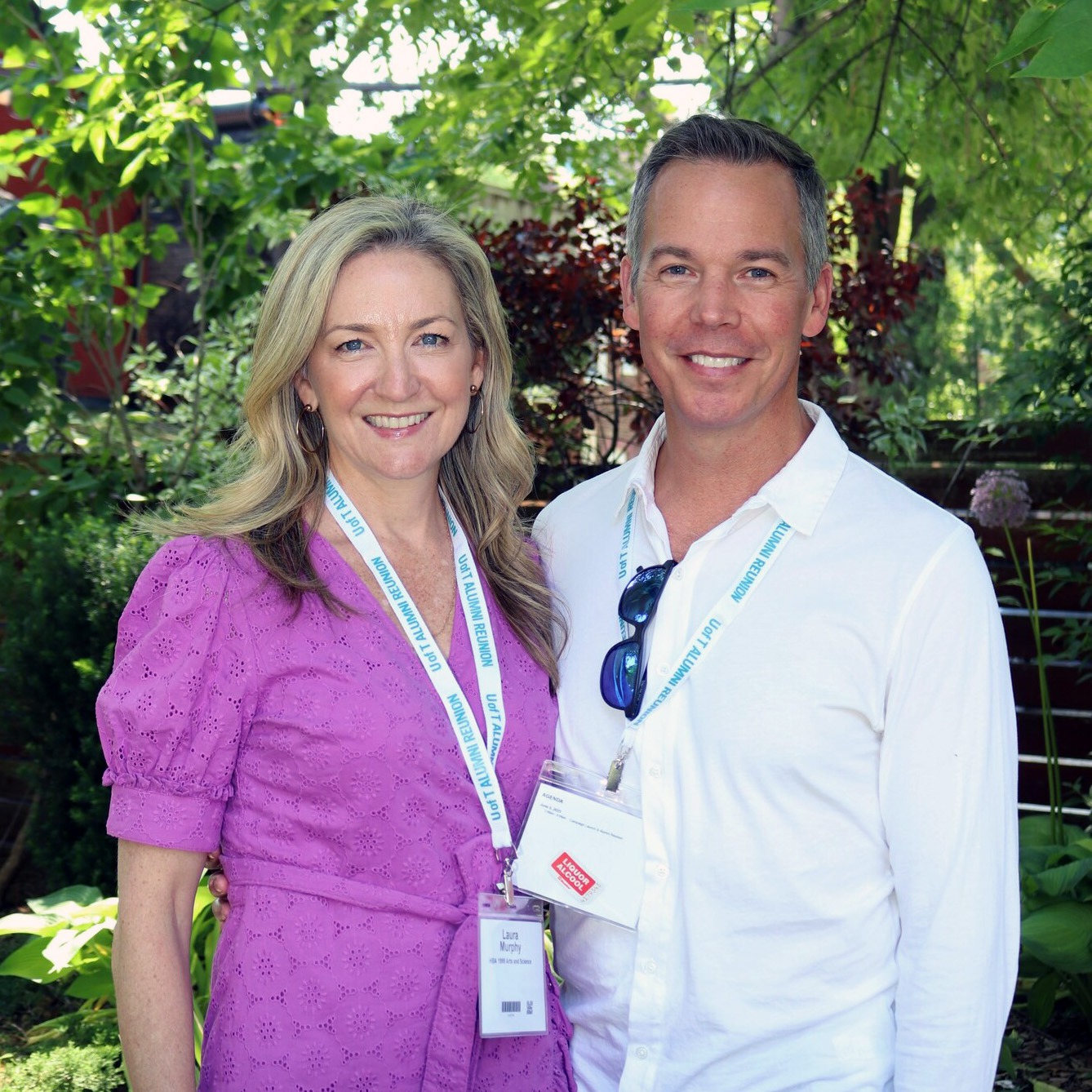
Murphy's connection to Innis includes creating a rooftop garden as a student and later supporting a new green roof terrace. Those are her projects and her college history. Alongside the photograph, they add context to the environmental interests surrounding the KMI partnership, without requiring a corporate mission statement to do all the explaining.
For Airhart, the image supplies a welcome change in setting. Company histories tend to compress founders into job titles. Here are two people who built a business together, attending a reunion. A considerable enterprise can fit into a surprisingly ordinary reunion photograph.
The long handover
VelocityEHS announced in September 2023 that Airhart would succeed John Damgaard as CEO on January 1, 2024. Damgaard would remain as executive chairman. The transition had been planned over time, and Airhart entered the role with years of operating experience inside the company.
There was continuity in his response. He thanked Damgaard and spoke about the team and customers already in place. The appointment gave an existing operator wider responsibility for the business he had helped build through its earlier incarnation. The distance from KMI co-founder to VelocityEHS CEO was measured in sustained participation.
That January, he discussed acquisitions and the company's investors, CVC and Partners Group. The business still intended to buy companies for technology or market share. Airhart also made his own timetable plain: “I'm personally in no hurry to exit.” For a founder whose company had already been acquired, it was a revealing choice of emphasis.
Still asking what the tools are for
By 2026, Airhart's public agenda included connected software and artificial intelligence. In the opening episode of VelocityEHS's Rewiring Risk podcast, he joined chief technology officer Ken Lupo to discuss modern infrastructure, disconnected systems and better decisions. The language of the tools had evolved; the practical question about getting information to the people using it remained recognizable.
In March, VelocityEHS launched a training library. Airhart criticized material that was generic, dated or poorly matched to the work being performed. Later that month, the appointment of Cory Gendron as chief revenue officer accompanied a push to expand the company's platform. Airhart connected the opportunity to AI and more integrated software, while emphasizing customer value.
His public LinkedIn writing adds a managerial preference to that agenda. He credits people who care about a difficult problem and argues for giving them room to pursue it. Former colleague Ivan Pozgaj describes him as humble, honest and human, recalling a leader who was accessible to his team. These are attributed impressions, but they fit the emphasis on participation running through his own comments.
The interesting question now is how that approach travels as the tools become more ambitious. Airhart has seen the business from the founder's desk, the customer discussion and the operating role. Each new capability creates another reason to remember the people expected to use it. The next chapter has plenty of technology in it. His career suggests he will keep returning to the customer at the other end of the screen.