Lâle White’s route into software ran through accounts receivable. That is a less fashionable entrance than the garage, although it has the advantage of coming with actual customers. Before she co-founded XiFin in 1997, she was a finance executive responsible for systems that tracked money, inventory, and costs. She understood the distance between a transaction recorded and a transaction resolved. A business can appear wonderfully busy while its money remains elsewhere.
At Laboratory Corporation of America and its predecessor, National Health Laboratories, White served as vice president of finance and led the development of financial software. Her remit included accounts receivable, inventory, cost accounting, and financial management. These are subjects that seldom improve a dinner party. They do, however, determine whether a company can pay for the next one.
That background gives her founding story its particular shape. White encountered a problem through the responsibility of running an operation. The available commercial systems did not adequately fit the work. She went on to build a company around that gap. Today she remains XiFin’s executive chair and chief executive, a long tenure attached to a problem that keeps acquiring new complications.
A finance degree with consequences
White earned a BA in finance and an MBA at Florida International University. The combination put financial analysis and business management in the same toolkit. Her subsequent career brought another ingredient: responsibility for developing the systems on which an organization depended. By the time she became a founder, the relationship between financial reporting and software was already part of her working life.
Consider the range of those earlier systems. Inventory asks what a business has. Cost accounting asks what its activity consumes. Accounts receivable asks what it is owed. Together, those disciplines offer a rather unsentimental education in running a company. A sale is one piece of information; the cost of delivering it and the likelihood of collecting it are others. White’s early work crossed those boundaries.
Her move into entrepreneurship carried that experience forward. XiFin’s original offering addressed high volumes of complex financial transactions. Its purpose was practical: give customers more control over back-office operations, reduce processing work, and make financial information useful to the people managing the business. The executive who had needed those capabilities became the executive selling them.
The attraction of this kind of business is easy to overlook. Its work happens after the moment that usually gets celebrated. Yet an unresolved transaction keeps demanding attention. Someone must investigate, correct, resubmit, or reconcile it. White’s career has been spent making that administrative remainder a subject worthy of sustained engineering attention.
- 1997Co-founds the business
- 2001Introduces the XiFin name
- 2014Partners with GTCR
- 2026Expands the AI strategy
Selling the internet, one workflow at a time
In February 2001, the business announced a name change from Medical Business Applications to XiFin. The announcement described a company founded in 1997 and preparing its next-generation billing and claims-management system for commercial release. American Medical Laboratories was beta-testing the initial accounts-receivable offering. White was already its CEO.
The language of that announcement is revealing. It emphasized sophisticated database and internet technology, conditional processing, and the integration of steps within a workflow. The ambition was to reduce labor, errors, and processing time. Long before today’s AI vocabulary arrived, the business was concerned with the small decisions that determine what happens next to a transaction.
There was a sales problem inside the technology problem. Early customers were accustomed to installed software and the equipment and maintenance that went with it. XiFin had to explain the appeal of an internet-delivered service. Other organizations’ systems also lacked the connectivity needed to exchange information smoothly. Building the product required accommodating the world as it actually operated.
A software demonstration can show a clean sequence of events. An operating business supplies the interruptions. The early XiFin proposition put ongoing processing and updates into the service itself. That choice made the company responsible for keeping its logic useful as circumstances changed. For White, software delivery and the continuing work of financial operations belonged in the same conversation.
The founder stays in the room
By August 2011, XiFin had made the Inc. 5000 list for five consecutive years. The company ranked number 126 among software companies on that year’s list. Recognition had begun to accumulate around a business whose original appeal was fairly prosaic: help organizations manage the money they had earned.
In July 2014, private equity firm GTCR acquired XiFin and partnered with White and her management team. White remained chief executive. The transaction introduced a new owner while retaining the founder at the operating center. It is a useful milestone in a career that has continued across changes in capital, product scope, and the vocabulary of enterprise technology.
GTCR later described a recurring-revenue business with high renewal rates, around 150 customers, and a record of growth. XiFin added two acquisitions in 2015. Those details describe the next challenge for a founder: expanding a business while preserving the specific knowledge that made customers choose it. Growth adds possibilities, and it adds more people whose work must fit together.
White also took her financial and governance experience into boardrooms beyond XiFin. She joined CombiMatrix’s board in March 2015 and later served on Cardiff Oncology’s board, beginning in April 2020. Alongside running her own company, she had responsibilities as a director in other organizations. Her responsibilities now included board service as well as running XiFin.
1997 to 2026. White continues as executive chair and CEO.
Three words for a growing team
White’s public comments about management return to listening and clear authority. She has described employees as a source of ideas and improvements, and acknowledged that people committed to the same goal can disagree about how to reach it. That is a recognizable problem in any growing organization. Enthusiasm produces opinions as reliably as it produces work.
Her formulation gives people three things together: responsibility, accountability, and the authority to act. Read as a management rule, it is admirably concrete. Someone needs to own the task, answer for the result, and possess enough latitude to do something about it. Remove one of those conditions and the arrangement becomes considerably less convincing.
There is a connection here to her earlier financial systems work. Both approaches depend on making responsibility visible and enabling the next action. Her stated preference for open communication places the awkward conversation inside the work of running the company. Disagreement becomes something management has to handle, alongside the product and the numbers.
“responsibility, accountability, and authority to act”
Lâle White on empowering employees
A trophy, and a much longer partnership
In June 2024, XiFin marked the 25th anniversary of its first customer. White and fellow co-founders Mike Coats and Jeffrey Yates were still associated with the company. The distinction matters: the anniversary celebrated a customer relationship milestone, rather than the 1997 founding date. The company described a workforce of more than 1,000 people.
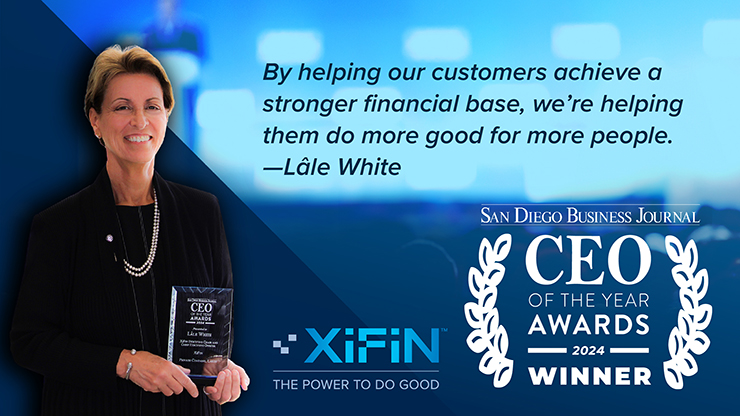
The following month brought an individual honor. The San Diego Business Journal named White CEO of the Year in its large private-company category. XiFin’s announcement also reported 165 percent revenue growth over three years. In her response to the award, White directed credit to the work and dedication of the team.
That summer, she also joined an Executive Coffee Talk with XiFin’s interns. The subjects included company formation, industry trends, and her entrepreneurial experience. It is a small detail beside an acquisition or a growth figure, but a useful one. A founder whose experience reaches back to 1997 was discussing the beginnings of a business with people near the beginnings of their careers.
The photograph of White holding the award records the ceremonial moment. The longer history around it includes co-founders, employees, and customers. Her response to the recognition kept those people in the picture. A trophy is conveniently portable; the organization that earns it is considerably harder to carry.
The paperwork gets a new set of tools
In February 2026, XiFin reported that volume flowing through its Empower RCM platform had increased 21.1 percent during 2025. Volume is a measure of activity, and the company presented it as evidence of wider adoption. It also appointed Sanjay Kumar chief technology officer to advance its AI strategy. White remained in the executive chair and CEO roles.
By April, the company was demonstrating its Empower AI ecosystem and an appeals agent. White and chief operating officer Kyle Fetter were listed together for a conference session on revenue and workforce efficiency. The technology had evolved, while the central business question remained familiar: how can software help people move complicated work toward a financial result?
August brought two further moves. XiFin announced a multiyear alliance with Notable Systems and an investment in its Series B financing. The arrangement focused on document intelligence: extracting, classifying, labeling, and routing information into existing workflows. Paperwork, that dependable survivor of every technological revolution, had become a target for another generation of tools.
The same month, Chris Martin joined as chief product officer. His responsibilities included product strategy, modularity, and making XiFin’s data and AI capabilities more accessible to customers. The appointment paired new product leadership with the technology leadership added earlier in the year. White was building the team for another phase of the company she had co-founded decades before.
Her advice to emerging entrepreneurs has emphasized persistence, a strong team, mentors, and attention to customers’ problems. Those priorities fit the visible course of her own career. The subject has changed names, owners, and technical language. White’s continuing interest lies in the work that needs finishing - and in giving the people doing it a better chance to finish.