Imagine buying twenty software licenses through your usual IT supplier. The purchase looks straightforward. Behind it, a vendor must activate the right accounts, a distributor must record the order, a reseller must preserve its margin, and somebody must send a bill. Next month, three employees leave. Two join. The price changes. The neat little purchase has become an ongoing negotiation between systems.
- CloudBlue connects the catalog, provisioning, subscriptions, and billing behind cloud marketplaces.
- Its buyers include telecom operators, distributors, managed service providers, and software vendors.
- Public plans start at $9,000 a month, plus setup and transaction fees.
CloudBlue sells software for precisely this situation. Its proposition is easy to underestimate because the visible result can resemble an online shop. The work underneath involves getting separate businesses to behave like a coordinated operation. A storefront attracts the order. The machinery behind it determines whether selling another subscription creates revenue or another administrative chore.
The plumbing behind the purchase
Start with the cast. A vendor creates the service. A distributor brings services together. A reseller owns the customer relationship. CloudBlue Connect gives these participants a shared framework for products, agreements, fulfillment requests, and usage information. Its documentation distinguishes vendor, distributor, and reseller portals. The customer sits at the end of this chain, mostly spared the details.
CloudBlue Commerce handles the commercial operation: orders, subscription lifecycles, billing, accounts, and reseller structures. Together, these capabilities let a provider assemble a branded marketplace, bundle services, manage different prices, and automate delivery. A software vendor can reach distribution partners; a telecom operator can add third-party software to an existing business relationship.
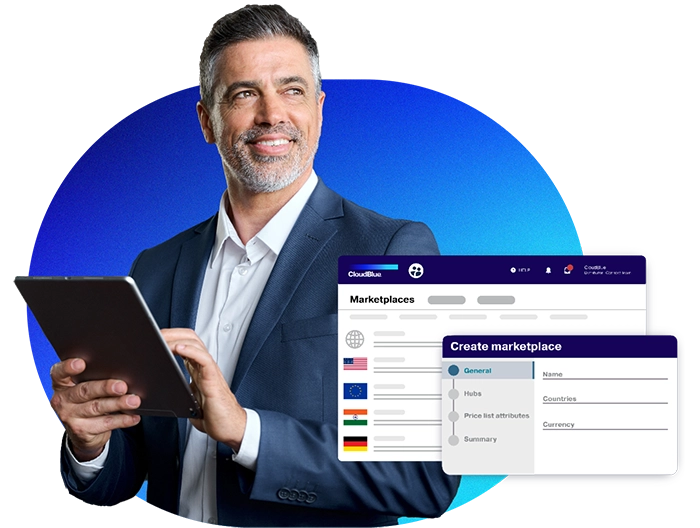
The expertise here is in the connections. CloudBlue publishes REST APIs, SDKs, and an extensible command-line tool. Its API documentation even suggests considering higher-level tools before building directly against the lowest-level interface. That is sensible advice from a company selling integration: the useful question is how much work you can avoid repeating.
- 01VendorDefines the service
- 02DistributorBuilds the catalog
- 03ResellerServes the buyer
- 04CustomerUses the subscription
Six months, twelve countries
A1 Digital supplies a useful test. In CloudBlue’s account, the company needed to coordinate a complicated marketplace across subsidiaries, currencies, and languages. Development complexity was consuming time. A1 brought operations into a common view, applied existing automations, and reserved development effort for integrations specific to its business.
The published results: 95% of use cases automated, a B2B marketplace launched in six months, and operations aggregated across twelve countries in Europe and Latin America. Those are customer-case-study claims, rather than a promise that every deployment will follow the same timetable. Their significance is the division of labor: reuse the common workflows; customize the remainder.
“It works smoothly and easily, which was amazing.”Herwig Kaltenhauser · A1 Digital
Bechtle’s case points to a related constraint. Expanding a software catalog means creating and maintaining connections to suppliers. CloudBlue’s published account describes Bechtle using Connect to access integrations from more than 200 vendors and manage connections through one interface. The attraction was a broader catalog with less duplicated integration work.
There is a lesson a reader can borrow without buying anything. Count the repeated steps between an order and a correct invoice. Identify which ones are shared across products and which are exceptions. Automate the shared steps first. The glamorous decision is what to sell next; the consequential decision may be how much new work each sale introduces.
A price tag with a point of view
CloudBlue’s public pricing makes its intended buyer unusually clear. Standard is listed at $9,000 per month, with one marketplace and up to ten catalog vendors. Enterprise is $23,000 per month, with unlimited catalog vendors and up to fourteen additional marketplaces. Both add setup and transaction fees. Premium is custom-priced.
12 × published monthly price. Excludes setup and transaction fees. Dollar notation follows the pricing page.
That is a substantial commitment before implementation. The economic argument depends on the work displaced: maintaining supplier integrations, reconciling billing, operating reseller channels, and supporting several markets. A small business with one uncomplicated subscription product should scrutinize whether it needs this scope. Automation can be valuable while still being the wrong purchase at a particular scale.
AppDirect also offers marketplaces, subscription billing, and partner management. Cloudmore addresses overlapping subscription and CSP billing problems. CloudBlue’s distribution background and connected workflows give buyers specific things to evaluate, rather than an automatic victory over either rival. Test the suppliers you actually use, the exceptions you actually encounter, and the reports your finance team actually needs.
A useful pilot would follow a subscription beyond its first successful order. Add seats, remove seats, change a reseller’s price, and reconcile the resulting charge. Then repeat the exercise across the markets you intend to serve. This is a practical buying test, not a reported CloudBlue customer experiment. It puts the demonstration where the operational risk lives: in changes over time.
The same reasoning sets a boundary. A shared platform needs usable product definitions, working supplier connections, and clear commercial agreements. If those inputs remain unsettled, automating the workflow simply moves the uncertainty faster. The organization still has to decide what it is selling and who owes whom.
Built inside the distribution business
CloudBlue arrived under its current software identity in May 2018, when Ingram Micro announced an independent software division and a Microsoft alliance. Ingram said the platform reflected more than $500 million of investment. This was an assembled operation with existing technology and customers, giving it a very different starting point from a newly funded application.
HostPapa completed its acquisition in August 2025, appointing Jorge Carvalho CEO and Tarik Faouzi general manager. The announced rationale connected CloudBlue’s commerce technology with Hostopia’s service delivery platform. CloudBlue’s current company page places it in the Managed.com family. The ownership story follows the same practical theme as the product: distribution and delivery belong together.

The company describes a distributed hybrid workforce. Its less photogenic work continues in release notes: July 2026 updates covered subscriptions, pricing, ordering, billing, and APIs. These are the components that decide whether the tidy buying experience survives ordinary business changes. Every added seat, revised price, and renewal gives the machinery another turn.