The paperwork survived the internet company. When FOB.com was caught in the dot-com collapse, Glenn Trout found a business inside a service that had been giving information away: the electronic distribution of material safety data sheets. With seed money from the venture backer and five employees, he turned that overlooked offering into a paid service at MSDSonline. The grand internet proposition had failed. The documents still had somewhere to be.
That is an unusually useful beginning for understanding Trout. His career has passed through the Air Force, paper manufacturing, deal advisory and software. But its recurring subject is information that somebody needs, somewhere else, before they can do their job properly. A document may lack the glamour of a new marketplace. It has the considerable advantage of being necessary.
Years later, he would lead VelocityEHS and then take the chief executive job at Source Intelligence. The scale and company names changed. The practical question kept returning: how do you make complicated information accessible to people with other things to do?
A marketing degree, then a different kind of control room
Trout graduated from Miami University’s Farmer School of Business in 1989, majoring in marketing. He later earned an MBA at Northwestern’s Kellogg school, studying management and strategy, marketing and international business. The combination fits a career spent both explaining products and assembling the businesses behind them.
Before Mead Publishing Paper, he served in the U.S. Air Force as an Air Weapons Controller. At Mead, he led sales, marketing and strategic planning, with responsibility for more than $350 million in revenues. He subsequently worked in Ernst & Young’s mergers and acquisitions advisory group. These were substantial operating and commercial assignments before the software chapter began.
It would be tempting to make the military job explain every later decision. His business record offers a more concrete connection: experience selling, planning and evaluating companies preceded a career that required all three. Building MSDSonline would involve finding customers. Expanding it would involve deciding which capabilities to build and which businesses to buy.
Marketing graduate
acquires KMI
brand launches
CEO appointment
The customer had a job to finish
Software for compliance has a demanding audience. Its users need to find information, understand an obligation and complete a task. Admiring the software is optional. Trout’s public explanations repeatedly returned to the practical burden placed on that user.
In September 2014, he wrote about the approaching transition to a new system of chemical classification and documentation. His central observation concerned a dependency: manufacturers could be ready to update their own documents while still waiting for information from suppliers further upstream. A deadline applied across a chain whose participants could not all move independently.
That was a revealing way to frame the problem. A company could be willing to comply and still lack an essential input. Trout described electronic tools that could deliver updated documents and help users see where their transition stood. The software’s usefulness lay in reducing uncertainty, rather than simply storing another file.
He also wrote about training in 2015, emphasizing the need for employees to apply information in their work. Making material available was only part of the task. The person receiving it had to be able to use it. This is a fairly stern test for a software business: the feature list matters less when the customer cannot finish the job.
Eight million users, and a name that had become too small
In August 2014, MSDSonline acquired Knowledge Management Innovations, known as KMI, in Oakville, Ontario. KMI brought a broader set of tools, including audits, inspections, corrective actions, risk analysis and training tracking. It also brought an emphasis on adoption: software intended to be intuitive, straightforward to implement and accessible to people learning it themselves.
The acquisition expanded the business beyond its document-management identity. In September 2015, MSDSonline and KMI began doing business as VelocityEHS, announcing the change at the National Safety Council Congress & Expo in Atlanta. The combined business arrived with more than 10,000 customers and more than eight million users worldwide. MSDSonline remained a product brand.
Trout’s explanation for the new name was practical. The company had more capabilities to describe. He wanted an accessible platform, simpler implementation and a user experience customers could navigate. The branding was supposed to catch up with the product. Corporate renaming can be an expensive way to move the furniture; here, the company had actually acquired more rooms.
A customer decision later that year made those priorities tangible. Specialty contractor J. F. Ahern selected VelocityEHS in part for its ease of use and implementation. Its work included fire protection, mechanical contracting and pipe fabrication. For such a customer, a manageable system has a clear purpose: people need to coordinate work across real operations, beyond a demonstration screen.
An open door, with an arcade nearby
Trout’s view of employees had a similarly direct formulation. In 2014, when MSDSonline was recognized for the fourth consecutive year as a Brill Street Top 50 Gen Y Chicago Employer, he described a straightforward obligation to treat employees well.
“Our employees do right by us and we try our best to do right by them.”
Glenn Trout, 2014
He pointed to younger employees moving into newly created management and director positions. There were games and outings, but also an open-door policy that extended to the chief executive. The promotions gave the culture a more concrete expression than the presence of a foosball table could manage on its own.
By 2019, VelocityEHS occupied 90,000 square feet in Chicago’s Merchandise Mart. Trout described open seating, communal lounges, an arcade and a meditation room. He described a roof deck where teams could meet, entertain guests or eat lunch during warmer weather. Chicago made the seasonal qualification necessary.

He spoke about balancing the work with opportunities to pause and spend time together. That detail makes the office more legible: meeting areas and leisure spaces belonged to the same plan. A software company sells tools for other people’s working lives while making daily choices about its own.
Making room for another operator
In July 2019, Matt Airhart became president and chief operating officer of VelocityEHS. Airhart, who had co-founded KMI, took responsibility for day-to-day operations. Trout remained CEO, concentrating on innovation and longer-term growth. He linked the change to the operating model and future acquisitions, and praised Airhart’s customer experience and domain knowledge.
The arrangement put a leader from the acquired company in charge of running the combined business. That is a consequential detail in a career full of combinations. Buying capabilities brings people with them; the subsequent allocation of responsibility shows how much room those people receive.
That November, Trout joined the National Safety Council’s board of directors. VelocityEHS then reported more than 18,000 customers and ten million users worldwide. The appointment added a nonprofit board role to his commercial work, alongside his involvement with the VPPPA Region V board. His career also included speaking and writing for the industry, putting him in contact with practitioners beyond his own customers.
The same question, further up the supply chain
In July 2021, Trout became CEO of Source Intelligence as ParkerGale Capital took a majority investment and the business combined with Total Parts Plus. The pairing brought supplier-compliance software together with parts data and lifecycle information. It gave him another information business to assemble, this time across supply chains.
ParkerGale partner Devin Mathews said the firm had known Trout for more than a decade. The appointment therefore came with an existing relationship. Trout described an ambition to make supply-chain data management and compliance accessible to both smaller and larger enterprises. It was a familiar aim applied to a wider network of suppliers, parts and products.
QTEC Solutions followed in January 2022, adding electronic-component lifecycle management. Its Q-Star product helped manufacturers anticipate component availability problems. ChainPoint joined in May 2023, extending traceability into raw materials such as cocoa, cotton, timber and palm oil, and broadening the company’s reach into food, apparel and retail.
- DocumentsFind the necessary record.
- OperationsConnect tasks and decisions.
- Supply chainsFollow products, parts and materials.
An editorial map of the scope of Trout’s software work.
In May 2024, Source Intelligence consolidated brands under its name. ChainPoint continued as a platform brand for standards and scheme-holder groups; C-Map, derived from Compliance Map, served corporate programs. As with VelocityEHS, broader capabilities created a naming problem. The customer still needed to understand which door to open.
A little time to look around the corner
Trout’s less corporate introduction is rather good. An event program presented him as a southern Ohio native, Bengals supporter and music enthusiast who claimed no musical talent. It also described his affection for both the Cubs and the Reds. Supporting two baseball teams is one way to diversify disappointment.
The humor sits comfortably beside his plainer business language. In January 2024, promoting a regulatory outlook webinar, he described supply-chain teams occupied by immediate demands: “They’re too busy taking care of today to worry about tomorrow.” The company’s annual opening webinar was intended to give those teams a chance to prepare for changes ahead.
A July 2025 Source Academy video showed him welcoming new employees as Source Intelligence’s CEO. It is a small public artifact, a greeting rather than a transaction announcement, and a reminder that every expanded platform also acquires a continuing job of explaining itself to the people joining it.
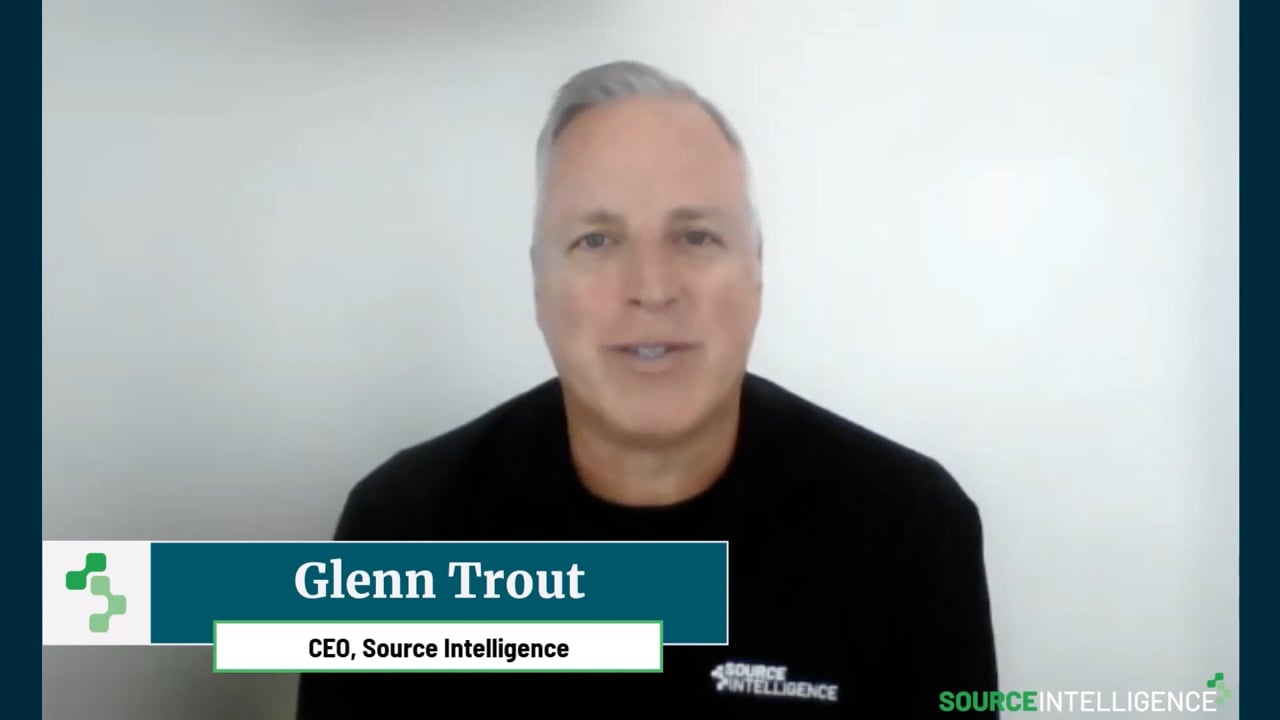 ▶ WATCH THE WELCOME · 47 SEC
The paperwork that outlasted FOB.com offers a useful way to read what followed. Trout kept working on businesses that help people retrieve, interpret and act on information. The products grew from documents to operations to global supply chains. The person at the other end still had a job to finish. Giving that person a little more clarity, and a little more time, has proved a durable occupation.
Continue reading & watching
- Glenn Trout on LinkedIn
- VelocityEHS
- Source Intelligence
- Watch: Welcome to Source Intelligence
- BizcastHQ interview profile
- The early MSDSonline story
- The 2015 VelocityEHS launch
- Trout on employee culture
- Inside the Chicago office
- The 2019 leadership change
- National Safety Council appointment
- Source Intelligence appointment
- QTEC acquisition
- ChainPoint acquisition
- The 2024 brand consolidation
- Trout’s regulatory outlook post
- Miami University alumni spotlight
- Trout on document dependencies
- Trout on training
- Event introduction
- KMI acquisition announcement
- Ahern’s 2015 selection